Machine learning is reshaping polymer science software by turning large, messy experimental and simulation datasets into practical predictions about materials, processing, and performance. In polymer science, software and tools have traditionally helped researchers draw structures, run molecular simulations, fit rheology curves, manage laboratory data, and calculate properties such as molecular weight distribution, glass transition temperature, crystallinity, or viscosity. Machine learning adds another layer: it detects patterns across chemical structures, processing histories, and test results, then uses those patterns to recommend formulations, predict outcomes, and accelerate decisions. For teams working in plastics, elastomers, coatings, fibers, membranes, biomedical polymers, or recycling, this matters because polymer development is slow, expensive, and highly multidimensional.
I have seen this shift firsthand in materials informatics projects where a formulation campaign that once required months of trial-and-error could be narrowed to a short list of candidates before the first batch was compounded. The reason is simple: polymer behavior depends on intertwined variables, including monomer chemistry, tacticity, molecular architecture, additives, fillers, humidity, shear history, and processing temperature. Classical software can calculate, simulate, and store these variables, but it often leaves scientists to infer the best next experiment. Machine learning-driven polymer science software closes that gap by ranking variables, identifying latent structure-property relationships, and estimating uncertainty. As a hub topic under educational resources focused on software and tools, this article explains what machine learning does inside polymer workflows, which platforms and methods matter, where it delivers real value, and where careful skepticism is still necessary.
What machine learning means in polymer science software
Machine learning in polymer science software refers to algorithms that learn statistical relationships from data rather than relying only on explicit physics equations or manual rules. In practice, these algorithms sit inside broader software stacks that include electronic lab notebooks, cheminformatics libraries, simulation packages, laboratory information management systems, data visualization tools, and model deployment environments. Common methods include linear regression, random forests, gradient boosting, support vector machines, clustering, principal component analysis, Gaussian processes, and neural networks. Each serves a different purpose. Regression predicts numeric properties such as tensile strength or Tg. Classification labels materials as pass or fail. Clustering groups similar formulations. Dimensionality reduction compresses high-dimensional descriptors into a tractable space for exploration.
Polymers are a demanding use case because they are not single molecules with one exact structure. A polymer sample is usually a distribution: chain lengths vary, branching varies, copolymer composition drifts, end groups differ, and additives alter the final response. Software therefore needs descriptors that capture repeat units, sequence information, constitutional repeating units, fingerprints, graph representations, process conditions, and test metadata. Tools such as RDKit, DeepChem, scikit-learn, TensorFlow, PyTorch, and pandas are frequently used in custom pipelines, while enterprise teams often connect models to Dassault Systèmes BIOVIA, Schrödinger, Materials Studio, Citrine Platform, or in-house databases. The best polymer science software does not treat machine learning as a magic button; it integrates data cleaning, feature engineering, validation, and experiment tracking so predictions remain traceable.
How software and tools support the full polymer development workflow
The role of machine learning becomes clearer when mapped onto the full lifecycle of polymer R&D. Discovery starts with chemical ideation: selecting monomers, catalysts, initiators, solvents, and target architectures. Here, software can mine prior experiments and patents to suggest candidate chemistries with desired modulus, permeability, or dielectric behavior. In synthesis planning, models estimate conversion, molecular weight, dispersity, or likely gelation windows under chosen conditions. During processing, tools predict extrusion torque, melt flow index, cure profile, warpage, or printability. In characterization, software links spectroscopy, chromatography, microscopy, and mechanical testing to structural descriptors. Finally, in scale-up and quality control, machine learning flags process drift and lot-to-lot variation before off-spec product reaches customers.
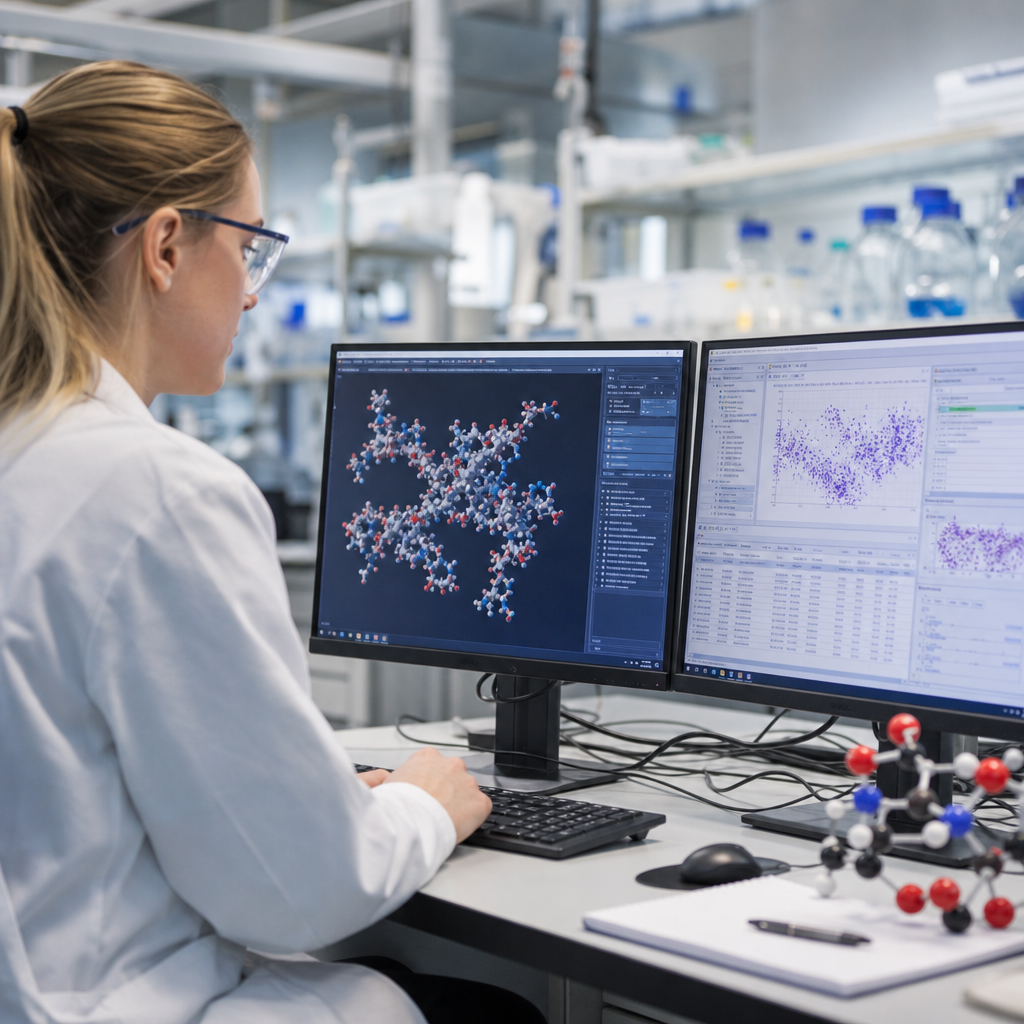
Real-world workflows usually combine several software categories. A scientist may capture reactions in an electronic lab notebook, pull spectroscopy files from instruments, standardize names through a LIMS, calculate descriptors in Python, train models in a notebook or cloud platform, and publish dashboards in Spotfire, Power BI, or Plotly Dash. Simulation outputs may come from molecular dynamics tools such as LAMMPS or GROMACS, coarse-grained engines, finite element tools like COMSOL, or quantum calculations from Gaussian or ORCA for monomer-level properties. The hub value of polymer science software lies in orchestration. Machine learning is most effective when these tools exchange clean, consistent data instead of trapping critical context in spreadsheets, image files, or poorly named folders.
High-value applications with examples from industry and research
Some machine learning applications consistently produce value in polymer science software. Property prediction is the most mature. Teams train models to estimate glass transition temperature, thermal stability, elastic modulus, gas permeability, ionic conductivity, dielectric constant, or degradation rate before synthesis. For example, battery researchers use models to screen polymer electrolytes by balancing conductivity, electrochemical stability, and mechanical integrity. Packaging teams model oxygen and water vapor transmission to narrow candidate barrier resins. Biomedical groups predict hydrogel swelling and drug release based on crosslink density, monomer ratios, and environmental pH.
Formulation optimization is another major use case. Adhesives, coatings, inks, and composite matrices can contain dozens of components whose interactions are nonlinear. Bayesian optimization software helps choose the next experiment by trading off exploration and exploitation. I have used this approach in formulation studies where the model proposed additive ranges humans would not have prioritized, yet those runs improved adhesion while keeping viscosity within process limits. Similar strategies guide elastomer compound design, balancing carbon black content, cure package, hardness, and compression set. In recycling, machine learning supports spectral sorting of mixed plastic streams, contamination detection, and prediction of mechanical property loss after multiple reprocessing cycles.
| Application | Typical inputs | Model output | Practical benefit |
|---|---|---|---|
| Property prediction | Repeat unit descriptors, composition, molecular weight, process history | Tg, modulus, permeability, conductivity | Reduces costly synthesis and testing |
| Formulation optimization | Ingredient ratios, additives, filler loading, cure conditions | Recommended next experiments and optimal ranges | Finds better recipes faster |
| Process monitoring | Temperature, pressure, torque, spectroscopy, line speed | Drift alerts, defect risk, off-spec probability | Improves yield and consistency |
| Characterization analytics | IR, Raman, NMR, GPC, DSC, DMA, microscopy | Classifications, correlations, hidden clusters | Speeds interpretation of complex data |
| Recycling and sustainability | Spectral signatures, blend composition, life-cycle variables | Sorting classes, property retention, design guidance | Supports circular materials decisions |
Data quality, representation, and model selection challenges
Successful machine learning in polymer science software depends less on exotic algorithms than on disciplined data practices. Polymer datasets are often small, biased, and inconsistent. The same resin can appear under multiple names. Units may differ across labs. Negative results are underreported. Processing conditions are incomplete. Test methods vary between ASTM and ISO standards, and even minor changes in humidity or sample conditioning can shift outcomes enough to break a model. This is why experienced teams build ontology and schema rules before they chase deep learning. They define controlled vocabularies, normalize units, track sample lineage, and store metadata such as instrument calibration, annealing history, and specimen geometry.
Representation is another hard problem. Small-molecule software can rely on a single structure string, but polymers need richer encodings. Options include handcrafted descriptors based on repeat units, polymer graphs, constitutional unit frequencies, sequence-aware embeddings for copolymers, and descriptors derived from simulations. Molecular weight averages, dispersity, branching index, crystallinity, and additive package often matter as much as chemistry. Model selection should reflect dataset size and decision needs. On small structured datasets, tree-based ensembles and Gaussian processes often outperform deep neural networks while offering better interpretability or uncertainty estimates. Neural methods become more attractive when organizations have large multimodal datasets combining text, spectra, images, and simulation outputs. Even then, external validation matters more than leaderboard scores.
How machine learning complements simulation instead of replacing it
A common misconception is that machine learning will replace molecular simulation and first-principles modeling in polymer science software. In practice, the strongest workflows combine them. Physics-based tools explain mechanisms, enforce constraints, and extrapolate to conditions where data is sparse. Machine learning accelerates screening, surrogate modeling, and inverse design. For example, a molecular dynamics study of chain mobility and free volume can generate descriptors that improve a permeability model. A finite element simulation of curing and residual stress can produce synthetic training data for process optimization. Conversely, a trained surrogate can stand in for a slow simulation when thousands of parameter combinations must be explored.
This hybrid pattern is already visible across materials R&D. Researchers use coarse-grained simulations to estimate morphology trends in block copolymers, then train models to navigate composition space efficiently. In additive manufacturing of polymers, process maps derived from heat transfer models can be paired with machine learning on printer logs and microscopy images to predict porosity or interlayer adhesion. In viscoelastic modeling, constitutive equations still matter, but machine learning can infer parameter ranges or detect when a material is operating outside the calibration regime. The practical lesson is that polymer science software should support interoperable pipelines, not isolated tools competing for ownership of the truth.
Choosing the right software stack for polymer teams
The best software and tools depend on team maturity, regulatory needs, and research goals. Academic groups often start with flexible open-source stacks built around Python. pandas handles tabular data, NumPy supports numerical work, scikit-learn covers standard models, RDKit manages chemical representations, and Plotly or Matplotlib provides visualization. Jupyter notebooks remain useful for exploration, but production work benefits from version control, modular code, and experiment tracking with MLflow, Weights & Biases, or DVC. For spectroscopy-heavy workflows, chemometrics packages and specialized preprocessing routines are essential because baseline correction, smoothing, and normalization heavily influence model quality.
Industrial organizations usually need more governance. They may integrate ELNs, LIMS, secure data lakes, model registries, audit trails, and role-based access controls. Platforms such as BIOVIA, Pipeline Pilot, KNIME, Citrine, and cloud services on AWS, Azure, or Google Cloud can reduce deployment friction, especially when non-programmers need access. However, buying a platform does not solve the hard parts automatically. Teams still need data stewards, polymer domain experts, and clear business questions. A good hub strategy for educational resources is to treat software categories separately: data management tools, simulation tools, chemoinformatics toolkits, visualization dashboards, optimization platforms, and machine learning operations infrastructure. That structure helps readers choose tools by workflow stage rather than by vendor marketing.
The limits, risks, and future of machine learning in polymer science software
Machine learning can improve polymer science software dramatically, but it has clear limits. Models trained on narrow chemistry spaces often fail on novel architectures. A predictor built on dry-lab data may not capture contamination, scale-up shear, or operator variation on a plant line. Black-box recommendations can mislead teams if uncertainty is hidden or if data leakage inflated apparent accuracy during development. Regulatory and customer-facing applications also require traceability. When a model influences medical materials, food-contact packaging, or safety-critical components, organizations must be able to explain what data informed the recommendation and how performance was verified.
Still, the direction is unmistakable. Better polymer representations, foundation models for materials data, automated laboratory platforms, and multimodal systems that combine text, structure, spectra, and process signals are making software more useful every year. The most successful teams will not ask whether machine learning belongs in polymer science. They will ask where it can remove bottlenecks without obscuring scientific judgment. That is the core benefit of this software-and-tools hub: it gives researchers, engineers, and technical managers a framework for choosing practical systems that turn polymer data into faster learning. If you are building your educational resources around modern materials development, start by mapping your current tools, identifying data gaps, and selecting one high-value machine learning use case to pilot well.
Frequently Asked Questions
How is machine learning changing polymer science software?
Machine learning is expanding polymer science software from a set of calculation and visualization tools into a more predictive decision-support environment. Traditional polymer software has been very effective at tasks such as structure drawing, molecular simulation, rheology analysis, laboratory data management, and property estimation based on established equations or curated databases. Machine learning adds the ability to learn patterns directly from large collections of experimental results, simulation outputs, processing records, and characterization data, even when those datasets are noisy, incomplete, or generated across different instruments and workflows.
In practical terms, this means polymer scientists can use software not only to analyze what has already happened, but also to predict what is likely to happen next. For example, a machine learning model can estimate tensile strength, viscosity, glass transition temperature, crystallinity, permeability, or degradation behavior from polymer composition, architecture, additives, and processing conditions. It can also help identify non-obvious relationships between formulation choices and final performance, which is especially valuable in complex systems such as blends, copolymers, composites, and recycled materials.
Another important shift is speed. Many polymer development cycles involve repeated synthesis, testing, and reformulation. Machine learning can reduce the number of physical experiments needed by narrowing down the most promising candidates before lab work begins. In software platforms, this often appears as recommendation engines, virtual screening workflows, anomaly detection tools, or optimization modules that guide researchers toward better formulations and process settings. Rather than replacing established polymer modeling methods, machine learning is increasingly being integrated alongside them, giving researchers a hybrid toolkit that combines physics-based understanding with data-driven prediction.
What kinds of polymer data are most useful for machine learning models?
Machine learning in polymer science depends heavily on the quality, consistency, and breadth of the available data. Useful datasets often include chemical structure information, monomer identities, copolymer ratios, molecular weight and molecular weight distribution, branching details, tacticity, additive packages, filler content, and processing conditions such as temperature, shear rate, cooling history, pressure, residence time, and curing schedule. On the output side, models benefit from measured properties such as modulus, strength, elongation, impact resistance, thermal stability, glass transition temperature, melt flow behavior, crystallinity, barrier properties, optical characteristics, and long-term durability.
Data from simulations can also play a major role. Molecular dynamics, coarse-grained simulations, quantum calculations, and finite element models can generate descriptors that are difficult or expensive to measure experimentally. These computational results can enrich polymer science software by providing features related to chain mobility, intermolecular interactions, diffusion tendencies, free volume, or predicted morphology. When combined with experimental data, simulation-informed machine learning models often become more robust and more chemically meaningful.
Equally important is metadata. Instrument settings, sample preparation methods, test standards, environmental conditions, and provenance records can strongly affect polymer data quality. A viscosity result measured under one set of shear and temperature conditions cannot be treated as identical to a result obtained under another. The best machine learning-enabled polymer software therefore emphasizes data cleaning, normalization, ontology mapping, unit consistency, and traceability. In many cases, the real competitive advantage is not just having more data, but having well-structured data that preserves context and makes cross-study comparisons reliable.
Can machine learning replace traditional polymer modeling and simulation methods?
In most cases, no. Machine learning is best understood as a complement to traditional polymer modeling, not a universal replacement. Physics-based methods such as molecular dynamics, Monte Carlo simulation, continuum mechanics, rheological modeling, and thermodynamic calculations remain essential because they provide interpretability and are grounded in the known behavior of polymer systems. These methods help researchers understand why a material behaves the way it does, not just what outcome to expect. That level of mechanistic insight is critical when developing new polymers, validating scientific hypotheses, or working outside the range of existing data.
Machine learning excels in situations where relationships are highly nonlinear, datasets are large, and predictions are needed quickly. For instance, if a company has years of internal formulation and processing records, a machine learning model may predict performance trends faster than running a full simulation workflow for every candidate. However, if the target chemistry is novel or the available data is sparse, machine learning may struggle to generalize reliably. It can be very accurate within the domain represented in the training data, but much less dependable beyond it.
The strongest polymer science software platforms increasingly combine both approaches. A simulation may generate descriptors for a machine learning model, or a machine learning system may screen candidates before detailed physics-based analysis. In other cases, hybrid models embed physical constraints directly into learning algorithms so predictions remain realistic. This blended strategy helps organizations balance speed, interpretability, and scientific rigor. The result is often better than either method alone: machine learning contributes efficiency and pattern recognition, while traditional modeling contributes theory, validation, and confidence in extrapolation.
What are the biggest challenges of using machine learning in polymer science software?
One of the biggest challenges is data quality. Polymer datasets are often fragmented across notebooks, spreadsheets, instrument exports, laboratory information systems, and simulation files. They may contain inconsistent naming, missing values, incompatible units, or incomplete descriptions of synthesis and processing history. Because polymer properties are highly sensitive to conditions, even small gaps in context can make a dataset much less useful for training reliable models. Software teams must therefore invest heavily in data infrastructure, curation, and standardization before machine learning can deliver meaningful results.
Another challenge is representation. Unlike small molecules, polymers are structurally complex and often heterogeneous. Chain length distributions, copolymer sequence patterns, branching, crosslinking, polydispersity, morphology, and additives all influence performance. Capturing this complexity in a machine-readable format is not straightforward. A model trained on oversimplified descriptors may miss key behavior or produce predictions that appear precise but are chemically incomplete. This is why feature engineering, polymer-specific descriptors, and domain expertise remain central to successful machine learning applications.
Interpretability and trust are also major concerns. In industrial and research settings, scientists usually need more than a number; they need to know whether the prediction is credible, what factors drove it, and how much uncertainty is involved. Black-box outputs without confidence estimates can be difficult to act on, especially in regulated, safety-critical, or high-cost development programs. Effective polymer science software addresses this by incorporating explainability tools, uncertainty quantification, version control, audit trails, and side-by-side comparison with established models or experimental baselines. Ultimately, the challenge is not just building an accurate model, but embedding that model into a workflow where scientists can understand, validate, and use it responsibly.
What benefits can researchers and manufacturers expect from machine learning-enabled polymer science software?
The most immediate benefit is faster materials development. Machine learning can help researchers screen formulations, predict likely property outcomes, and prioritize experiments with a higher probability of success. This reduces trial-and-error work, shortens development timelines, and allows teams to explore a wider design space without proportionally increasing lab costs. In polymer R&D, where even small formulation adjustments can trigger extensive testing, this efficiency can have a significant commercial and scientific impact.
Manufacturers can also gain better process control. By learning from production data, machine learning models can identify relationships between processing conditions and final product quality, helping operators reduce defects, improve consistency, and respond more quickly to drift in raw materials or equipment behavior. In applications involving extrusion, molding, compounding, coating, or curing, software equipped with predictive analytics can support parameter optimization, quality forecasting, and preventive maintenance. These capabilities are particularly useful when scaling a formulation from lab to pilot to full production, where many polymer systems behave differently across environments.
There is also a strategic benefit in knowledge retention and reuse. Polymer development often depends on experience accumulated over many years, but that knowledge is not always easy to transfer across teams or facilities. Machine learning-enabled software can turn historical data into a reusable institutional asset by capturing patterns that would otherwise remain buried in reports or tribal knowledge. Over time, this can improve decision-making across formulation design, sustainability initiatives, product qualification, and customer-specific customization. When implemented well, machine learning does not just automate analysis; it helps polymer organizations become more predictive, more efficient, and more resilient in how they innovate.