Aerospace engineering has always advanced through materials science, and polymer innovations now sit at the center of that progress. In practical terms, polymers are long-chain molecules engineered to deliver specific combinations of strength, flexibility, thermal stability, chemical resistance, electrical behavior, and low mass. In aerospace, that definition expands beyond common plastics to include high-performance thermoplastics, thermosets, elastomers, structural adhesives, polymer matrix composites, coatings, films, foams, and additive manufacturing feedstocks. I have worked on programs where replacing a metal bracket, interior panel, radome layer, or seal with a polymer-based alternative changed not only weight but also manufacturability, corrosion performance, fuel efficiency, and maintenance planning. That is why polymer innovation matters: every kilogram saved in an aircraft or spacecraft influences payload, range, emissions, operating cost, or mission capability.
This article serves as a hub for industry-specific case studies within aerospace engineering, showing where polymers create measurable value and where their limits require careful design discipline. The aerospace sector includes commercial aviation, military aviation, rotorcraft, space systems, unmanned aircraft, urban air mobility, and maintenance operations, each with different certification standards and environmental demands. A cabin sidewall panel faces smoke and toxicity requirements under FAR 25.853, while a satellite component must survive vacuum outgassing limits often assessed through NASA and ASTM screening methods. Engineers therefore do not ask whether polymers are useful in general; they ask which polymer family, process route, reinforcement system, and qualification path fit a given use case. Understanding those decisions is essential for anyone evaluating aerospace materials applications, planning design-for-certification, or comparing aerospace case studies across industries.
Why polymers are increasingly critical in aerospace engineering
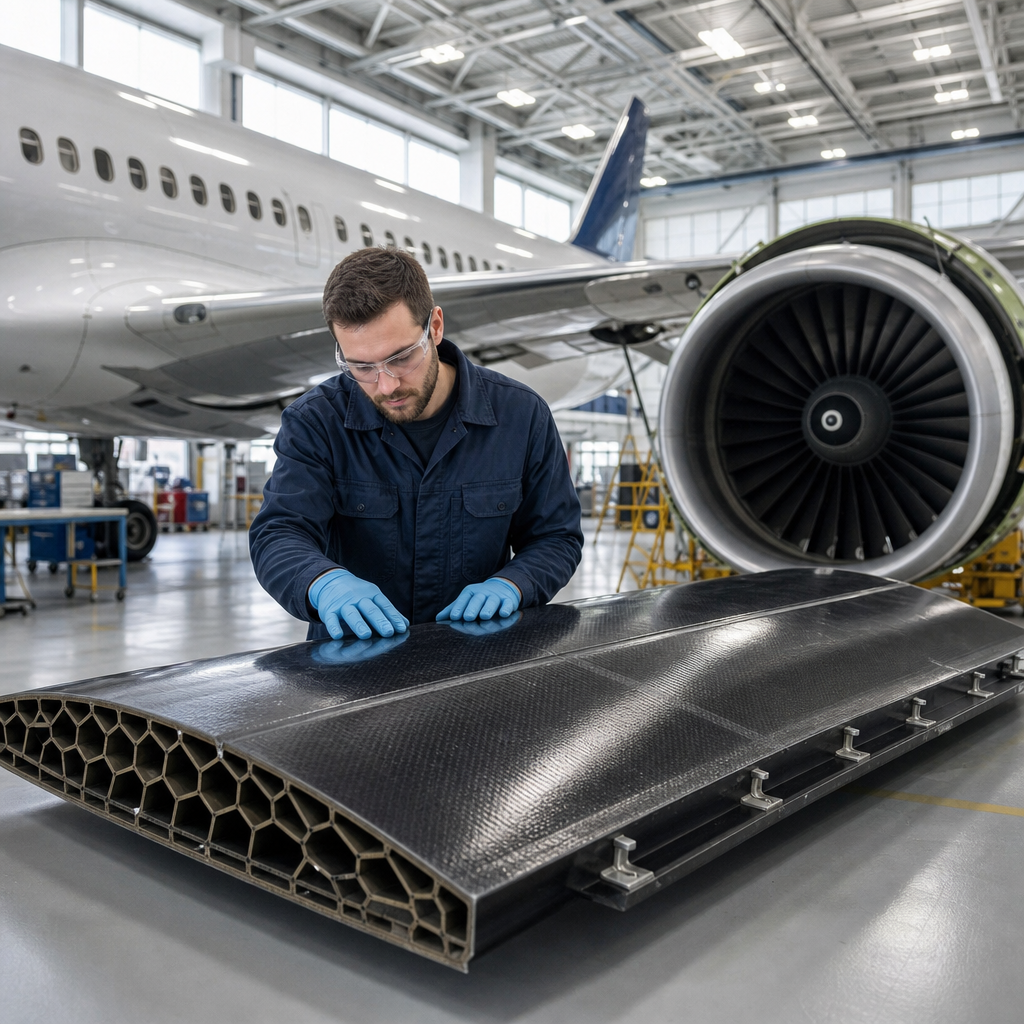
Polymers benefit aerospace engineering because they solve the field’s most persistent tradeoff: achieving higher performance with lower mass. Compared with aluminum, steel, or titanium, many polymer systems can be molded into complex geometries, integrated into fewer parts, and tailored at the molecular or composite level for targeted behavior. Carbon fiber reinforced polymer, or CFRP, illustrates this clearly. By embedding high-stiffness carbon fibers inside a polymer matrix such as epoxy or PEEK, engineers create structures with excellent specific stiffness and specific strength. That is one reason major commercial airframes such as the Boeing 787 and Airbus A350 rely heavily on composite fuselage and wing structures. The benefit is not simply lighter weight; it also includes corrosion resistance, fatigue performance, and fewer fasteners in large integrated assemblies.
The answer to a common question is straightforward: polymers reduce aircraft weight, improve fuel efficiency, resist corrosion, enable complex shapes, and support advanced functions such as electrical insulation, radar transparency, sealing, damping, and additive manufacturing. However, those benefits come with constraints. Polymers can absorb moisture, degrade under ultraviolet exposure, creep under sustained loads, soften at elevated temperature, or require difficult nondestructive inspection methods after impact damage. In aircraft interiors, flame, smoke, and toxicity performance can be as important as strength. In propulsion zones, the temperature envelope may exceed what standard engineering polymers can tolerate, pushing engineers toward polyimides, PEEK, PEKK, PTFE derivatives, or hybrid metal-composite solutions. Good aerospace engineering uses polymer innovations precisely where their performance envelope is proven, not where marketing language suggests they belong.
Structural composites in commercial and military aircraft
The most visible aerospace case studies involve structural composites. Commercial aircraft manufacturers adopted polymer matrix composites first in secondary structures, then in primary load-bearing assemblies as design methods, manufacturing controls, and certification evidence matured. The Boeing 787 Dreamliner, for example, uses roughly 50 percent composite materials by weight, including major fuselage barrel sections and wing structures. The Airbus A350 follows a similar strategy. In both cases, the polymer matrix composite approach helped cut airframe mass and improve corrosion and fatigue behavior relative to legacy metal-intensive designs. Airlines then benefit from lower fuel burn and reduced maintenance tied to corrosion-prone areas, though repair procedures and technician training become more specialized.
Military aircraft show another dimension of polymer innovation: stealth, mission tailoring, and durability under aggressive operating profiles. Polymer composites support radar-transparent radomes, conformal fairings, control surfaces, access panels, and low-observable structures that would be difficult to produce with metals alone. Adhesives and polymer films also play a role in joining dissimilar materials and managing galvanic corrosion, especially where carbon composites interface with aluminum or titanium. In my experience, one of the less discussed gains is part consolidation. A composite layup can replace an assembly of stamped metal parts, reducing fastener count, drilling operations, and tolerance stack-up. That improves quality and lowers recurring assembly time, provided tooling and cure-cycle economics support the production rate.
| Application area | Polymer innovation | Primary benefit | Key design constraint |
|---|---|---|---|
| Fuselage and wings | Carbon fiber epoxy composites | Weight reduction and fatigue resistance | Impact damage inspection and repair |
| Cabin interiors | Flame-retardant thermoplastics and laminates | Lower mass with compliance to fire standards | Smoke and toxicity requirements |
| Radomes | Glass or quartz fiber polymer composites | Radar transparency | Dielectric property control |
| Wire systems | High-performance insulation polymers | Electrical safety and durability | Arc tracking and thermal aging |
| Spacecraft components | Low-outgassing polymers | Mass savings and functional integration | Vacuum stability and radiation effects |
Cabin interiors, passenger systems, and the economics of lightweighting
Aircraft cabin systems are one of the clearest examples of how aerospace engineering benefits from polymer innovations at scale. Sidewall panels, stowage bins, seat components, tray tables, lavatory modules, air ducts, cable raceways, floor coverings, and decorative laminates increasingly use advanced thermoplastics, honeycomb sandwich panels, and reinforced polymer systems. Materials such as PEI, PPS, PEEK, and phenolic-based composites are common because they can meet strict flame, smoke, and toxicity requirements while staying light and processable. A few kilograms saved per seat or monument may sound small, but multiplied across a fleet, the fuel and payload impact becomes significant. Operators notice these savings directly in route economics.
There is also a strong maintenance and passenger experience case. Polymer interior components resist corrosion, can integrate clips and attachment features, and often provide better acoustic damping than metal equivalents. In retrofit programs, I have seen airlines prioritize polymer-based redesigns not only to save weight but to simplify cleaning, improve cosmetic durability, and reduce replacement time for high-touch components. The tradeoff is that certification evidence can become extensive when changing a seemingly minor interior part, because smoke density, heat release, and toxicity data may be required. Material selection is therefore a systems decision involving design engineering, flammability specialists, suppliers, airline customers, and certification authorities.
Propulsion, thermal management, seals, and fluid systems
Polymers contribute to propulsion systems less through hot-section structures and more through seals, hoses, wire insulation, sensor packaging, thermal barriers, acoustic treatments, and fluid handling components. Fluoropolymers, polyimides, silicones, and specialized elastomers are essential where aerospace systems must resist fuels, hydraulic fluids, lubricants, ozone, pressure cycling, and wide temperature swings. In engine nacelles and adjacent systems, polymer matrix composites can be used for acoustic liners that help reduce noise, while high-temperature resins support selected ducting and non-primary structures. These are not glamorous applications, but they are mission-critical because failure often causes leaks, electrical faults, or unplanned maintenance events.
A practical case study is wire and cable insulation. Legacy insulation systems in older fleets experienced issues such as cracking and arc tracking over time. Newer polymer formulations improved flexibility, abrasion resistance, and thermal aging performance, directly affecting aircraft safety and maintainability. Another example is seals in fuel and hydraulic systems. Selecting the wrong polymer can lead to swelling, embrittlement, compression set, or chemical incompatibility, especially with sustainable aviation fuel blends or aggressive de-icing chemicals. Aerospace engineers rely on compatibility testing, accelerated aging, and standards-based qualification because polymer performance in service depends on environment as much as on material datasheets.
Space systems, satellites, and extreme-environment design
In spacecraft and satellites, polymer innovations enable structures, insulation, films, adhesives, deployables, cable management, and printed components that would be difficult to realize with metals alone. Yet space is unforgiving. Materials must tolerate vacuum, thermal cycling, atomic oxygen in low Earth orbit, radiation exposure, and contamination control requirements. Low-outgassing polymers are used so that volatile compounds do not condense on optics, sensors, solar arrays, or thermal control surfaces. Engineers frequently review total mass loss and collected volatile condensable materials data during material down-selection, because contamination can degrade mission performance in ways that are invisible during ground assembly.
Polyimide films such as Kapton are well known in spacecraft thermal control and electrical insulation, while cyanate ester and epoxy composite systems appear in lightweight structural panels and instrument supports. Polymer foams and composite sandwich panels deliver stiffness at low density, which matters in launch cost calculations. Additive manufacturing also has growing relevance in space, particularly for tooling, ducting, and secondary hardware using PEKK or ULTEM-class materials. However, space programs are conservative for good reason. Radiation, microcracking from thermal cycling, and long-duration creep can alter performance over mission life. The best case studies are those where material innovation is paired with exhaustive environmental testing, contamination analysis, and clear margins.
Advanced manufacturing, additive processes, and certification realities
One of the strongest reasons aerospace engineering benefits from polymer innovations is manufacturability. Thermoplastic composites can support faster forming and welding compared with traditional thermoset autoclave routes, while resin transfer molding and out-of-autoclave processing can reduce cycle time and tooling cost for selected parts. Additive manufacturing extends that advantage by enabling low-volume, complex geometries without dedicated hard tooling. Aerospace companies use polymer 3D printing for brackets, ducting, jigs, fixtures, cockpit components, and validated end-use parts where geometry complexity, supply chain speed, and weight justify the process. Materials commonly discussed include PEKK, PEEK, ULTEM 9085, and reinforced nylon systems, depending on regulatory and thermal demands.
Still, certification is the gatekeeper. Aerospace does not accept a printed polymer part because it looks right or saves mass in theory. It must show repeatable process control, acceptable porosity, stable mechanical properties, traceable feedstock, and environmental durability. Statistical allowables, lot acceptance testing, and configuration management matter as much as the material itself. I have seen promising polymer concepts stall not because the chemistry failed, but because the process window was too narrow for production consistency. The lesson across industry-specific case studies is consistent: the winning polymer innovation is not the most exotic material, but the one that can be designed, manufactured, inspected, repaired, and certified within program constraints.
What aerospace leaders should evaluate next
For engineers, procurement teams, and program managers, the next step is to evaluate polymer applications by mission environment, certification burden, manufacturing maturity, and lifecycle economics rather than by weight savings alone. The strongest opportunities are usually in part consolidation, interiors, electrical systems, radomes, secondary structures, space hardware, and maintenance-driven redesigns where corrosion resistance and manufacturability deliver compound benefits. Ask direct questions: What load case governs the design? What is the maximum continuous-use temperature? How will the material respond to fluids, ultraviolet exposure, impact, vacuum, or fire testing? Can the supplier provide traceability, allowables, and repair data? Those answers determine whether a polymer innovation becomes a fleet-wide advantage or an expensive engineering detour.
As a hub for aerospace industry-specific case studies, this page shows a simple pattern. Polymers create value when they are selected with discipline, matched to the operating environment, and supported by robust qualification evidence. They help commercial aircraft burn less fuel, improve cabin systems, support stealth and radome functions, protect wiring and seals, and enable lighter spacecraft hardware. They also introduce real challenges, including temperature limits, inspection complexity, and certification effort. The benefit is not abstract; it appears in lower operating cost, better corrosion performance, functional integration, and design freedom. If you are building out your case studies and applications strategy, start by mapping high-value aerospace components where polymer innovations can deliver measurable, certifiable gains, then expand into deeper material-specific articles from that foundation.
Frequently Asked Questions
1. Why are polymer innovations so important in aerospace engineering?
Polymer innovations are important in aerospace engineering because they help solve one of the industry’s most persistent challenges: improving performance while reducing weight. Aerospace systems must operate under intense mechanical loads, wide temperature swings, vibration, moisture exposure, UV radiation, fuels, hydraulic fluids, and strict safety requirements. Traditional metals still play a major role, but advanced polymers give engineers a wider design toolkit by offering low density, tailored mechanical properties, corrosion resistance, electrical insulation or conductivity when needed, and excellent compatibility with composite structures.
In practice, modern aerospace polymers include far more than everyday plastics. They include high-performance thermoplastics, thermosets, elastomers, structural adhesives, coatings, sealants, foams, and polymer matrix composites. These materials can be engineered to perform specific functions in cabins, avionics housings, radomes, insulation systems, fuel system components, wire coatings, interior panels, ducting, and structural assemblies. Because they are highly tunable at the molecular and formulation level, polymers can be optimized for flame resistance, chemical stability, toughness, fatigue life, or heat performance depending on the application.
The broader benefit is that polymer innovation supports the aerospace industry’s most strategic goals: fuel efficiency, payload optimization, longer service intervals, design flexibility, and lower lifecycle costs. By helping aircraft and spacecraft become lighter, more durable, and more efficient, polymers directly contribute to better performance and more advanced engineering solutions across commercial aviation, defense, and space systems.
2. How do advanced polymers help reduce aircraft and spacecraft weight?
Advanced polymers reduce weight primarily because they offer useful structural and functional performance at a much lower mass than many traditional metallic materials. In aerospace, every kilogram matters. A lighter aircraft typically requires less fuel to operate, can carry more payload, and may place less stress on surrounding systems. In spacecraft, mass reduction is even more valuable because launch costs are strongly tied to payload weight. Polymers help engineers remove unnecessary mass without giving up the performance needed for demanding environments.
This weight advantage shows up in several ways. First, polymer-based components often replace heavier metal parts in non-structural and semi-structural applications such as interior assemblies, housings, brackets, ducts, panels, insulation elements, and cable protection systems. Second, polymer matrix composites combine polymers with reinforcing fibers such as carbon or glass to create materials with excellent strength-to-weight and stiffness-to-weight ratios. These composites can be used for airframes, control surfaces, fairings, and satellite structures where reduced mass is a major engineering objective.
Another major benefit is design integration. Polymers can often be molded or formed into complex geometries that would require multiple metal parts, fasteners, and machining steps if made conventionally. That means engineers can consolidate assemblies into fewer components, reducing both part count and system weight. Structural adhesives based on polymer chemistry can also reduce the need for heavy mechanical fastening in certain designs. Taken together, these advantages allow aerospace engineers to achieve meaningful mass savings while maintaining structural efficiency, aerodynamic performance, and manufacturability.
3. What kinds of aerospace components commonly use high-performance polymers?
High-performance polymers are used across a wide range of aerospace components because different polymer families can be tailored to meet very specific operational demands. Inside aircraft cabins, they are commonly found in interior panels, seat components, overhead storage systems, tray tables, window surrounds, flooring elements, insulation blankets, and decorative surfaces. In these applications, the materials must be lightweight, durable, and compliant with strict flame, smoke, and toxicity standards.
Beyond the cabin, polymers appear in wire and cable insulation, connector systems, seals, gaskets, O-rings, hoses, ducts, bushings, bearings, brackets, fairings, radomes, sensor housings, and protective coatings. Structural adhesives and sealants are especially important in aerospace assembly because they help bond different materials, distribute loads more evenly, and protect against environmental ingress. In avionics and electronics, specialized polymers provide dielectric insulation, thermal management support, and dimensional stability in tightly packaged systems.
In more advanced structural applications, polymer matrix composites are used in fuselage sections, wing components, empennage structures, helicopter rotor elements, and spacecraft panels. These systems rely on resin matrices that work together with reinforcing fibers to deliver high strength and stiffness at low weight. In space environments, polymer-based materials may also be selected for thermal blankets, lightweight deployable structures, and components requiring resistance to vacuum conditions, radiation exposure, or thermal cycling. The key point is that polymers are no longer limited to secondary uses; they now support both functional and increasingly critical roles across modern aerospace platforms.
4. How do polymer materials perform under extreme aerospace conditions?
Polymer materials can perform exceptionally well under extreme aerospace conditions when they are properly selected and engineered for the mission profile. Aerospace environments are not uniform. A commercial aircraft cabin, an engine-adjacent component, a high-altitude exterior surface, and an orbital spacecraft all expose materials to very different combinations of stress, temperature, pressure, radiation, chemicals, and fatigue. For that reason, aerospace engineers do not treat polymers as generic materials. They evaluate specific polymer chemistries and formulations based on precise performance requirements.
Many advanced polymers are designed for thermal stability, allowing them to retain useful mechanical and dimensional properties across broad temperature ranges. Others are optimized for chemical resistance to fuels, lubricants, de-icing fluids, hydraulic fluids, and cleaning agents. Elastomeric polymers can maintain sealing performance under vibration and pressure variation, while high-performance thermoplastics and thermosets may offer strong fatigue resistance, creep resistance, and long-term durability. In electrical systems, polymers can be formulated for insulation, shielding support, or static management depending on the application.
That said, performance in aerospace always depends on verification, not assumptions. Engineers must account for issues such as outgassing in vacuum, moisture absorption, UV exposure, microcracking, thermal aging, flame behavior, and compatibility with adjacent materials. Materials used in aerospace go through extensive qualification, testing, and certification processes to confirm that they can withstand operational demands over time. When these factors are addressed correctly, polymer innovations provide reliable, high-value performance even in some of the harshest environments encountered in engineering.
5. What is the future of polymer innovation in aerospace engineering?
The future of polymer innovation in aerospace engineering is closely tied to the industry’s push for lighter structures, smarter materials, more efficient manufacturing, and greater sustainability. Engineers and materials scientists are developing polymer systems that go beyond simply replacing heavier materials. The focus is increasingly on creating multifunctional materials that can contribute to structural performance while also offering benefits such as embedded sensing, improved thermal management, electrical functionality, damage tolerance, or easier repairability.
One major area of progress is in next-generation composites and high-performance thermoplastics. These materials can support faster manufacturing cycles, automated fabrication, improved weldability or joining, and better recyclability compared with some conventional thermoset systems. Additive manufacturing is also expanding the role of aerospace polymers by enabling lightweight lattice structures, custom ducting, rapid prototyping, and low-volume production of complex parts with reduced material waste. This is especially valuable in space and defense programs where customized designs and rapid iteration can be mission-critical.
Sustainability is another important driver. Aerospace manufacturers are under increasing pressure to reduce emissions, lower fuel consumption, and consider end-of-life material strategies. Polymer innovations contribute by reducing aircraft weight, supporting more efficient designs, and opening the door to more recyclable or reprocessable material systems. Looking ahead, the most influential polymer technologies will likely be those that combine lightweight performance, durability, manufacturability, and environmental responsibility. In that sense, polymers are not just supporting aerospace progress—they are helping define what the next generation of aerospace engineering will look like.