Polymers have become essential to modern solar technology because they improve how light is captured, converted, protected, and delivered at a lower cost than many traditional materials. In solar energy harvesting, a polymer is a large molecule made of repeating units that can be engineered to conduct electricity, transmit light, block moisture, add mechanical strength, or selectively interact with specific wavelengths. That design flexibility matters across nearly every major solar platform, from crystalline silicon modules to thin-film devices, concentrated solar systems, building-integrated photovoltaics, flexible wearables, and next-generation organic and perovskite cells. I have worked with solar product teams evaluating backsheets, encapsulants, conductive films, and polymer barrier layers, and the practical lesson is consistent: module efficiency on a datasheet means little if the surrounding materials cannot survive heat, ultraviolet exposure, humidity, and mechanical stress for years in the field.
When people ask how polymers enhance solar energy harvesting, the short answer is simple. They raise energy yield by helping modules absorb more usable light, reduce optical and electrical losses, resist environmental degradation, lower weight, and enable form factors that rigid glass-and-metal systems cannot deliver. They also influence manufacturability. Roll-to-roll coating, lamination, extrusion, and printable electronics all depend on polymer science to scale production and control cost. In real projects, polymer selection often determines whether a design succeeds commercially. A high-transmission encapsulant can preserve current generation, a durable backsheet can prevent premature failure, and a tailored conductive polymer can replace brittle or expensive components in advanced cells. As a hub for innovative polymer applications, this article explains where polymers fit in solar systems, which material classes matter most, what benefits they create in practice, and where engineers still face tradeoffs.
Why polymers matter in solar module design
Polymers matter because a solar module is not just a semiconductor device; it is a multilayer environmental protection system built around a light-converting core. In a standard crystalline silicon module, polymers appear in the encapsulant, backsheet, junction box potting compounds, edge seals, cable insulation, adhesives, and sometimes frontsheet or antireflective films. In advanced technologies, they also appear as hole transport layers, electron-selective interlayers, substrates, transparent electrodes, and printable photoactive materials. Each role affects performance. Ethylene-vinyl acetate, or EVA, remains a common encapsulant because it bonds cells, cushions them from stress, and transmits light efficiently after lamination. Polyolefin elastomers are gaining share where lower water vapor transmission and reduced potential-induced degradation risk are priorities. Fluoropolymer-based backsheets such as PVF and PVDF structures are valued for weatherability and electrical insulation, especially in demanding climates.
These materials do more than sit around the active layer. They directly influence levelized cost of electricity by changing degradation rates, maintenance needs, transport cost, and installation speed. A lighter polymer frontsheet for a rooftop laminate can reduce mounting requirements. A better barrier film in a perovskite module can extend operational life enough to turn a promising lab result into a bankable product path. Even small optical improvements matter. If an encapsulant or coating increases transmission by a fraction of a percent across useful wavelengths, that gain is multiplied across every cell in the array over years of operation. Conversely, poor polymer choices can trigger yellowing, delamination, cracking, acetic acid formation, hydrolysis, or dielectric failure. In field forensics, I have seen under-specified materials erase the advantage of an otherwise good cell architecture.
Optical polymers that increase light capture
One of the clearest ways polymers enhance solar energy harvesting is by improving optical management. Solar cells perform best when more photons enter the active layer instead of being reflected, scattered away, or absorbed parasitically by surrounding materials. Engineers use polymer films and coatings to control refractive index, surface texture, haze, and spectral transmission. Antireflective polymer coatings can reduce front-surface reflection, while textured polymer films can trap light through controlled scattering. In bifacial modules, transparent polymer backsheets or edge materials can help preserve rear-side response where system design allows albedo gains from reflective ground surfaces.
In concentrated photovoltaics and luminescent solar concentrators, polymer optics become even more important. Acrylics such as PMMA and polycarbonate are used in lenses and waveguides because they can be molded accurately, remain lightweight, and maintain good visible transmission. Luminescent solar concentrators often rely on polymer matrices doped with dyes or quantum dots that absorb sunlight and re-emit it toward embedded solar cells. The matrix must balance transparency, photostability, and low self-absorption. Material scientists also tune fluorinated polymers and silicones for high transmittance and ultraviolet durability in specialty applications. The practical payoff is straightforward: better optical coupling means more current generation without changing the semiconductor itself.
Protective polymers that extend operating life
Durability is where polymer engineering often delivers the highest financial value. Solar modules operate outdoors for decades under ultraviolet radiation, thermal cycling, humidity, wind loading, and pollution. Protective polymers act as the first line of defense against these stressors. Encapsulants absorb mechanical shock, maintain dielectric isolation, and limit moisture ingress. Backsheets shield against weather and provide electrical insulation. Sealants protect vulnerable edges, where water entry can accelerate corrosion and delamination. In emerging devices such as perovskite solar cells, multilayer polymer barrier films are indispensable because the active materials are far more sensitive to oxygen and moisture than silicon.
Standards such as IEC 61215 and IEC 61730 guide qualification, but passing qualification does not eliminate material risk. Long-term field behavior depends on climate and design details. For example, EVA can generate acetic acid under certain conditions, contributing to corrosion in susceptible constructions. Polyolefin encapsulants can reduce that risk but may require tighter processing control during lamination. Fluoropolymer backsheets offer strong weather resistance, yet cost and supply considerations matter. Polyamide, PET, and coextruded multilayer alternatives can perform well if hydrolysis resistance and adhesion are properly engineered. The central point is that better polymer protection preserves power output over time. A module that degrades more slowly harvests more energy over its lifetime, even if its initial efficiency matches a competitor.
Conductive and semiconductive polymers in next-generation cells
Innovative polymer applications are not limited to packaging. Conductive and semiconductive polymers actively participate in charge transport in several advanced solar technologies. In organic photovoltaics, donor polymers such as PM6 and earlier materials including P3HT are blended with acceptors to form bulk heterojunctions that convert light into electrical current. Their molecular structure determines bandgap, absorption range, morphology, and charge mobility. Over the last decade, non-fullerene acceptor systems paired with optimized donor polymers have pushed laboratory organic solar cell efficiencies above 19 percent, showing that polymer electronics are no longer a niche academic curiosity.
In perovskite and dye-sensitized solar cells, conductive polymers often serve as transport layers or electrode modifiers. PEDOT:PSS has been widely used as a hole transport material because it is solution-processable and optically transparent, although its acidity and hygroscopic behavior can create stability concerns if the device stack is not carefully designed. Researchers address those issues through additives, neutral formulations, interface engineering, and alternative polymer transport layers. Printable conductive polymers also support flexible substrates where brittle indium tin oxide can crack under strain. In product development, the attraction is obvious: polymers enable low-temperature processing, compatibility with roll-to-roll manufacturing, and lightweight flexible modules that open applications conventional glass modules cannot address.
Flexible, lightweight, and integrated solar applications
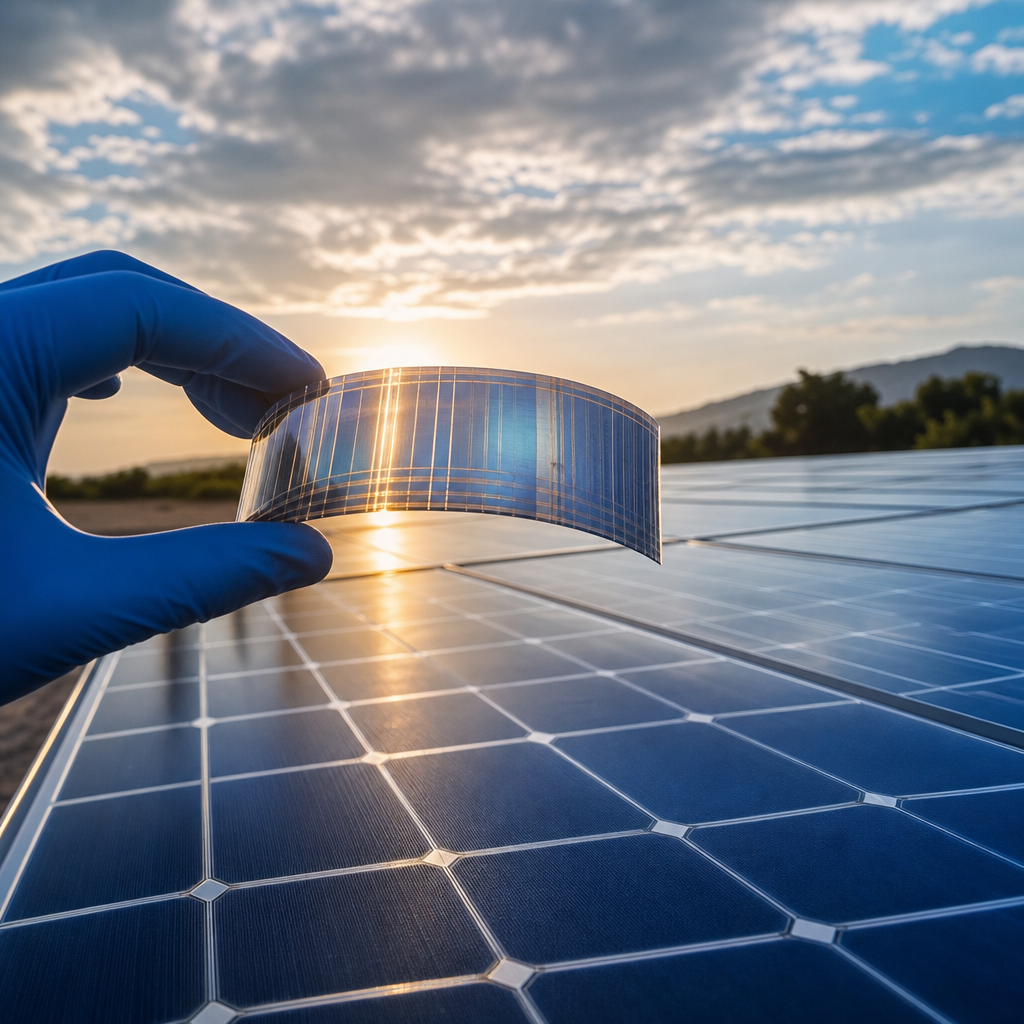
Polymers make solar harvesting possible in places where rigid modules are impractical. Flexible photovoltaic laminates for curved roofs, membranes, vehicles, drones, portable chargers, and wearable electronics all depend on polymer substrates and encapsulation systems. Polyimide, PET, PEN, thermoplastic polyurethane, and specialized fluoropolymers are commonly used where weight reduction and bendability are critical. A lightweight polymer-based laminate can cut transport and installation effort significantly, especially on structures with low load-bearing capacity. That matters in retrofits, temporary installations, and mobile energy systems where every kilogram affects cost or performance.
Building-integrated photovoltaics offer another strong example. Semitransparent modules, colored laminates, and solar façade elements often use polymers in interlayers, sealants, glazing composites, and decorative optical films. These materials help architects balance energy generation with daylighting, aesthetics, and safety requirements. Agrivoltaics and greenhouse applications also benefit from polymer tuning because spectral-selective films can transmit wavelengths useful for plant growth while supporting power generation. In field deployment, however, flexibility always comes with tradeoffs. Mechanical durability, fire performance, ultraviolet stability, and cleaning resistance must be verified for the exact use case. The best polymer-enabled solar products succeed because they match material properties to real operating conditions rather than chasing flexibility for its own sake.
Key polymer applications across solar technologies
The easiest way to understand polymer value is to map each material class to its function, benefit, and limitation in actual systems.
| Application | Common polymers | Main benefit | Typical challenge |
|---|---|---|---|
| Encapsulants | EVA, POE, ionomers | Cell protection, light transmission, adhesion | Yellowing, moisture control, processing window |
| Backsheets | PVF, PVDF, PET multilayers | Weather resistance, insulation | Cracking, hydrolysis, cost tradeoffs |
| Flexible substrates | PET, PEN, polyimide | Low weight, bendability | Thermal limits, dimensional stability |
| Transport layers | PEDOT:PSS, conjugated polymers | Printable charge extraction | Stability and interface sensitivity |
| Optical films | PMMA, silicones, fluoropolymers | Antireflection, light trapping | UV durability, abrasion resistance |
| Barrier films | Multilayer polymer stacks | Moisture and oxygen protection | Pinhole control, edge sealing |
Across these categories, material selection should be driven by climate, electrical architecture, mechanical load, and service-life target. There is no universally best polymer, only the best fit for a defined design envelope.
Manufacturing advantages and commercial case studies
Polymers enhance solar economics because they support scalable manufacturing. Roll-to-roll coating for organic photovoltaics, slot-die deposition of transport layers, extrusion of backsheets, and automated lamination of encapsulants all rely on polymer processability. Compared with thick glass and metal assemblies, polymer-rich systems can reduce material use, shorten cycle times, and enable high-throughput production of large-area films. In my experience, manufacturability is often the hidden reason one polymer system wins over another. A material with slightly better lab performance may lose if it requires narrow temperature control, slow curing, or difficult storage conditions.
Commercial examples show this clearly. Bifacial silicon module makers increasingly evaluate encapsulant and backsheet combinations to reduce moisture ingress and improve long-term energy yield in humid climates. Flexible solar manufacturers for recreational vehicles and marine use depend on fluoropolymer top layers and elastomeric encapsulants to survive vibration and salt exposure. Companies developing perovskite-on-silicon tandems are investing heavily in barrier films, polymer interlayers, and low-temperature interface materials because tandem efficiency gains are meaningless without stable packaging. The pattern is the same across applications: polymer innovation rarely draws headlines like record cell efficiency, but it is often the difference between a prototype and a commercially viable solar product.
Limits, risks, and what to evaluate next
Polymers are powerful enablers, but they are not magic materials. They can discolor, creep, absorb water, outgas additives, lose adhesion, and degrade under ultraviolet light or high voltage stress. Some high-performance options carry cost or recycling challenges. Fire behavior and smoke toxicity must be evaluated in building applications. Material compatibility also matters: a strong barrier film can still fail if the edge seal is weak, and an excellent transport polymer can still underperform if it creates a poor energy-level alignment at the interface. That is why serious evaluation combines accelerated testing, outdoor exposure, spectroscopy, adhesion testing, damp-heat analysis, and electrical reliability measurements.
The biggest takeaway is clear. Polymers enhance solar energy harvesting not by one mechanism, but by improving optics, protection, charge transport, flexibility, and manufacturability across the entire device stack. For teams building a subtopic strategy around innovative polymer applications, the next step is to go deeper into each branch: encapsulants, barrier films, conductive polymers, flexible substrates, building integration, and perovskite packaging. Start by identifying which polymer function most affects your solar use case, then compare materials against lifetime performance, not just initial efficiency. That approach leads to better products, more reliable energy generation, and smarter investment in solar innovation.
Frequently Asked Questions
1. What role do polymers play in solar energy harvesting?
Polymers play multiple roles in solar energy harvesting because they can be tailored to solve several performance challenges at once. In the simplest terms, a polymer is a large molecule built from repeating units, but in solar technology those repeating units can be designed to deliver very specific properties. Some polymers are engineered to conduct electricity, allowing them to move charges generated by sunlight. Others are designed to be optically clear, so light can pass through protective layers with minimal loss. Still others act as barriers against moisture, oxygen, and environmental contaminants that would otherwise degrade delicate solar components.
This versatility makes polymers valuable across nearly every major solar platform. In photovoltaic modules, they are used in encapsulants, backsheets, adhesives, coatings, and electrical layers. In thin-film and emerging solar cells, including organic and hybrid systems, polymers may actively participate in light absorption and charge transport. In concentrated solar and solar thermal applications, polymer-based materials can provide structural support, weather resistance, insulation, and selective optical behavior. Because they can be processed at relatively low temperatures and manufactured at scale, polymers also help lower production costs and enable lightweight, flexible formats that are difficult to achieve with rigid inorganic materials alone.
What makes polymers especially important is not just that they replace one material with another, but that they allow engineers to fine-tune how a solar device captures, converts, protects, and delivers energy. That combination of functionality, adaptability, and cost efficiency is why polymers have become foundational to modern solar energy harvesting.
2. How do polymers help solar panels capture and convert more sunlight?
Polymers enhance sunlight capture and conversion in several direct and indirect ways. First, they can improve the optical path of incoming light. Transparent polymer layers are often used to cover or encapsulate solar cells while minimizing reflection and scattering losses. Some polymer coatings can be engineered with anti-reflective or light-managing properties, helping more photons reach the active layer where electricity is generated. Others can be tuned to interact with specific wavelengths, which is useful when engineers want to guide, filter, or redistribute parts of the solar spectrum for better overall device performance.
Second, certain polymers are active electronic materials. In organic solar cells, for example, semiconducting polymers can absorb sunlight and generate charge carriers. Their molecular structure can be adjusted so they absorb different regions of the solar spectrum, align more effectively with partner materials, and transport charges more efficiently. This ability to customize the chemistry is a major advantage. Researchers can alter backbone structure, side chains, crystallinity, and energy levels to improve light harvesting, exciton separation, and charge mobility. In practical terms, that means polymer-based active layers can be designed to convert more of the sun’s energy into usable electrical current.
Third, polymers support conversion efficiency by stabilizing the environments in which solar cells operate. If moisture enters a device or if ultraviolet exposure damages sensitive layers, performance drops over time. Barrier polymers, UV-resistant coatings, and mechanically resilient encapsulants preserve the optical and electrical integrity of the cell. So even when a polymer is not the main light-absorbing material, it may still be critical to maintaining high conversion efficiency in real-world conditions. In many solar systems, better harvesting is not only about initial efficiency on day one, but about preserving that efficiency over years of exposure, heat, humidity, and mechanical stress. Polymers are central to that long-term performance.
3. Why are polymers often considered more cost-effective than traditional solar materials?
Polymers are often more cost-effective because they combine material efficiency, manufacturing flexibility, and performance benefits in ways that reduce total system cost. Many traditional materials used in solar technologies, such as glass-heavy structures, specialty metals, or highly processed inorganic layers, can be expensive to source, shape, and integrate. By contrast, many polymers can be synthesized in large volumes, processed into films or coatings, and applied using scalable methods such as roll-to-roll manufacturing, printing, lamination, coating, and extrusion. These techniques can reduce energy use during production and support high-throughput fabrication.
Another reason polymers can lower costs is that they reduce weight and simplify installation. Lightweight polymer components can decrease transportation expenses and make solar systems easier to handle in the field. Flexible polymer-based materials also open up applications where conventional rigid panels are impractical, such as curved surfaces, portable systems, building-integrated products, and low-load rooftops. When fewer structural reinforcements are needed, the balance-of-system cost can decline as well.
Polymers also contribute to cost-effectiveness through durability and reliability. A well-designed encapsulant or backsheet can protect solar cells from moisture intrusion, electrical failure, thermal cycling, and UV damage. That means fewer failures, less maintenance, and a longer service life. In economic terms, the value of a polymer is not limited to its purchase price; it also affects how much energy the system produces over time and how often components need replacement. When a material helps preserve power output and lowers lifecycle costs, it improves the overall economics of solar energy harvesting. That is why polymers are frequently seen as cost-effective not just in manufacturing, but across the entire operational lifetime of a solar system.
4. Are polymers only used as protective materials, or can they be active parts of solar cells too?
Polymers are absolutely more than protective materials. While they are widely used in protective roles such as encapsulation, insulation, adhesion, and environmental sealing, many polymers also serve as active functional components inside solar devices. This is one of the most exciting aspects of polymer science in renewable energy. Depending on their structure, polymers can be designed to conduct electricity, transport holes or electrons, absorb specific wavelengths of light, or create interfaces that improve charge extraction. In other words, polymers can participate directly in the physics of solar energy conversion, not just in packaging the device.
A clear example is found in organic photovoltaics, where conjugated polymers act as semiconductors. These materials contain alternating bond structures that allow electrons to move more freely than they would in conventional insulating plastics. When sunlight is absorbed, these polymers can generate excited states that lead to charge separation and current flow. They are also used in transport layers that help shuttle charges to the appropriate electrodes with lower losses. In perovskite and hybrid solar cells, polymers may appear in hole transport layers, interfacial modifiers, binders, or passivation strategies that improve efficiency and device stability.
Even in conventional silicon-based modules, polymers often do more than simply shield the cell. They influence optical transmission, electrical insulation, thermal behavior, and long-term module integrity, all of which affect actual energy yield. So it is best to think of polymers as platform-enabling materials. In some systems they are active absorbers or charge transport media; in others they are performance-critical support materials that make efficient operation possible at scale. Their importance lies in this broad functional range, which is much greater than the old idea of polymers being “just plastic coverings.”
5. What is the future of polymers in solar technology?
The future of polymers in solar technology is very strong because the solar industry increasingly needs materials that are lightweight, tunable, scalable, and compatible with advanced device architectures. As solar applications expand beyond standard rooftop modules into wearables, vehicles, windows, building facades, portable power systems, agrivoltaics, and grid-scale installations, materials must meet more diverse requirements. Polymers are well suited to this future because they can be engineered for flexibility, transparency, conductivity, barrier performance, thermal stability, and selective optical behavior within a single design framework.
Research is moving in several important directions. One is the development of higher-performance semiconducting polymers for organic photovoltaics, where scientists continue to improve efficiency, morphology control, and operational lifetime. Another is the use of advanced polymers in perovskite solar cells, where interfacial layers, encapsulation systems, and defect-management strategies are essential to pushing these devices closer to long-term commercial viability. There is also growing interest in recyclable, bio-based, and lower-environmental-impact polymers that support more sustainable manufacturing and end-of-life management.
At the module level, future polymer innovations are expected to improve resistance to UV exposure, moisture ingress, heat, and mechanical fatigue, all of which directly influence field reliability. Smart polymer coatings may help manage self-cleaning, anti-soiling, thermal regulation, or spectral conversion. Manufacturing advances could also allow solar devices to be printed or fabricated on flexible substrates at lower cost and in new form factors. Taken together, these trends suggest that polymers will not be peripheral materials in next-generation solar systems. They will be central enablers of efficiency, durability, affordability, and design freedom, helping solar energy harvesting become more effective and more widely deployable across the global energy landscape.