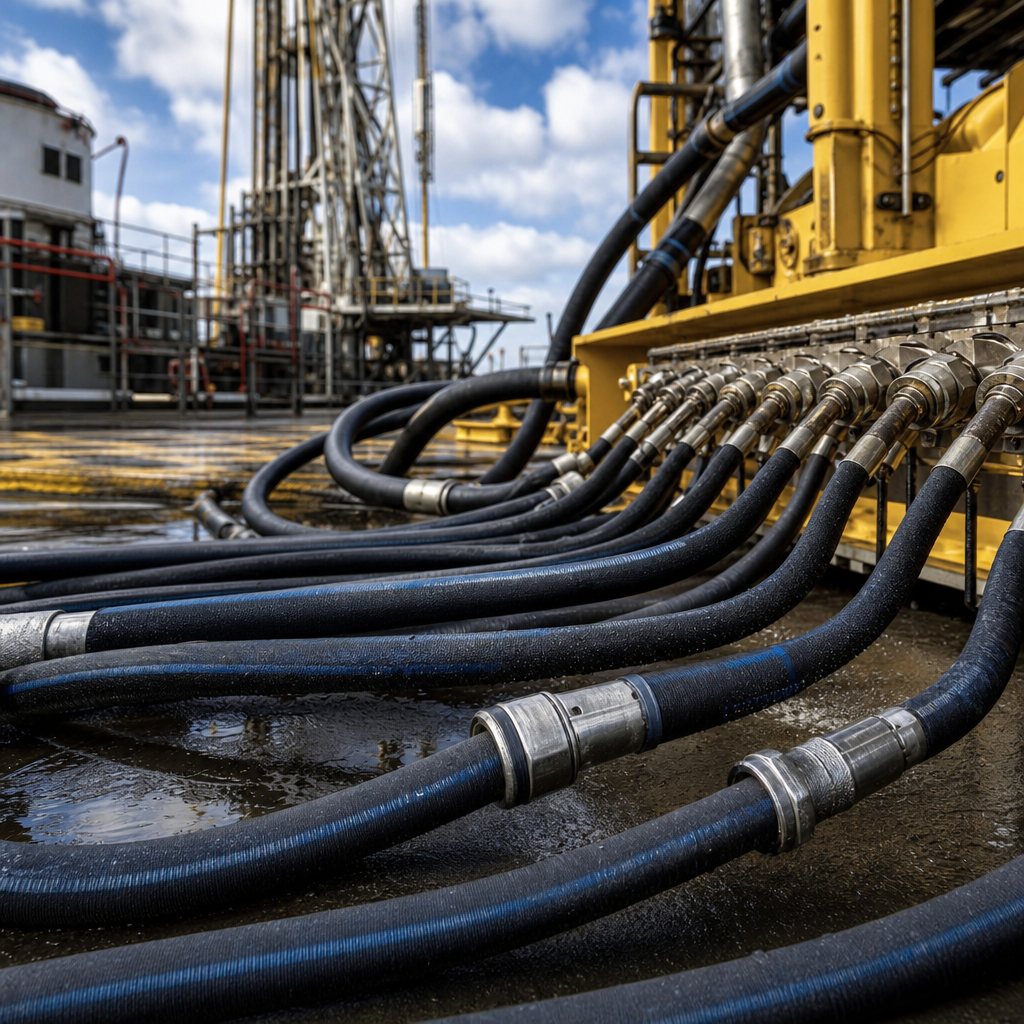
Heavy-duty industrial hoses work in punishing environments, and polymers are the materials that make that performance possible. In chemical transfer, mining dewatering, food processing, oil and gas loading, compressed air service, and hydraulic support systems, a hose must bend without kinking, contain pressure without rupturing, resist abrasion and weathering, and remain compatible with the media flowing through it. The term polymer refers to a class of materials built from long molecular chains, including elastomers such as EPDM and nitrile, thermoplastics such as PVC and polyurethane, and high-performance fluoropolymers such as PTFE. In hose engineering, these materials are not interchangeable commodities. Each polymer brings a distinct balance of flexibility, temperature resistance, chemical compatibility, gas permeability, fatigue life, and cost.
I have worked with hose selection and failure analysis long enough to know that most hose problems trace back to material mismatch rather than assembly error alone. A hose can have adequate reinforcement and still fail early if the tube hardens in hot oil, if the cover cracks under ozone exposure, or if the lining swells after repeated contact with solvents. That is why polymers sit at the center of industrial hose development. They define the performance envelope before reinforcement, couplings, and routing are even considered. For buyers, maintenance teams, and design engineers, understanding polymers in industrial applications is essential because it improves uptime, safety, and total lifecycle cost. This hub article explains how polymers support heavy-duty industrial hoses, where different materials excel, what standards guide decisions, and how this topic connects to broader case studies across industrial operations.
Why polymers are the foundation of industrial hose performance
An industrial hose is a multilayer system, typically made of an inner tube, reinforcement layer, and outer cover. The inner tube handles chemical exposure and product purity. Reinforcement, often textile braid, spiral synthetic yarn, or steel wire, carries pressure. The outer cover protects against abrasion, UV, ozone, oil splash, and environmental attack. Polymers are used in at least two of these three layers and often in adhesives or tie gums between them. Their role is structural, chemical, and operational at the same time.
The most important design principle is that hose performance starts with the media, temperature, and movement profile. For example, EPDM performs well with hot water and many cleaning solutions, so it is widely used in washdown and steam-related service. Nitrile rubber is preferred for petroleum-based oils and fuels because it resists swelling better than many general-purpose elastomers. Natural rubber remains valuable in slurry and abrasive service because its resilience helps absorb particle impact. Polyurethane offers excellent abrasion resistance in material handling hoses. PTFE is selected when the fluid is highly corrosive, high purity is required, or temperature extremes exceed what common rubbers can tolerate.
These choices affect more than durability. They also influence bend radius, weight, electrostatic behavior, permeation, and cleanability. In food and pharmaceutical lines, a polymer may need to meet FDA or EU food-contact requirements and tolerate CIP chemicals. In chemical plants, the same hose may need conductive construction to control static. In mining, the limiting factor may be cover wear from dragging over rough surfaces. A heavy-duty hose succeeds when the polymer package is matched to the exact service conditions, not when a catalog description seems close enough.
Key polymer families used in heavy-duty industrial hoses
Elastomers remain the backbone of many heavy-duty hose designs because they combine flexibility with resilience. EPDM, or ethylene propylene diene monomer, is known for strong resistance to heat, ozone, and water-based media. It is common in coolant, washdown, and some steam applications, though steam service still demands strict pressure and temperature control. NBR, commonly called nitrile, is a standard choice for fuel transfer, hydraulic return, and oily compressed air because it handles hydrocarbons well. Neoprene is often used in covers thanks to balanced weather and oil resistance. SBR and natural rubber appear in bulk transfer and slurry hoses where toughness matters.
Thermoplastics serve a different set of priorities. PVC is economical and chemically resistant to many non-hydrocarbon media, making it common in water suction and discharge hoses, agricultural service, and some ducting products. TPU and other polyurethane formulations stand out when abrasion is severe, such as pneumatic conveying of pellets, powders, or chips. Polyethylene and polypropylene appear in specialty chemical tubing and corrugated ducting. Thermoplastic constructions can be lighter than rubber alternatives and may allow smoother bores, but they can also become stiffer at low temperatures or creep under sustained load if the design is pushed beyond its limits.
Fluoropolymers occupy the top tier for chemical resistance. PTFE is the best-known example and is widely used in hoses handling acids, solvents, aggressive cleaning agents, and high-purity fluids. It has low friction, broad chemical compatibility, and useful temperature capability, but it is less flexible than many rubbers unless formed in convoluted constructions. FEP and PFA can also appear in specialty applications requiring clean transfer and low extractables. In practice, these materials are chosen when the cost of contamination, corrosion, or frequent replacement is higher than the premium price of the hose itself.
| Polymer | Typical strengths | Common hose applications | Main limitations |
|---|---|---|---|
| EPDM | Hot water, ozone, weather, many cleaning chemicals | Washdown, coolant, some steam and utility hoses | Poor resistance to many oils and fuels |
| NBR | Oil and fuel resistance, good flexibility | Petroleum transfer, hydraulic return, compressed air with oil mist | Less suitable for strong ozone exposure without proper cover compounds |
| Natural rubber | High resilience, strong abrasion resistance in slurry service | Mining slurry, sandblast, material handling | Limited resistance to oils, weathering, and some chemicals |
| PVC | Low cost, broad general chemical resistance, light weight | Water suction and discharge, agriculture, general transfer | Can stiffen in cold conditions and has lower heat tolerance |
| Polyurethane | Excellent abrasion resistance, good tear strength | Pneumatic conveying, ducting, granular material transfer | May be less suitable for high-heat service depending on grade |
| PTFE | Outstanding chemical resistance, high purity, wide temperature range | Chemical transfer, pharmaceutical, solvent and acid service | Higher cost and different flexibility profile than rubber hoses |
How polymer selection changes with pressure, temperature, and media
Pressure ratings get attention first, but the tougher engineering work usually involves the interaction of polymer chemistry with temperature and media. Chemical compatibility charts are helpful starting points, yet they are not enough by themselves because concentration, cycling, and contamination can change results dramatically. A nitrile tube may tolerate diesel well at moderate temperature but age much faster if the fluid contains aggressive additives or if the hose sees repeated heat soak near engines. Likewise, EPDM can thrive in hot water service and fail quickly in petroleum exposure. The same nominal pressure hose can therefore deliver very different service life depending on the polymer compound selected.
Temperature amplifies every material weakness. Elevated heat accelerates oxidation, hardening, softening, and extraction of plasticizers. Low temperatures reduce flexibility and can increase the risk of cracking during bending or impact. This is especially important in outdoor operations where a hose may be dragged across a yard in winter, then used with warm fluid an hour later. I have seen operators focus on a hose’s maximum intermittent temperature and overlook the sustained operating limit, which is the figure that usually matters more for aging. Reputable manufacturers publish both data and tie them to specific media.
Media considerations also include permeation and cleanliness. Gas and vapor service can penetrate some polymers over time, creating odor, weight loss, or safety concerns. Solvents may migrate into a tube and change dimensions. Food, beverage, and pharmaceutical systems require low extractables and surfaces that can be cleaned predictably. That is why hose selection must account for the full service profile: product, concentration, flow rate, pressure spikes, ambient conditions, external contamination, and expected cleaning regime.
Reinforcement, cover compounds, and multilayer hose construction
Polymers do not work alone in heavy-duty hoses; they are engineered into layered constructions that balance flexibility and strength. The tube polymer handles the fluid. Reinforcement carries internal pressure and vacuum load. Cover compounds absorb the abuse of daily use. Adhesion between these layers is a critical but often overlooked factor. If the tie gum or bonding system is poorly matched, a hose can blister, delaminate, or kink prematurely even when the base polymers looked correct on paper.
Textile-braided hoses are common for air, water, and lower-pressure transfer because they remain flexible and cost-effective. Spiral wire reinforcement appears in suction and discharge hoses that need vacuum resistance and shape retention. Wire-braid and multi-spiral constructions support higher pressure but increase stiffness and weight. The polymer must accommodate these mechanical demands. A soft tube can improve flexibility, yet if it lacks tear resistance it may fail near fittings under impulse loading. A rugged cover can protect against abrasion, but if it is too hard it may crack during repeated flexing. Good hose design is always a system-level compromise.
Cover compounds deserve special attention because industrial hoses usually fail from outside-in damage as often as from internal chemical attack. In steel mills, quarries, and construction sites, abrasion from dragging can wear through covers long before the tube is exhausted. Ozone cracking affects hoses stored near electric motors and welders. Sunlight and weather exposure matter in bulk loading terminals and mobile equipment. For that reason, many hose manufacturers use chloroprene, EPDM, or specially formulated synthetic covers designed around external hazards rather than media compatibility alone.
Standards, testing, and common failure modes in the field
Heavy-duty hose development is shaped by standards and test methods, not just marketing claims. Depending on the application, engineers may reference ISO, SAE, EN, FDA, USP Class VI, 3-A Sanitary Standards, or API guidance. Pressure testing verifies burst margin and proof performance. Vacuum tests confirm collapse resistance. Impulse and flex tests simulate service cycling. Abrasion testing evaluates cover wear. Chemical immersion and extraction studies reveal swelling, hardness change, and mass loss. For static-sensitive applications, electrical continuity or conductivity testing is essential. The value of standards is consistency: they let buyers compare products on common performance criteria.
Field failures usually present recognizable patterns. Tube swelling suggests incompatible media or excessive temperature. Cover cracking points to ozone, UV, thermal aging, or poor storage. Delamination can indicate bonding issues, permeation, or operation beyond bend radius. Kink damage often means the hose was forced into a routing path it was not designed to handle. Burst failures near couplings may trace to improper insertion depth, incorrect ferrule selection, or pressure surges that exceeded dynamic rating. In my experience, documenting the failed section, service history, and cleaning chemicals is often enough to narrow the root cause quickly.
Preventive maintenance is therefore inseparable from polymer selection. Visual inspection should include checking for soft spots, blisters, exposed reinforcement, cracked covers, and coupling movement. Hoses in chemical service should be tagged with installation date and media history. Storage matters too. The Rubber Manufacturers Association guidance, still widely referenced through updated industry practices, emphasizes cool, dark, dry storage away from ozone sources and sharp bends. Even the best polymer compound loses value when inventory sits in poor conditions for years before installation.
Industrial case studies that show polymers in action
Case studies make polymer selection practical. In mining slurry transfer, natural rubber-lined hoses continue to outperform many alternatives because the elastic tube absorbs the impact of suspended solids better than harder materials. In one aggregate operation I reviewed, switching from a general-purpose synthetic rubber tube to a natural rubber slurry hose reduced replacement frequency during wet sand transfer because the original hose suffered rapid groove wear at bends. The chemistry did not change; the wear mechanism did, and the polymer needed to match it.
In chemical processing, PTFE-lined hose often solves multiple problems at once. A plant transferring mixed solvents and acids had been stocking several rubber hose types to cover different lines, creating selection errors during maintenance shutdowns. Standardizing critical transfers on PTFE-lined assemblies simplified compatibility decisions and reduced contamination risk, even though unit cost increased. The savings came from fewer emergency replacements, fewer wrong-hose installations, and better cleaning validation. This is a common pattern in plants where fluid portfolios are broad and downtime is expensive.
Food and beverage systems show another dimension of polymers in industrial applications: compliance and cleanability. Smooth, non-tainting tube materials and documented sanitation compatibility matter as much as pressure rating. EPDM and specialized thermoplastics are often chosen for CIP lines, while transfer hoses for syrup, dairy, or alcohol may use tailored compounds that protect taste and withstand repeated cleaning cycles. Across all these examples, the lesson is consistent. The best heavy-duty industrial hose is not the strongest-looking hose. It is the hose whose polymer system matches the real service environment. Review your media, temperature, movement, and compliance requirements, then use that data to select or upgrade the right hose platform.
Frequently Asked Questions
1. Why are polymers so important in heavy-duty industrial hose design?
Polymers are essential to heavy-duty industrial hose design because they provide the combination of flexibility, strength, chemical resistance, and durability that these demanding applications require. In industrial service, a hose is rarely exposed to just one challenge at a time. It may need to carry aggressive chemicals, tolerate high internal pressure, bend repeatedly around equipment, resist abrasion from rough surfaces, and remain reliable in outdoor weather or extreme temperatures. Polymers make it possible to engineer a hose wall and liner that can handle these overlapping demands without sacrificing performance.
At a material level, polymers are made from long molecular chains, and that structure gives engineers a high degree of control over how a hose behaves. By selecting specific polymer families and fine-tuning their formulations, manufacturers can create hoses that are soft and flexible, rigid and pressure-resistant, or balanced somewhere in between. This is especially important in sectors such as mining dewatering, oil and gas transfer, food processing, compressed air systems, and hydraulic support lines, where hose failure can lead to downtime, contamination, safety incidents, or environmental release.
Another reason polymers matter so much is that they are not used as a one-size-fits-all solution. Different hose layers can use different polymer compounds for different purposes. The inner tube may be optimized for media compatibility, the outer cover may be designed for abrasion and UV resistance, and the reinforcement package may be selected to manage pressure and vacuum loads. In other words, polymers are not just components of the hose; they are the material foundation that allows the entire hose assembly to be tailored to real-world industrial conditions.
2. What properties do polymers give industrial hoses that metal or other materials cannot easily provide?
Polymers give industrial hoses a unique performance profile that is difficult for metal or more rigid materials to match, especially when movement, flexibility, and media compatibility are critical. One of the biggest advantages is bendability without kinking. Heavy-duty hoses often need to flex during installation and operation, and polymers allow the hose to absorb movement, vibration, and routing changes while still maintaining flow capacity. Metal systems can be strong, but they are typically heavier, less flexible, and more vulnerable to fatigue in applications involving repeated motion.
Polymers also excel at balancing pressure containment with manageable weight. A polymer-based hose reinforced with textile, wire, or spiral materials can withstand substantial internal pressure while remaining lighter and easier to handle than many rigid piping alternatives. This matters in field operations such as tank truck loading, construction sites, mine pumping, and mobile industrial equipment, where portability and ease of use are major operational advantages.
In addition, polymers can be formulated for specific resistance properties. Some are built to stand up to oils and fuels, others to acids and alkalis, and others to steam, water, food products, or dry bulk materials. That level of customization is especially valuable because hose performance depends heavily on the exact media being transferred. A properly selected polymer can reduce swelling, cracking, hardening, permeation, and contamination. Polymers also offer strong resistance to environmental stressors such as sunlight, ozone, oxidation, and moisture, helping extend hose life in harsh indoor and outdoor settings.
Finally, polymers allow for cost-effective manufacturing of complex hose constructions. They can be extruded, layered, bonded, and compounded with additives to improve performance in very specific ways. This means manufacturers can produce hoses that are not only durable, but also application-specific, which is one of the main reasons polymer technology remains central to modern industrial hose development.
3. How do different types of polymers affect hose performance in specific industrial applications?
Different polymers affect hose performance by determining how well the hose handles the media, pressure, temperature, and physical environment of a specific application. No single polymer is ideal for every service condition, which is why material selection is one of the most important parts of hose engineering. The right polymer can improve service life, safety, and efficiency, while the wrong one can lead to rapid degradation, leaks, reduced flexibility, or catastrophic failure.
For example, rubber-based polymers such as EPDM are often selected for water, steam, and some chemical applications because they offer strong weathering and heat resistance. Nitrile compounds are commonly used when oils, fuels, and petroleum-based products are involved, since they typically provide better resistance to hydrocarbon exposure. PVC and polyurethane may be used in applications where lightweight construction, abrasion resistance, or cost efficiency are priorities. In food and beverage processing, specialized polymer liners are chosen not only for chemical compatibility, but also for cleanliness, taste neutrality, and regulatory compliance.
In mining and slurry handling, abrasion resistance becomes especially important because the hose may carry water mixed with sand, rock fines, or other solids that wear away the inner tube over time. In these environments, durable polymer compounds can help reduce wall erosion and extend maintenance intervals. In oil and gas loading, polymer selection must take into account fuel compatibility, static dissipation requirements, weather exposure, and the need to maintain structural integrity under repeated transfer cycles. In compressed air and hydraulic support systems, the polymer must resist pressure cycling and remain flexible enough to avoid cracking during use.
Temperature also plays a major role. Some polymers remain flexible in cold environments, while others perform better under elevated temperatures. If a hose is expected to operate outdoors year-round, in contact with hot process fluids, or in intermittent high-temperature cleaning cycles, the polymer formulation must be chosen accordingly. This is why industrial hose design is never just about selecting a generic material; it is about matching a polymer’s full performance profile to the actual service conditions the hose will face.
4. How do polymers help industrial hoses resist abrasion, chemicals, weather, and pressure at the same time?
Polymers help industrial hoses resist multiple threats at the same time because they can be engineered into layered constructions, with each layer contributing a different protective function. A heavy-duty hose is usually not a single homogeneous tube. Instead, it is a system made up of an inner liner, reinforcement layers, and an outer cover. The inner liner is often selected for chemical compatibility and smooth flow, the reinforcement manages pressure and structural loads, and the outer cover is built to withstand abrasion, ozone, UV exposure, moisture, and general wear. Polymers are what make this layered performance possible.
On the chemical side, polymer chemistry determines whether the hose wall stays stable when exposed to acids, solvents, oils, cleaning agents, or food products. A compatible polymer resists swelling, softening, extraction, and permeation, all of which can compromise hose integrity. For abrasion resistance, tougher polymer compounds can be formulated to handle scraping, dragging, rubbing, and particulate flow. This is especially useful in construction, aggregate handling, agricultural processing, and mining environments where hose surfaces are constantly subjected to mechanical wear.
For weather resistance, polymers can be compounded with additives that improve resistance to ultraviolet light, ozone, oxidation, and temperature cycling. This is critical for hoses stored or operated outdoors, where sunlight and atmospheric exposure can gradually crack or embrittle unprotected materials. Pressure resistance, meanwhile, depends on how the polymer works together with reinforcement. The polymer must bond effectively with textile or wire reinforcements, maintain its shape under internal stress, and recover from repeated pressurization cycles without fatigue damage.
The real advantage is that polymer technology allows these properties to be combined rather than treated as trade-offs in every case. While no material is invulnerable, advanced compounding and hose construction techniques let manufacturers design products that maintain flexibility, pressure handling, and environmental durability in a single assembly. That multi-property performance is exactly why polymers are so valuable in heavy-duty hose applications where failure is not just inconvenient, but costly and potentially dangerous.
5. What should buyers and engineers consider when selecting a polymer-based heavy-duty industrial hose?
Buyers and engineers should begin by looking beyond the hose’s general category and focusing on the exact service conditions it will encounter. Polymer-based hoses are highly capable, but their performance depends on selecting the right material construction for the job. The first question should always be: what media will flow through the hose? Chemical compatibility is fundamental. Even a hose that appears mechanically strong can fail early if the inner tube is not suited to the fluid, slurry, gas, or food product being transferred. Concentration, temperature, and cleaning procedures should all be evaluated, because these factors can significantly change how a polymer behaves.
Next, consider pressure and vacuum requirements, including surge conditions. A hose may perform well under steady pressure but struggle with spikes, pulsation, or repeated cycling if it is not properly reinforced. Bend radius is also important. If the hose must route through tight spaces or move frequently in service, the selected polymer and reinforcement design must support flexibility without kinking or collapsing. In abrasive environments, both the inner tube and outer cover should be assessed, since wear can occur from the material inside the hose as well as from contact with the ground, equipment, or structural edges.
Environmental exposure is another major factor. Outdoor service may require enhanced UV and ozone resistance. Hot process areas may call for polymers that maintain integrity at elevated temperatures. Cold-weather applications may demand materials that remain flexible rather than becoming brittle. Regulatory requirements may also matter, especially in food processing, pharmaceuticals, or applications involving potable water. In these cases, the polymer must meet not just performance targets, but also compliance