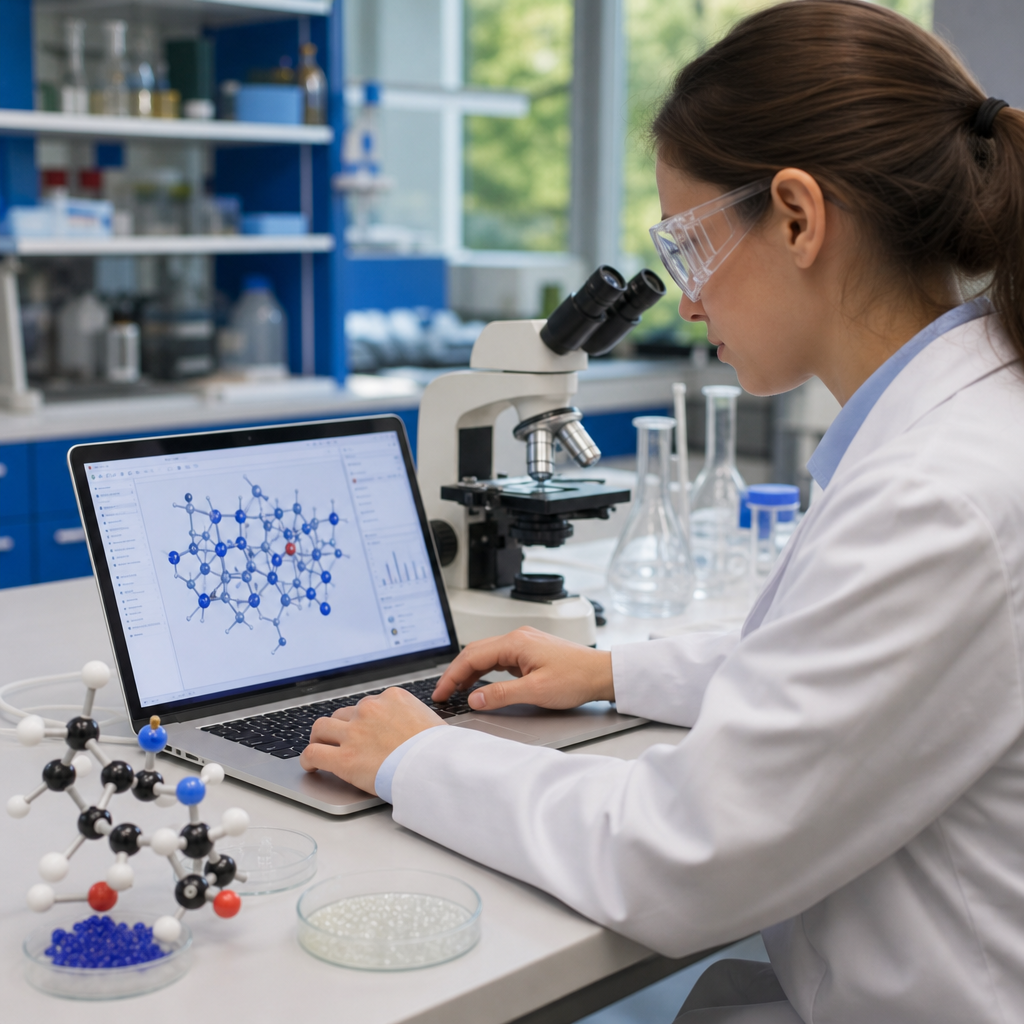
Creating and sharing polymer science content online requires more than subject knowledge. It demands clear explanations, reliable sources, formats that fit digital behavior, and a publishing workflow that turns complex chemistry into material people can actually use. In practice, polymer science content online can include articles about thermoplastics and thermosets, lab demonstrations, microscopy images, molecular structure graphics, webinars, data explainers, classroom modules, and application case studies for packaging, biomedical devices, coatings, textiles, electronics, and recycling. If the goal is education, the content must translate specialist language into accurate plain English without stripping away scientific meaning.
Polymer science is the study of macromolecules, including their synthesis, structure, properties, processing, degradation, and end uses. Online resources are digital materials that help people learn, teach, research, or apply this knowledge through websites, video platforms, repositories, newsletters, and social channels. I have seen strong polymer education projects succeed when they answer a simple question quickly: what does this material do, how is it made, and why does that matter in the real world? Readers range from undergraduates and teachers to product engineers, procurement teams, journalists, and curious general audiences. Each group needs a different level of detail, but all of them need clarity.
This topic matters because polymer science affects daily life and public policy. Plastics regulation, battery materials, membrane filtration, additive manufacturing, medical implants, and circular economy initiatives all depend on polymer literacy. Yet many online explanations remain either too technical for newcomers or too shallow for serious learners. A well-built educational hub solves that gap by organizing resources around intent: definitions for beginners, mechanisms for students, standards for professionals, and current examples for decision makers. When content is published with strong structure, credible references, and reusable visuals, it becomes easier to teach from, cite in reports, and share across classrooms, labs, and industry teams.
An effective hub page should therefore do three jobs at once. First, it should define essential concepts such as monomer, polymerization, molecular weight distribution, crystallinity, glass transition temperature, rheology, and biodegradation. Second, it should point readers toward deeper resources, including topic articles, databases, journals, standards, and learning media. Third, it should make sharing easy through accessible formatting, concise summaries, and practical examples. If you are building polymer science content online, think like an educator and an editor: decide who the content serves, what question it answers, and what evidence proves the explanation is sound.
Start with audience, scope, and learning outcomes
The best polymer science websites begin with a sharply defined audience. A first-year chemistry student needs a different introduction than a packaging engineer comparing polyethylene terephthalate and high-density polyethylene. Before drafting anything, set the reader profile, knowledge level, and desired outcome. I usually define one primary audience and two secondary audiences for each resource. For example, a page on polymer recycling may target educators first, students second, and sustainability managers third. That choice determines vocabulary, examples, and the amount of process detail included.
Scope matters just as much. Polymer science is broad, so pages that try to explain everything often explain nothing well. Build each resource around a specific question such as “What is the difference between addition and condensation polymerization?” or “How does crystallinity affect barrier properties?” Then list the concepts a reader must understand before leaving the page. These become the learning outcomes. Good outcomes are measurable: define a copolymer, compare amorphous and semicrystalline materials, identify why Tg influences product performance, or explain why chain entanglement changes viscosity.
For a hub under Educational Resources, organize content into subtopics that reflect how people search and learn. Strong categories include fundamentals, material families, testing methods, processing, sustainability, applications, career resources, and teaching tools. Each category should link to supporting articles. This internal structure helps readers navigate and signals topical depth. It also prevents duplication. Instead of repeating a full explanation of differential scanning calorimetry on every page, create one authoritative guide and link to it from pages on thermal transitions, crystallization, and quality control.
Build content around core polymer concepts and plain-language explanations
Online polymer science education works when it keeps technical precision but avoids unnecessary density. Define the scientific term first, then connect it to a familiar effect. Take glass transition temperature. A precise explanation is that Tg marks the temperature range where amorphous polymer regions shift from a glassy, rigid state to a more rubbery, mobile state. A practical explanation is that a polymer used below its Tg often feels hard and brittle, while above Tg it may become flexible or tacky. Both statements are needed because one satisfies scientific accuracy and the other helps a reader remember why the property matters.
Use named examples whenever possible. Polyethylene demonstrates simple chain architecture and broad commercial relevance. Polystyrene shows how side groups affect rigidity. Nylon helps explain condensation polymerization and hydrogen bonding. Polypropylene illustrates tacticity and crystallinity. Epoxy systems show network formation in thermosets. Polylactic acid supports discussions about biobased feedstocks, compostability limits, and processing tradeoffs. Real materials anchor abstract ideas.
Good educational pages also answer common questions directly. What is a polymer? A polymer is a large molecule made of repeating structural units called monomers. Why does molecular weight matter? Higher molecular weight often increases strength, toughness, and melt viscosity, though processing may become more difficult. What is the difference between thermoplastics and thermosets? Thermoplastics soften on heating and can often be remelted, while thermosets form crosslinked networks that do not melt after curing. Clear, direct answers improve comprehension and make the resource easier to quote in classrooms, reports, and summaries.
Use trusted sources, standards, and datasets
Accurate polymer science content depends on disciplined sourcing. Use peer-reviewed journals for mechanisms and current research, textbooks for foundational definitions, and recognized organizations for standards and terminology. Reliable references include IUPAC recommendations for nomenclature, ASTM and ISO standards for test methods, and databases such as MatWeb, PoLyInfo, and publisher platforms hosting polymer handbooks and review articles. University departments, national laboratories, and professional societies also provide dependable educational material, especially for introductory explanations and safety guidance.
When summarizing a property or performance claim, cite the context. Tensile strength, melt flow index, oxygen transmission rate, and thermal stability all depend on grade, additives, orientation, moisture, test method, and processing history. A statement like “nylon is strong” is too loose to be useful. A better explanation notes that polyamides often exhibit good strength and abrasion resistance, but moisture uptake can alter dimensions and mechanical behavior. This kind of precision builds trust and prevents readers from carrying simplified claims into design decisions.
Standards deserve special attention because they translate science into reproducible practice. If you discuss differential scanning calorimetry, tensile testing, or flammability, name the method framework where appropriate and explain why methods affect results. In my own work, content becomes much more useful when readers can connect a definition to a recognized procedure. A student learning melt flow rate should also learn that the reported value depends on temperature, load, and protocol. That link between concept and measurement is where online education becomes professionally credible.
Choose formats that match how people learn online
Different polymer topics benefit from different media. A concept like free-radical polymerization works well as a step diagram or short animated sequence. A topic like polymer recycling pathways may need a comparison table. Microscopy, fracture surfaces, spherulites, and phase separation benefit from labeled images. Processing topics such as extrusion, injection molding, blow molding, and electrospinning are easier to understand through short videos or annotated process flows than through text alone. The strongest resource hubs combine formats rather than forcing every topic into a long article.
Use this format guide when planning a polymer science content library:
| Content type | Best use in polymer science | Example topic |
|---|---|---|
| Glossary article | Definitions and quick orientation | Monomer, copolymer, Tg, Mw |
| Explainer guide | Concepts with mechanisms and examples | Crystallinity and barrier properties |
| Video or animation | Processes and reaction sequences | Injection molding cycle |
| Infographic | Comparisons and decision aids | Thermoplastics versus thermosets |
| Case study | Real-world application and tradeoffs | Selecting a polymer for medical tubing |
| Downloadable worksheet | Teaching and classroom use | Polymer identification exercise |
Accessibility should be built into every format. Add alt text to figures, captions to videos, readable contrast, and descriptive headings. Avoid uploading text as an image when a searchable paragraph will do the job better. If you publish graphs, explain the axes and the takeaway in words below the figure. Many readers skim first and study later. Good formatting lets both behaviors succeed.
Create a publishing workflow that supports quality and consistency
Consistency is what turns isolated posts into a credible educational hub. Establish an editorial workflow before publishing at scale. Start with a content brief that includes target audience, main question, learning outcomes, required sources, internal links, and planned visuals. Draft the piece with a standard structure: definition, why it matters, how it works, examples, limitations, and related resources. Then run a technical review by someone who understands the chemistry and a copy edit by someone who prioritizes clarity. This two-step review catches both scientific errors and confusing phrasing.
A style guide is especially useful in polymer science because terminology can drift. Decide how you will handle abbreviations, capitalization, units, and nomenclature. For instance, write out polyethylene terephthalate on first mention, then use PET. State units consistently, such as MPa, °C, and g/mol. Distinguish number-average molecular weight from weight-average molecular weight when needed. If you discuss biodegradability, define the environment and standard conditions instead of leaving the term ambiguous.
Publishing should not end at launch. Monitor which pages attract questions, where readers drop off, and which topics lead users to the next resource. Tools such as Google Search Console, analytics platforms, heat maps, and on-page feedback forms reveal whether an explanation is working. If a page on polymer blends receives repeated questions about compatibilizers, expand that section or create a dedicated article. The best online resource hubs improve through observation, revision, and better linking over time.
Share content strategically across channels and communities
Distribution determines whether excellent content is actually used. Share polymer science resources where educators, students, and practitioners already gather. That includes email newsletters, LinkedIn, YouTube, research group pages, professional societies, course management systems, and community forums related to materials science and chemical engineering. A long-form article can become a short video, a slide carousel, a lab handout, and a one-paragraph newsletter summary. Repurposing is not dilution when each format preserves accuracy and serves a real user need.
Context matters in outreach. A teacher may want a lesson-ready summary with discussion questions. An engineer may need a concise explanation linked to standards and property data. A sustainability team may respond best to a case study comparing mechanical recycling, chemical recycling, and material substitution. Tailor the introduction and callout points to the channel while keeping the destination page comprehensive. I have found that short posts posing a specific question, such as “Why does crystallinity improve barrier performance?” consistently outperform generic announcements because they match real curiosity.
Partnerships can extend reach without compromising quality. Universities, makerspaces, museums, standards organizations, student chapters, and industry associations often need accessible educational materials. Offer reusable assets with clear attribution terms. Invite faculty or lab specialists to review advanced topics such as rheometry, gel permeation chromatography, or dynamic mechanical analysis. Expert review improves accuracy, and co-promotion broadens visibility. Over time, this creates a stronger network around the resource hub and positions it as a dependable starting point for polymer learning online.
Creating and sharing polymer science content online is ultimately an editorial discipline built on scientific rigor. Start by defining the audience, the exact question being answered, and the learning outcomes that make the page useful. Then explain core ideas in plain language without sacrificing technical accuracy. Support claims with recognized standards, peer-reviewed sources, and context about how properties are measured. Choose formats that fit the subject, whether that means a glossary, an explainer, a process video, or a classroom worksheet. Finally, publish through a repeatable workflow and distribute through channels where educators, students, and practitioners already look for help.
The main benefit of a well-designed polymer science resource hub is that it turns scattered information into dependable learning pathways. Readers can move from definitions to mechanisms, from material families to test methods, and from theory to application without losing the thread. That structure saves time, improves understanding, and makes the content more reusable in teaching, research, and professional decision making. In a field where language, standards, and performance details all matter, thoughtful online publishing is not optional. It is the difference between content that is merely visible and content that is genuinely useful.
If you are building an Educational Resources section on Online Resources, begin with a hub page that maps the topic clearly, links to deeper articles, and answers the most common polymer questions directly. Audit your existing materials, identify gaps in fundamentals and applications, and create the next resource your audience would actually bookmark and share.
Frequently Asked Questions
1. What makes polymer science content effective online?
Effective polymer science content online combines scientific accuracy with clarity, structure, and usability. Many creators understand the chemistry well, but online readers often need information presented in a way that is easier to scan, visualize, and apply. Strong content does not simply list definitions or summarize research papers. It explains what a concept means, why it matters, where it appears in real materials or applications, and how a reader can connect it to manufacturing, product design, education, or laboratory work.
A good starting point is audience awareness. Content written for undergraduate students should not read like a technical note intended for polymer engineers, and a post for product developers should not assume the same background as a classroom explainer. When creating online material, it helps to define whether the piece is for beginners, advanced learners, teachers, researchers, or industry professionals. That decision shapes vocabulary, depth, examples, and even the type of visual support you include.
Format also matters. Polymer science often involves abstract ideas such as chain architecture, crystallinity, viscoelasticity, crosslink density, and degradation mechanisms. These topics become much easier to understand when paired with diagrams, microscopy images, annotated molecular structures, process flow charts, or short demonstrations. In digital publishing, readers respond well to content broken into sections with clear subheadings, concise paragraphs, labeled graphics, and examples tied to real materials such as polyethylene, epoxy resins, silicones, or biodegradable polymers.
Reliability is another essential factor. Effective content cites trustworthy sources, distinguishes between well-established principles and emerging findings, and avoids overstating claims about performance, sustainability, or safety. If you are discussing recyclability, barrier properties, thermal resistance, or biomedical compatibility, readers should be able to see where the information comes from and how current it is. The most useful polymer science content is both accessible and dependable, making it easier for readers to learn, share, and act on what they have read.
2. How can I explain complex polymer science topics clearly to a general online audience?
The best way to explain complex polymer science clearly is to reduce unnecessary complexity without weakening the science. That means translating technical concepts into plain language, building from familiar examples, and organizing information in a step-by-step sequence. Readers generally understand difficult topics better when you move from the visible and practical to the molecular and theoretical. For example, instead of starting with a formal definition of thermosets, you might begin by explaining that some plastics can be reheated and reshaped while others permanently harden into a stable network, then connect that behavior to molecular structure.
Analogies can help, but they need to be accurate and limited. Comparing polymer chains to cooked spaghetti, nets, coils, or woven fibers can make structure and motion easier to imagine, especially when discussing entanglement, elasticity, or crosslinking. However, it is important to follow the analogy with the real scientific explanation so readers do not leave with an oversimplified model. In polymer science, clarity comes from pairing intuitive language with precise terminology, not replacing one with the other.
Visual explanation is especially powerful. A short annotated figure showing linear chains versus crosslinked networks can often do more than several paragraphs of text. The same is true for graphs of stress-strain behavior, thermal transition diagrams, microscopy comparisons, or processing schematics. If your platform allows it, interactive images, side-by-side comparisons, and short narrated videos can make difficult material much easier to understand. Even simple design choices such as captions, arrows, labels, and highlighted keywords can improve comprehension significantly.
It also helps to define terms as they appear rather than assuming readers will pause to search for them. If you use words like amorphous, copolymer, tack, modulus, or hydrolytic degradation, explain them immediately in context. Good online teaching does not overwhelm readers with every possible detail at once. Instead, it creates a logical pathway: define the concept, show an example, explain the mechanism, then connect it to applications such as packaging, coatings, electronics, textiles, or medical devices. That approach makes polymer science content more understandable, more memorable, and more likely to be shared.
3. What types of formats work best for sharing polymer science content online?
The most effective format depends on the topic, audience, and platform, but polymer science usually benefits from a mix of text, visuals, and media. Articles are excellent for explaining concepts in depth, especially when covering topics such as polymerization methods, morphology, thermal behavior, additives, or material selection. A well-structured article can rank in search results, answer specific reader questions, and serve as a long-term reference resource.
Visual formats are especially important because polymer science often relies on structure-property relationships that are easier to show than describe. Molecular structure graphics, microscopy images, schematic process diagrams, and comparison tables work well in blog posts, slide decks, newsletters, and educational resources. If you are publishing on social platforms, short-form visual content can be highly effective. For example, a single labeled image comparing thermoplastics and thermosets, or a carousel explaining crystallinity in five steps, can make technical ideas easier for wider audiences to engage with.
Video and webinars are useful when the topic involves motion, process, or demonstration. Lab procedures, tensile testing, extrusion, solvent effects, thermal transitions, and microscopy walkthroughs often make more sense when viewers can watch rather than read. Webinars are particularly strong for advanced audiences because they allow for depth, live explanation, and audience questions. Recorded sessions can later be repurposed into clips, transcripts, blog posts, or downloadable teaching materials, making them efficient as part of a broader content workflow.
Downloadable educational formats also perform well. Classroom modules, glossaries, case studies, data explainers, and application guides can offer high value to teachers, students, and industry readers. The key is matching format to intent. If the goal is awareness, short visuals and brief explainers may be best. If the goal is trust and authority, detailed articles and source-backed guides are stronger. If the goal is deeper engagement, webinars, tutorials, and multi-part learning resources are often the most effective. A diversified format strategy allows polymer science content to reach people in the form they are most likely to use.
4. How do I make polymer science content credible, accurate, and trustworthy?
Credibility in polymer science content starts with careful sourcing and disciplined communication. Readers need to know that the information is based on established principles, reputable research, or practical industry knowledge rather than unsupported claims. The best practice is to rely on peer-reviewed journal articles, textbooks, standards organizations, university publications, technical data sheets, and recognized professional bodies. When possible, link directly to primary or high-quality secondary sources so readers can verify details for themselves.
Accuracy also depends on precision in wording. In polymer science, small differences in terminology can change meaning significantly. For example, biodegradable does not automatically mean compostable, recyclable does not guarantee that infrastructure exists to recycle a material, and heat-resistant can refer to very different performance levels depending on use conditions. Clear content avoids broad statements that flatten important distinctions. Instead, it explains conditions, limitations, and context. If a polymer performs well chemically but poorly under UV exposure, or if a processing advantage comes with mechanical tradeoffs, that nuance should be part of the content.
Another way to build trust is to separate explanation from promotion. If you are discussing a product, resin family, additive package, or commercial process, readers should be able to tell what is educational information and what is marketing. Transparent disclosure helps preserve authority. It is also helpful to include dates or note when information may change, especially in fast-moving areas such as polymer sustainability, advanced recycling, bio-based materials, and regulatory compliance.
Finally, trustworthy content is carefully reviewed. If possible, have subject matter experts check technical explanations before publication. A strong editorial process catches ambiguous phrasing, unsupported conclusions, inconsistent units, and oversimplified comparisons. Even small details such as correct chemical names, test method references, scale bars on images, or proper labeling of thermal transitions can influence credibility. Over time, consistently accurate and well-sourced polymer science content builds authority, improves audience confidence, and increases the likelihood that your work will be cited, shared, and revisited.
5. What is the best workflow for creating and publishing polymer science content consistently?
A consistent workflow begins with planning content around audience needs and recurring themes. Rather than creating posts one at a time without a system, it is more effective to build a content pipeline. Start by identifying core categories relevant to your goals, such as fundamentals, material comparisons, testing methods, processing techniques, sustainability, applications, and educational resources. From there, develop topic ideas based on search intent, common questions, classroom needs, industry pain points, or gaps in existing coverage.
Once a topic is selected, gather source material before drafting. That may include journal references, standards, lecture notes, technical papers, product literature, lab images, or internal expertise. During drafting, structure the content for online reading by using clear headings, short sections, and a logical progression from basic explanation to practical relevance. For polymer science, it is often useful to include a definition section, a mechanism or structure section, a real-world example section, and a limitations or considerations section. This makes the content easier to navigate while still preserving