How to get started with polymer science research begins with understanding what polymer science actually covers, where the field touches daily life, and which courses and training programs build the fastest path from curiosity to competent lab work. Polymers are large molecules made of repeating units called monomers, and they include commodity plastics, biomedical hydrogels, coatings, elastomers, membranes, adhesives, composites, and high-performance materials used in aerospace and electronics. Research in this area spans synthesis, characterization, processing, modeling, sustainability, and product design. In practice, that means a student may spend one week learning step-growth polymerization kinetics, the next week running differential scanning calorimetry, and the week after analyzing tensile data or reading standards from ASTM and ISO.
This topic matters because polymer science sits at the center of major industrial and societal challenges. Packaging needs barrier materials with lower environmental impact. Energy systems need better separators, binders, and ion-conducting membranes. Medicine depends on resorbable sutures, controlled-release formulations, and tissue scaffolds. Manufacturing needs lighter, stronger, more durable materials that can still be processed at scale. I have seen new researchers enter the field believing polymer work is mostly plastics processing, then quickly realize that successful research draws equally from chemistry, physics, engineering, and data analysis. A clear education roadmap saves time, prevents avoidable safety mistakes, and helps students choose courses and training programs that match the kind of research they want to do.
For an educational resources hub, the most useful approach is to organize learning around research readiness. That means identifying the foundational subjects, the hands-on lab skills, the instrumentation training, the computational tools, and the professional development experiences that move someone from classroom knowledge to publishable work. It also means understanding the tradeoffs among degree programs, online certificates, short courses, workshops, and mentored research placements. Some pathways are ideal for future PhD candidates, while others fit technicians, product developers, quality specialists, or cross-disciplinary scientists entering from chemical engineering, materials science, or biomedical engineering. The sections below explain what to study first, which training formats matter most, and how to turn coursework into polymer science research capability.
Build the Core Knowledge Base First
The strongest start in polymer science research comes from mastering five academic foundations: general chemistry, organic chemistry, physical chemistry, materials science, and statistics. General chemistry establishes bonding, thermodynamics, and solution behavior. Organic chemistry matters because polymer synthesis depends on functional groups, reaction mechanisms, stereochemistry, and purification logic. Physical chemistry provides kinetics, phase behavior, diffusion, and thermodynamic models such as Flory-Huggins theory, which helps explain polymer mixing and solubility. Materials science adds structure-property-processing relationships, while statistics supports design of experiments, uncertainty analysis, and reproducibility. Students who skip one of these pillars usually struggle later when interpreting molecular weight distributions, glass transitions, or rheology curves.
Math and computation are equally important. At minimum, a beginner should be comfortable with calculus, basic differential equations, spreadsheets, and one scientific programming environment such as Python or MATLAB. In my experience, students who can script simple data cleaning and plotting routines become productive much faster because characterization instruments often export noisy, imperfect datasets. Learning to fit calibration curves, compare replicate runs, and document assumptions is part of research training, not an optional add-on. A beginner also benefits from exposure to polymer nomenclature, including number-average molecular weight, weight-average molecular weight, dispersity, tacticity, crystallinity, viscoelasticity, and crosslink density. These terms appear immediately in papers, lab meetings, and course assignments.
When choosing courses and training programs, look for sequences rather than isolated classes. A strong undergraduate or bridge pathway usually includes introductory polymer science, polymer chemistry, polymer physics, characterization methods, transport phenomena, and a laboratory module. If your institution lacks a dedicated polymer major, combine electives from chemistry, chemical engineering, and materials science. Massachusetts Amherst, Akron, MIT, Cornell, Georgia Tech, and ETH Zurich are examples of institutions known for strong polymer-related teaching or research environments, but many excellent regional universities offer practical preparation through materials laboratories and industry-linked capstone projects. The exact institution matters less than whether the curriculum builds conceptual depth and repeated contact with real materials, real instruments, and real scientific writing.
Choose Courses and Training Programs That Match Research Goals
Not all polymer science research careers require the same training. A student interested in synthetic methodology needs deeper coursework in reaction design, catalysis, and spectroscopy. Someone aiming at polymer processing and manufacturing needs rheology, extrusion, injection molding, and quality control. A biomaterials path should include cell-material interactions, surface science, regulatory concepts, and sterile technique. Sustainability-focused researchers need polymer recycling, life-cycle assessment, green chemistry, and circular materials systems. The right question is not simply, “What is the best polymer science course?” It is, “Which program builds the methods, instruments, and domain knowledge used in the research area I want to enter?”
Short courses and certificates can accelerate entry, especially for working professionals or students from adjacent fields. The ACS often lists continuing education options relevant to polymers. ASM International, SPE, and materials characterization vendors also offer workshops on thermal analysis, spectroscopy, microscopy, and processing. Online programs can help with fundamentals, but they cannot replace hands-on training in sample preparation, instrument calibration, contamination control, or safe handling of solvents and initiators. The best hybrid model pairs online theory with in-person laboratories, summer schools, or supervised internships. In hiring and graduate admissions, evidence of practical experience still carries exceptional weight.
| Goal | Best Course Mix | Useful Training Formats | Common Early Research Output |
|---|---|---|---|
| Polymer synthesis | Organic chemistry, polymer chemistry, spectroscopy | Research lab rotation, NMR workshop, safety training | Monomer synthesis, reaction optimization, SEC analysis |
| Polymer physics | Physical chemistry, thermodynamics, polymer physics | DSC/DMA training, data analysis bootcamp | Phase behavior study, thermal transitions report |
| Processing and manufacturing | Rheology, transport, materials processing | Extrusion lab, industry internship | Viscosity mapping, process-property correlations |
| Biomaterials | Biomaterials, surface science, bioengineering | Cell culture module, cleanroom or sterile lab training | Hydrogel characterization, biocompatibility screening |
| Sustainable polymers | Green chemistry, recycling, life-cycle assessment | Recycling workshop, policy seminar, characterization lab | Degradation study, recycled blend performance data |
For this educational resources hub, it helps to think of training in layers. First come foundational courses. Next come method-specific modules such as spectroscopy, thermal analysis, and rheology. Then come applied experiences: lab rotations, undergraduate research, internships, co-ops, and graduate seminars. Finally, there are professional skill programs covering literature review, scientific communication, ethics, and project management. Students often underestimate the last layer, yet it is usually the difference between completing experiments and completing credible research. A well-run program teaches not only how to make or test a polymer, but also how to maintain notebooks, store data, cite prior work, and defend conclusions under questioning.
Learn the Essential Laboratory and Instrument Skills
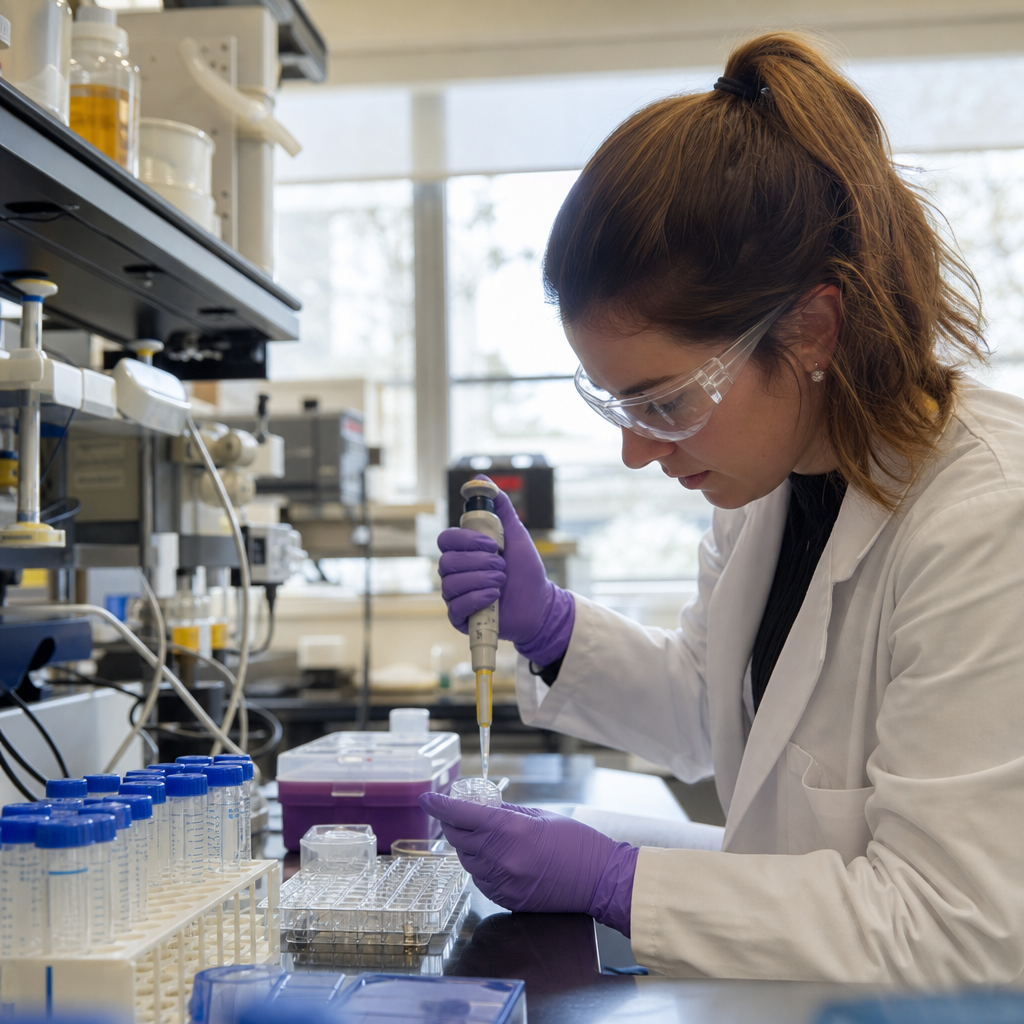
Polymer science research becomes real when students start handling materials, preparing samples, and interpreting instrument output. The essential skill set includes weighing and mixing, solution preparation, inert atmosphere techniques when needed, purification, film casting, curing, molding, and specimen cutting. Beginners should also learn drying protocols, solvent compatibility, contamination risks, and traceability practices such as lot numbering and sample labeling. In polymer labs, small preparation errors can produce misleading thermal or mechanical results. A sample that absorbed moisture overnight may show a shifted glass transition. An incompletely removed solvent can distort mass loss in thermogravimetric analysis. Reproducibility starts long before the instrument turns on.
The core characterization tools in most polymer programs are Fourier-transform infrared spectroscopy, nuclear magnetic resonance, size exclusion chromatography, differential scanning calorimetry, thermogravimetric analysis, dynamic mechanical analysis, tensile testing, rheometry, optical microscopy, scanning electron microscopy, and contact angle measurement. Each answers a different research question. FTIR confirms functional groups. NMR supports structural assignment and conversion estimates. SEC measures molecular weight distribution. DSC identifies thermal transitions such as glass transition and melting. TGA shows thermal stability and volatile content. DMA measures temperature-dependent viscoelastic behavior. Rheometry reveals processability and network formation. SEM helps visualize fracture surfaces, porosity, or phase separation. The key training issue is not memorizing definitions, but knowing which technique answers which question and what artifacts can mislead interpretation.
Good courses and training programs make students practice complete analytical workflows. For example, a characterization module might ask whether a newly synthesized copolymer actually formed, whether its composition changed mechanical behavior, and whether thermal stability remained acceptable. Students would then choose FTIR or NMR for composition, SEC for molecular weight, DSC and DMA for thermal-mechanical response, and tensile testing for end-use relevance. That integrated approach mirrors real research. In my own lab experience, the students who advanced fastest were not the ones who knew the most instrument menus; they were the ones who linked synthesis decisions to analytical evidence and could explain why one dataset confirmed or contradicted another.
Develop Research Habits That Universities and Industry Expect
Successful polymer science researchers are trained as much by habits as by courses. A rigorous notebook is nonnegotiable. Record reagent sources, batch numbers, exact masses, mixing times, temperatures, purification steps, instrument settings, calibration dates, and unexpected observations. Save raw files, not just final plots. Version-control scripts and label datasets consistently. If a sample cracks during demolding or changes color during curing, write it down immediately. These details often explain outliers later. Universities, national labs, and industrial R&D groups all value students who can reconstruct an experiment weeks later without guessing.
Literature reading is another trainable skill. Start with review articles from journals such as Progress in Polymer Science, Macromolecules, Biomacromolecules, Polymer, ACS Macro Letters, and Journal of Applied Polymer Science. Then move to recent primary papers and read them strategically: problem statement, methods, characterization, and limitations. New researchers often focus only on successful results, but the best learning comes from asking why authors chose a specific initiator, curing schedule, solvent, or test standard. Citation mapping helps too. Find the paper everyone references for a method, then read that original source. This builds technical judgment and prevents shallow repetition of common claims.
Formal training in safety, ethics, and standards is essential. Polymer labs use flammable solvents, reactive monomers, peroxide initiators, vacuum ovens, heated presses, UV sources, cryogens, and rotating equipment. Good programs teach hazard communication, SDS use, waste segregation, fume hood practice, glove selection, and emergency response before independent work begins. They also cover data integrity and image handling. From a technical standpoint, exposure to ASTM or ISO testing methods matters because polymer properties are highly sensitive to specimen geometry, conditioning, strain rate, and thermal history. A tensile strength value without method details is often meaningless. Students who understand standards produce data that other researchers can trust and compare.
Turn Coursework into Real Research Experience
The fastest way to start polymer science research is to pair coursework with mentored projects as early as possible. Undergraduate research assistantships, summer research experiences, co-op programs, and capstone labs convert abstract concepts into problem-solving ability. A student who learned polymerization mechanisms in class may discover in the lab that oxygen inhibition ruins a free-radical curing experiment, or that a beautifully designed copolymer is impossible to characterize well without better purification. Those moments are not setbacks; they are the beginning of research thinking. They teach troubleshooting, iteration, and humility before the data.
If you are building a path through courses and training programs, prioritize experiences that produce a tangible artifact. That could be a poster, a literature review, a validated standard operating procedure, a reproducible dataset, or a small coauthored paper. These outputs prove readiness better than course titles alone. They also help when applying for graduate school or technical roles. In admissions and hiring discussions, I have repeatedly seen candidates stand out because they could clearly explain one complete project: the question, the method, the failures, the controls, the final interpretation, and the next experiment they would run.
Finally, treat this educational resources hub as a launch point, not a checklist. The best starting plan is simple: complete the core science sequence, add a dedicated polymer course, enroll in at least one characterization lab, obtain safety certification, join a research group or internship, and build fluency in data analysis and technical reading. From there, specialize based on interest in synthesis, physics, processing, biomaterials, or sustainability. Polymer science rewards structured preparation because the field is broad, interdisciplinary, and deeply practical. Choose courses and training programs that combine theory with repeated lab exposure, and you will enter research able to ask better questions, generate better data, and contribute meaningfully. Start by mapping your next two semesters and contacting one polymer-focused lab this week.
Frequently Asked Questions
What is polymer science, and why is it such an important field to study?
Polymer science is the study of large molecules made from repeating building blocks called monomers, along with the way those molecules are designed, synthesized, processed, characterized, and used in real products. It sits at the intersection of chemistry, materials science, physics, engineering, and even biology, which is one reason it is such an exciting area for new researchers. When you begin learning how to get started with polymer science research, it helps to understand that the field is not limited to “plastics” in the everyday sense. It also includes hydrogels for drug delivery, elastomers for tires and seals, coatings that protect buildings and devices, membranes for water purification, adhesives, fibers, biomedical implants, composites, and high-performance materials used in aerospace and electronics.
The importance of polymer science comes from how deeply polymers shape modern life. Packaging, medical devices, smartphones, automotive components, sports equipment, textiles, paints, and renewable energy technologies all rely on polymers with carefully engineered properties. Researchers in this field work on improving strength, flexibility, thermal stability, conductivity, barrier performance, recyclability, and biocompatibility. They also address urgent global challenges such as plastic waste, sustainable feedstocks, circular materials design, and lower-energy manufacturing. For a student or early-career researcher, polymer science offers a rare combination of strong scientific fundamentals and immediate real-world relevance. That makes it a practical, high-impact place to begin a research journey.
What background knowledge do I need before starting polymer science research?
A strong starting foundation usually includes general chemistry, organic chemistry, physical chemistry, and basic physics, because polymer behavior depends on molecular structure, thermodynamics, kinetics, and mechanics. Mathematics is also useful, especially algebra, calculus, and some statistics, since research often involves data analysis, modeling, and interpretation of experimental results. If you have access to materials science or chemical engineering coursework, those subjects are particularly helpful because they connect molecular design to processing and performance. Biology can also become important if your interests lean toward biomaterials, tissue engineering, or drug delivery systems.
Beyond coursework, it is important to build conceptual fluency in a few core polymer topics. These include polymerization methods such as step-growth, chain-growth, radical, ionic, and controlled or living polymerization; structure-property relationships; molecular weight and molecular weight distribution; glass transition and melting behavior; crystallinity; viscoelasticity; phase behavior; and degradation mechanisms. You do not need to master every concept before entering a lab, but you should be comfortable learning how molecular architecture affects material properties. For example, branching, crosslinking, tacticity, copolymer composition, and chain length can dramatically change how a polymer performs.
Just as important is developing practical scientific literacy. Learn how to read journal articles, keep a lab notebook, analyze figures, and ask clear technical questions. If possible, become familiar with common characterization techniques such as NMR spectroscopy, FTIR, DSC, TGA, GPC or SEC, rheology, tensile testing, microscopy, and X-ray methods. Even a basic understanding of what these tools measure will make your transition into lab work much smoother. In most cases, curiosity, consistency, and a willingness to learn are more important at the beginning than already being an expert.
Which courses, training programs, or learning paths are best for getting started quickly?
If your goal is to move from curiosity to competent early-stage lab work as efficiently as possible, the fastest path is usually a structured mix of core coursework, lab exposure, and targeted technical training. At the undergraduate level, the most useful courses are polymer chemistry, materials science, organic chemistry, analytical chemistry, physical chemistry, and transport or thermodynamics if you are in engineering. For students in chemical engineering, courses in reaction engineering, materials processing, and mechanics of materials can be especially valuable. If your institution offers a dedicated polymer science or macromolecular science class, that should be a top priority because it introduces the vocabulary and logic of the field in a focused way.
Outside traditional degree programs, short courses, certificate programs, summer research experiences, and online modules can accelerate your progress. Many universities, professional societies, and research centers offer workshops in polymer characterization, spectroscopy, thermal analysis, rheology, and cleanroom or instrumentation safety. These are useful because polymer research is often tool-driven; knowing how to prepare samples, run instruments, and interpret data makes you valuable in a lab much sooner. If you are deciding between broad theory and hands-on training, try to combine both. A student who understands the basics of polymer structure and can also operate DSC, prepare thin films, or analyze GPC traces is in a strong position.
Another efficient learning path is to join a research group early, even in a volunteer or assistant role, and let your coursework support what you are seeing in practice. This creates a feedback loop: class concepts become easier to understand when you observe them in experiments, and experiments become more meaningful when you know the theory behind them. Reading review articles, attending departmental seminars, and following current topics such as recyclable polymers, battery materials, membranes, or biomedical hydrogels can also help you identify a specialization. The best path is not necessarily the one with the most classes, but the one that blends fundamentals, mentorship, and repeated exposure to real research problems.
What does beginner-level polymer science research actually look like in the lab?
Beginner-level polymer science research often starts with learning lab fundamentals rather than immediately designing entirely new materials from scratch. You may begin by reproducing a known polymer synthesis, preparing standard formulations, fabricating films or coatings, or characterizing samples made by more experienced researchers. This stage is extremely valuable because it teaches precision, repeatability, and the importance of controlled variables. In polymer work, small differences in temperature, solvent choice, reaction time, mixing speed, humidity, purification, or sample history can lead to major differences in results. A new researcher learns quickly that careful technique is just as important as creativity.
In a typical project, you might synthesize a polymer, purify it, and then confirm its structure and molecular weight using tools such as NMR and GPC. From there, you may examine thermal behavior with DSC or TGA, measure mechanical performance through tensile testing or DMA, study flow behavior with rheology, or inspect morphology using microscopy. If the project involves biomaterials, you might also assess swelling, degradation, biocompatibility, or controlled release behavior. If it involves coatings or membranes, you may evaluate adhesion, permeability, chemical resistance, or surface properties. These tasks help you understand that polymer research is not only about making molecules, but also about connecting chemistry to function.
Early lab work also includes learning safety culture, waste handling, instrument etiquette, data organization, and troubleshooting. Polymers are often studied using solvents, reactive monomers, initiators, or high-temperature processes, so safe habits matter from the beginning. You will also spend time reading protocols, comparing your results to literature values, and discussing unexpected outcomes with your advisor or lab mates. That is normal. Research is rarely linear, and polymer systems can be especially complex. The real milestone for a beginner is not perfection; it is learning how to generate reliable data, interpret it honestly, and steadily improve experimental judgment.
How can I choose a research area in polymer science and prepare for long-term success?
The best way to choose a polymer science research area is to look at the kinds of problems that genuinely hold your attention. Polymer science is broad enough that different personalities thrive in different niches. If you enjoy synthesis and molecular design, you may be drawn to creating new monomers, copolymers, or dynamic covalent networks. If you prefer structure-property relationships, characterization-heavy work involving spectroscopy, thermal analysis, or scattering techniques may suit you well. If you are motivated by applications, you might focus on biomaterials, sustainable packaging, soft robotics, energy storage, water treatment membranes, composites, or electronics. There is no single correct entry point; the right choice is the one that keeps you engaged enough to persist through the inevitable challenges of research.
To prepare for long-term success, pay close attention to mentorship, lab environment, and the quality of training opportunities. A supportive advisor and a well-run group can dramatically influence your growth. Look for research settings where students are taught not only how to perform experiments, but also how to think critically, read the literature, present data, and write clearly. Polymer science rewards people who can connect disciplines, so try to develop both depth and range. Become strong in one area, such as synthesis or characterization, but stay literate in processing, mechanics, sustainability, and application needs. This versatility makes you more effective in both academic and industrial settings.
It is also wise to build professional habits early. Read papers regularly, attend seminars, ask thoughtful questions, maintain a detailed lab notebook, and learn how to present negative or ambiguous results honestly. Network with graduate students, postdocs, professors, and industry scientists whenever possible. Internships, conferences, and collaborative projects can reveal how polymer research differs across academia, manufacturing, healthcare, and advanced technology sectors. Over time, successful researchers are not just the ones with technical skills, but the ones who combine scientific rigor, curiosity, resilience, and communication. If you start with that mindset, polymer science can offer a deeply rewarding path with strong opportunities for impact and career growth.</