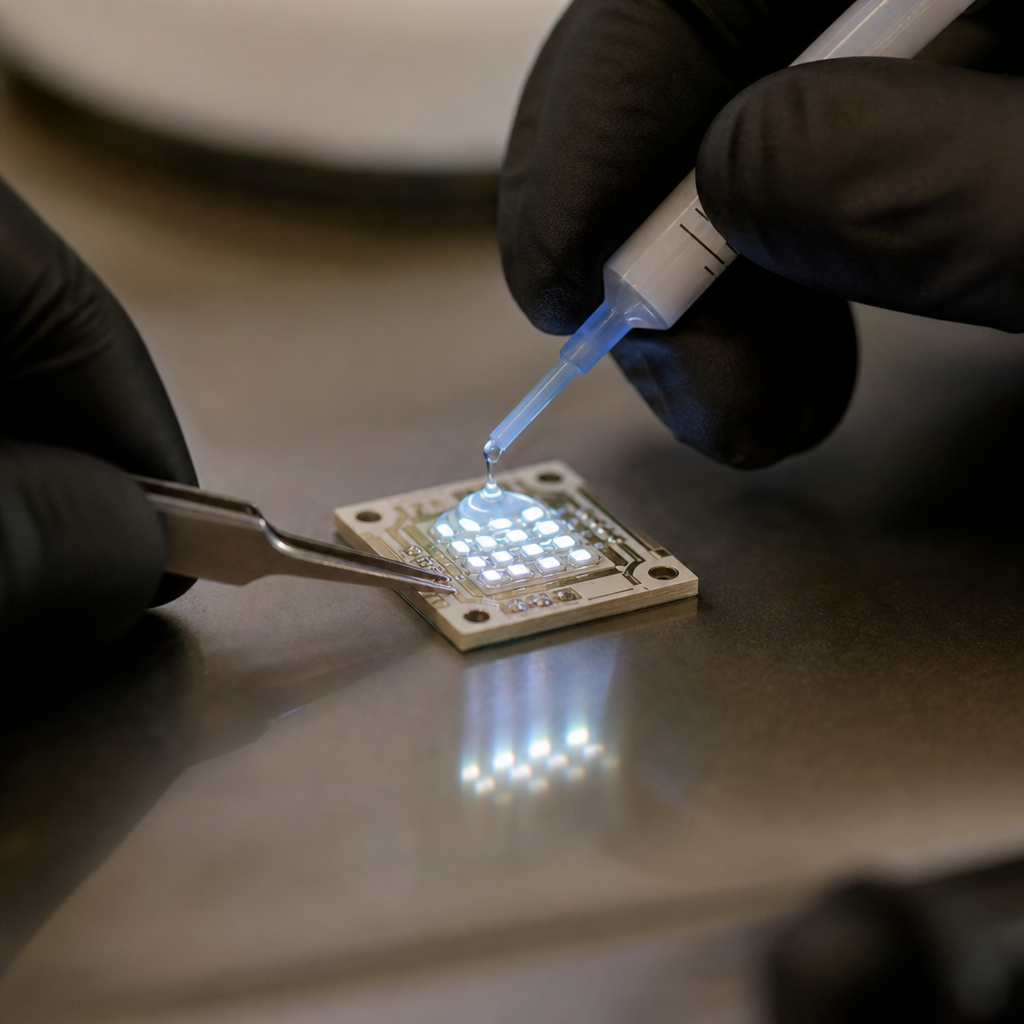
Light-emitting diodes have become the default lighting and display technology because they convert electricity into visible light with far less waste than incandescent or fluorescent systems, and polymers play a central role in making that efficiency possible. In electronics, polymers are large molecules engineered to deliver specific optical, thermal, electrical, and mechanical properties, from transparent encapsulants and phosphor binders to conductive transport layers and flexible substrates. When people ask how polymers improve the efficiency of LEDs, the practical answer is straightforward: the right polymer helps more generated photons escape, protects sensitive semiconductor materials from oxygen and moisture, manages heat and stress, and allows precise thin-film processing at commercial scale. I have worked with LED packaging teams evaluating silicone, epoxy, polyimide, and conductive polymer systems, and the performance differences are not subtle. A poor polymer choice can yellow, crack, delaminate, absorb blue light, or trap heat; a good one can preserve lumen output for thousands of hours while improving color quality and manufacturing yield. This matters well beyond lamps. The same materials decisions influence phone screens, automotive headlamps, medical devices, signage, horticultural lighting, and wearable electronics. As a hub page for polymers in high-tech and electronics, this article explains the mechanisms, the main polymer classes, the design tradeoffs, and the application case studies that connect materials science to real LED efficiency gains.
Why LED Efficiency Depends on Materials Around the Chip
An LED chip generates light in a semiconductor junction, but system efficiency is never determined by the semiconductor alone. Engineers usually separate performance into internal quantum efficiency, which describes how effectively electrons and holes create photons, and external quantum efficiency, which measures how many of those photons actually leave the device. Polymers primarily improve the second number, though some also support better electrical balance in advanced structures. A high-refractive-index encapsulant reduces total internal reflection at the chip interface, allowing more light extraction. A low-absorption matrix around phosphor particles minimizes conversion losses in white LEDs. A mechanically compliant package material reduces stress on wire bonds and solder joints during thermal cycling, which protects long-term output. In manufacturing, polymer processability also matters because consistent dispensing, curing, film thickness, and adhesion translate directly to lower defect rates.
Consider a common white LED built from a blue gallium nitride die plus a yellow phosphor. If the binder holding the phosphor absorbs blue wavelengths, yellows under heat, or develops microcracks, light output drops and color shifts. If the lens material has poor UV stability, outdoor fixtures lose transmission over time. If moisture penetrates to the chip or silver reflector, corrosion increases electrical resistance and lowers output. That is why polymer selection is treated as a performance decision, not just a packaging detail. In practice, the best LED packages combine optics, barrier performance, thermal endurance, and manufacturability in one carefully tested polymer system.
Key Polymer Functions in LED Packages and Modules
In conventional LED packaging, polymers do four jobs at once. First, they shape light. Encapsulants, primary lenses, secondary optics, and optical adhesives determine transmission, scattering, and beam control. Second, they protect the device. Barrier coatings and molding compounds limit oxygen, water vapor, ionic contamination, and abrasion. Third, they handle mechanical loads. During operation, LEDs cycle between room temperature and elevated junction temperatures, and polymers absorb differential expansion between ceramic, metal, glass, and semiconductor parts. Fourth, they support manufacturing. Many LED production lines depend on fast-curing, dispensable, screen-printable, spin-coatable, or roll-to-roll compatible polymers.
Different polymer families serve these functions in different ways. Epoxies were widely used in early indicator LEDs because they were inexpensive and easy to mold, but they tend to yellow under high flux and heat, so high-power lighting shifted strongly toward silicones. Polyimides are valued where thermal endurance and dielectric performance are critical, especially in flexible circuits and insulation layers. Conductive polymers such as PEDOT:PSS appear in organic LEDs and some hybrid electronic stacks because they help with hole injection and layer uniformity. Fluoropolymers and acrylics show up in films, coatings, and optics where chemical resistance or surface properties matter. The common thread is that polymer chemistry can be tuned more easily than brittle inorganic materials, which gives engineers a broad design window.
How Optical Polymers Increase Light Extraction
Light extraction is one of the clearest ways polymers improve LED efficiency. Gallium nitride has a refractive index much higher than air, so photons generated inside the chip tend to reflect back internally instead of escaping. By surrounding the die with an encapsulant whose refractive index is closer to that of the semiconductor, engineers reduce reflection losses. Silicones are especially valuable here because optical-grade formulations combine high transparency with refractive indices commonly around 1.4 to 1.5, low stress, and strong resistance to discoloration. Lens geometries molded from these materials further improve extraction by redirecting trapped rays toward useful angles.
Surface texture and scattering control also matter. Some packages use polymer domes, diffusers, or microstructured films to smooth angular output and reduce visible hotspots without sacrificing too many lumens. In display backlights and luminaires, remote phosphor plates often use polymer matrices to create more uniform color conversion and better thermal separation from the hot chip. I have seen line upgrades where replacing a lower-grade epoxy lens with a high-transmission silicone package improved lumen maintenance enough to justify the material cost within one product generation. The gain does not always appear as a dramatic initial efficacy jump; often the real benefit is preserving optical transmission after long exposure to blue light, heat, and humidity.
Conductive and Semiconductive Polymers in Advanced LEDs
Not all LED polymers are passive packaging materials. In organic light-emitting diodes, polymers can function directly in charge transport and emission stacks. Conductive polymers such as PEDOT:PSS are used as hole transport or hole injection layers because they provide a smooth, solution-processable interface between electrodes and emissive materials. That smoothness reduces pinholes and helps distribute current more evenly, which improves device efficiency and lifetime. Polyfluorenes, poly(p-phenylene vinylene) derivatives, and other conjugated polymers have also been developed as emissive materials in polymer LEDs, particularly for displays and specialty applications.
The mechanism is different from inorganic high-power LEDs, but the efficiency logic is similar: better charge balance means more injected carriers recombine radiatively instead of being lost through heat-generating pathways. Polymer layers also support low-temperature fabrication on flexible substrates, which is why OLED displays in phones, smartwatches, and foldable devices rely heavily on polymer-compatible process integration. The limitation is that many organic systems are highly sensitive to moisture and oxygen, so their efficiency gains depend on equally sophisticated barrier films and encapsulation strategies. In other words, one polymer improves charge transport, while another protects the entire stack from degradation.
Thermal Stability, Reliability, and Lumen Maintenance
LED buyers often focus on initial lumens per watt, but field efficiency is really about lumen maintenance over time. A lamp that starts strong and drops quickly is not efficient in practical use. Polymers influence this through thermal stability and aging resistance. High-power LEDs operate with junction temperatures that can exceed 100 degrees Celsius in demanding fixtures. At those conditions, some polymers embrittle, outgas, yellow, or lose adhesion. Optical silicones generally outperform traditional epoxies in high-flux packages because they retain clarity and elasticity at elevated temperatures. Polyimides perform well in flexible circuitry and insulation because they tolerate heat that would deform many commodity plastics.
Reliability engineers usually validate these materials using standards-based tests such as temperature-humidity bias, high-temperature operating life, thermal shock, and ultraviolet exposure. Failures are often polymer-related even when the chip remains electrically intact. A reflector cup resin can darken. A phosphor binder can crack. A conformal coating can let in ionic contaminants that corrode metal contacts. In automotive LEDs, where vibration, road salt, and wide temperature swings are common, those failure modes directly affect light output and safety. That is why reputable suppliers publish data on transmittance retention, yellowness index, coefficient of thermal expansion, and water absorption rather than relying on generic plastic classifications.
Comparing Polymer Types Used in LED Systems
The table below summarizes how major polymer families are used across LED and electronics applications.
| Polymer type | Typical LED role | Main efficiency benefit | Main limitation |
|---|---|---|---|
| Silicone | Encapsulant, lens, phosphor binder | High optical clarity, low yellowing, good heat resistance | Higher cost, softer surface than some resins |
| Epoxy | Legacy encapsulant, adhesive, molding compound | Low cost, easy processing, strong adhesion | Can yellow and crack under heat or blue/UV exposure |
| Polyimide | Flexible circuit substrate, dielectric layer, insulation | Excellent thermal stability and dimensional control | Usually not the first choice for primary optical paths |
| PEDOT:PSS and related conductive polymers | Hole transport or injection layer in OLEDs | Better charge balance and smooth film formation | Sensitive to moisture, acidity can affect adjacent layers |
| Acrylic and fluoropolymer films | Optical films, coatings, protective layers | Good transmission, tunable surface properties, weather resistance | Property set varies widely by formulation |
Case Studies Across High-Tech and Electronics Applications
In general lighting, the switch from epoxy to silicone encapsulants was a major practical step in enabling high-brightness white LEDs. Early packages could deliver acceptable performance for indicators, but as drive currents increased, yellowing and optical decay became unacceptable. Silicone systems improved lumen maintenance and allowed more aggressive thermal operation. In automotive headlamps, polymer lenses and optical adhesives must survive heat from densely packed arrays while maintaining beam precision. Manufacturers therefore combine heat-resistant silicones with carefully stabilized thermoplastics and coatings to prevent haze, cracking, and photodegradation.
Displays provide another instructive example. In OLED panels, multiple polymer-related layers contribute to efficiency: planarization materials create smooth surfaces, conductive polymers aid charge injection, and ultra-barrier encapsulation protects oxygen-sensitive organic emitters. Flexible displays would be far less practical without polymer substrates and thin-film barrier stacks that bend without catastrophic cracking. In horticultural lighting, where fixtures may run for long periods in humid environments, polymer seals and conformal coatings help maintain photon output and electrical safety. In medical electronics, UV-curable optical adhesives are used to bond compact light engines and sensors with tight alignment tolerances. Across these case studies, the material choice is rarely about one property alone. Efficiency improves when optical, chemical, and mechanical performance are balanced for the actual use environment.
Design Tradeoffs Engineers Must Manage
No polymer is ideal in every LED design. Higher refractive index may improve extraction but can come with higher absorption or more difficult processing. Softer silicones relieve stress well, yet they may attract dust or require harder top coatings in exposed optics. Epoxies bond strongly and are economical, but long-term optical stability can be poor in high-power blue or ultraviolet devices. Conductive polymers can simplify solution processing, but their interfaces must be tuned carefully to avoid unwanted reactions, work-function mismatch, or moisture-driven degradation.
Cost and manufacturing speed also shape efficiency in the real world. A material that delivers the best optical results in the lab may be rejected if it cures too slowly, requires narrow humidity control, or creates low dispensing yield. I have seen package teams choose a slightly less transmissive encapsulant because its viscosity control cut void defects enough to improve overall shipped performance. Sustainability adds another layer. Some electronics brands now assess halogen content, solvent use, recyclability, and repairability alongside optical metrics. The right decision is therefore application-specific. For a streetlight, lifetime and weathering dominate. For a foldable display, flexibility and barrier integrity dominate. For a low-cost indicator, legacy resins may still be adequate.
Future Directions for Polymers in LED Efficiency
The next wave of improvement will come from more specialized polymer formulations rather than one universal material replacing all others. In microLED displays, transfer accuracy, sidewall protection, and mass repair all create opportunities for advanced photo-patternable polymers, low-stress adhesives, and ultra-thin optical layers. In quantum dot conversion systems, polymer matrices must control oxygen exposure, particle dispersion, and blue-light stability without reducing color purity. Nanocomposite polymers that incorporate ceramic or silica fillers are being developed to improve thermal conductivity while keeping electrical insulation and processability. Self-healing coatings, lower-permeation barriers, and higher-index transparent silicones are also active areas of development.
For manufacturers and buyers, the practical lesson is simple. Treat polymers as functional performance materials, not commodity fillers around the real electronics. In LEDs, they directly influence light extraction, color stability, reliability, manufacturability, and total cost of ownership. The most efficient device is not just the one with the best chip; it is the one whose polymer system keeps that chip delivering usable light for years in its actual environment. If you are building a materials strategy for high-tech and electronics applications, start by mapping each polymer to a failure mode, an efficiency target, and a service condition. That approach leads to better specifications, better products, and better long-term energy performance.
Frequently Asked Questions
How do polymers improve the overall efficiency of LEDs?
Polymers improve LED efficiency by solving several performance challenges at once. In an LED package or device stack, the goal is not only to generate light efficiently at the semiconductor junction, but also to extract that light, preserve it, and maintain stable operation over time. Polymers help at each of these stages. Transparent polymer encapsulants protect the chip while allowing a high percentage of generated light to pass through. Carefully engineered polymers can also reduce optical losses by matching refractive indices more effectively than air gaps or poorly suited materials, which helps more photons escape instead of being trapped inside the device.
They also contribute to thermal and mechanical reliability, which has a direct effect on efficiency. Excess heat lowers LED performance, accelerates material degradation, and can shift color output. Polymer materials used in adhesives, coatings, and substrates can be formulated for thermal stability, flexibility, and stress relief, reducing cracking, delamination, and other failures that would otherwise degrade luminous efficacy. In advanced LED architectures such as OLEDs and printed or flexible LEDs, conductive and semiconductive polymers can even serve as transport layers that improve charge balance, meaning electrons and holes recombine more effectively to produce light instead of generating waste heat. In practical terms, polymers help LEDs stay brighter, run more consistently, and maintain higher efficiency across a longer service life.
What types of polymers are used in LED manufacturing?
Several categories of polymers are used in LEDs, and each serves a different purpose. One of the most familiar is the encapsulant polymer, which surrounds and protects the LED chip. These materials must be optically clear, resistant to yellowing, and durable under heat and blue or ultraviolet light exposure. Silicone-based polymers are especially common in high-performance LEDs because they offer excellent transparency, thermal stability, and resistance to photodegradation. Epoxy polymers have also been used widely, particularly in lower-cost or legacy applications, although they can be more prone to discoloration over time in demanding environments.
Another important group includes phosphor binder polymers. In white LEDs, blue or near-UV light from the chip is converted into broader-spectrum light by phosphor particles. Polymers hold these phosphors in place, distribute them evenly, and help maintain optical consistency. There are also conductive and semiconductive polymers used in thin-film and organic LED structures, where they support hole transport, electron transport, or light emission itself. Beyond that, polymers appear in flexible substrates, dielectric layers, protective coatings, lens materials, adhesives, and moisture barriers. The exact chemistry varies depending on whether the application is general lighting, automotive lighting, displays, medical devices, or wearable electronics, but the unifying idea is the same: polymers are tailored to deliver the right combination of transparency, stability, flexibility, and processability.
Why are polymer encapsulants so important in high-efficiency LED design?
Polymer encapsulants are critical because they influence both immediate light output and long-term device reliability. The encapsulant sits very close to the LED chip, so any optical imperfection, chemical instability, or thermal weakness can quickly affect performance. A good encapsulant protects the semiconductor from moisture, oxygen, dust, and mechanical damage while remaining highly transparent to the wavelengths the LED emits. If the material absorbs too much light, scatters it unpredictably, or yellows over time, the LED becomes less efficient and its color quality can deteriorate.
Encapsulants also help with light extraction. LEDs generate light inside materials with relatively high refractive indices, and without an appropriate surrounding medium, a portion of that light can be trapped by internal reflection. Polymers can be engineered to improve optical coupling between the chip and the outside environment, allowing more useful light to escape. On top of that, they can be molded into dome shapes or optical structures that further enhance emission patterns. In high-power LEDs, the encapsulant must also withstand significant heat and intense photon flux without cracking, clouding, or shrinking. That is why advanced silicone polymers are often preferred: they combine optical clarity with heat resistance and long-term durability, helping preserve efficiency throughout the life of the product.
Do polymers help only with lighting LEDs, or do they also improve LED displays and flexible electronics?
Polymers are just as important in displays and flexible electronics as they are in general lighting, and in some cases they are even more essential. In LED displays, including OLED panels and emerging microLED systems, polymers contribute to thin-film processing, pixel definition, electrical insulation, optical management, and environmental protection. Conductive and semiconductive polymers are especially significant in OLEDs, where they can function as charge transport or emissive layers. Their tunable chemistry allows engineers to optimize energy level alignment, film formation, and charge mobility, all of which affect how efficiently electrical energy becomes visible light.
For flexible and wearable devices, polymers are indispensable because traditional rigid materials cannot provide the same bendability and low-weight performance. Polymer substrates can support LED arrays on curved, foldable, or stretchable surfaces while maintaining optical and electrical functionality. Barrier polymers and multilayer polymer coatings also help shield sensitive components from moisture and oxygen, which is particularly important in organic electronic systems. In displays, polymers can influence color purity, viewing angle, contrast, and power consumption by improving how light is generated, guided, filtered, or extracted. So while polymers certainly enhance conventional lighting LEDs, their value extends far beyond that into the broader world of high-performance, lightweight, and flexible optoelectronics.
What challenges do engineers face when selecting polymers for LED applications?
Choosing the right polymer for an LED is a balancing act because the material must perform well across multiple demanding conditions at the same time. Optical clarity is an obvious requirement, but it is not enough on its own. The polymer must also resist yellowing, oxidation, photochemical breakdown, and thermal aging, especially in blue, ultraviolet, and high-power LED applications where energy densities can be severe. If a polymer degrades, it can absorb more light, alter the emission spectrum, reduce brightness, and shorten the useful lifetime of the device. Engineers also have to consider refractive index, adhesion to neighboring materials, coefficient of thermal expansion, moisture permeability, and compatibility with manufacturing processes such as dispensing, molding, coating, or printing.
Cost and scalability are additional considerations. A polymer may perform beautifully in the lab but be too expensive, too slow to process, or too difficult to integrate into mass production. In display technologies, ultra-thin and highly uniform films are often required, which places strict demands on viscosity, curing behavior, and defect control. In automotive or outdoor lighting, long-term resistance to heat, humidity, vibration, and UV exposure becomes a top priority. Regulatory and sustainability concerns are increasingly part of the equation as well, pushing manufacturers to seek materials with safer chemistries, longer service life, and improved recyclability. The best polymer for LED efficiency is rarely the one with the highest value in a single property; it is the one that delivers the strongest overall performance across optics, electronics, durability, and manufacturability.