Automotive manufacturing changed fundamentally when polymers moved from minor trim materials to engineered solutions for weight, durability, safety, corrosion control, and design freedom. In practical terms, polymers are long-chain molecules that can be molded, foamed, reinforced, bonded, or coated to perform jobs once reserved for steel, aluminum, glass, or rubber. In vehicle production, the term covers commodity plastics such as polypropylene, engineering plastics such as polyamide, elastomers used in seals and hoses, thermosets in composites, and advanced matrices reinforced with glass or carbon fiber. I have worked with sourcing, material selection, and failure reviews on polymer parts, and the pattern is consistent: when manufacturers face a recurring production or performance problem, polymers often become the most efficient answer because they can be tuned precisely to the requirement.
That matters because modern automakers are under simultaneous pressure to cut emissions, improve electric vehicle range, reduce warranty claims, simplify assembly, and deliver better comfort and safety at scale. A conventional passenger car now contains hundreds of kilograms of polymeric material across the interior, underbody, electrical system, exterior panels, adhesives, coatings, and battery architecture. According to industry analyses from organizations such as PlasticsEurope and major resin suppliers, polymers can account for roughly half the volume of a vehicle while contributing far less than half its mass. That volume-to-weight advantage is not cosmetic. Every kilogram saved can support fuel economy targets, offset battery weight, improve handling, or enable larger safety structures. Just as important, polymers solve manufacturing bottlenecks by consolidating parts, resisting corrosion, damping noise, and allowing complex geometries that metals would require several stamped or welded pieces to achieve.
This hub article explains how polymers addressed core automotive manufacturing challenges and why the subject sits at the center of practical materials engineering. It covers lightweighting, corrosion resistance, crash and thermal performance, electrical integration, surface quality, and process efficiency, then connects those themes to common tradeoffs. If you want a clear answer to the question, “How do polymers solve problems in car manufacturing?” the short version is this: they reduce weight, enable integrated design, lower part counts, improve durability in targeted environments, and help manufacturers build more efficient vehicles with repeatable high-volume processes.
Lightweighting and fuel economy
The most visible manufacturing challenge polymers addressed is mass reduction. For decades, vehicle engineers treated weight as a systems problem rather than a single-part problem. Replacing metal with polymer on one bracket delivers a small gain; redesigning a front-end module, instrument panel carrier, liftgate, or seat structure around polymer architecture delivers a measurable one. Polypropylene, ABS, polycarbonate blends, polyamide, and glass-fiber-reinforced thermoplastics allowed manufacturers to replace heavier stamped assemblies with molded components that combined ribs, clips, ducts, and attachment points in one tool cycle. In my experience, this part consolidation is often more valuable than the raw density difference, because fewer fasteners, welds, and assembly steps reduce cost and variation alongside mass.
Real-world examples are everywhere. Polypropylene bumper fascias became standard because they absorb low-speed impact energy, recover shape, and weigh far less than older metal systems. Glass-filled polyamide intake manifolds replaced aluminum in many engines, reducing weight while tolerating heat, oil vapor, and underhood chemicals. Composite leaf springs and reinforced plastic front-end carriers have been used to cut kilograms from suspension and body systems. In electric vehicles, where battery packs add substantial mass, lightweight polymer housings, underbody shields, cable channels, and thermal interfaces are essential to protect range. The engineering principle is straightforward: lower vehicle mass reduces the energy required for acceleration and climbing, and it can allow downsizing of adjacent systems from brakes to hinges.
Lightweighting through polymers is not automatic, however. Engineers must check creep, modulus retention at temperature, impact behavior in winter conditions, and dimensional stability over time. A nylon component near the engine may absorb moisture and change dimensions; a polypropylene part may need mineral or glass reinforcement to meet stiffness targets. Good automotive material selection therefore relies on validated data from standards such as ISO 527 for tensile properties and OEM-specific heat aging, chemical resistance, and crash tests. The lesson manufacturers learned is that polymers solve the weight problem best when the part is redesigned for polymer behavior, not when a metal geometry is copied without adjustment.
Corrosion resistance and durability
Another challenge polymers solved decisively is corrosion. Traditional steel components are vulnerable to road salt, water, humidity cycles, and trapped debris. Even coated metals can fail at seams, chips, and fastener interfaces. Polymers do not rust, and when selected correctly they tolerate the chemical exposure found in fuel systems, washer reservoirs, wheel liners, and underbody protections far better than many metal alternatives. This is why high-density polyethylene became common in fuel tanks, polypropylene in wheel arch liners, and thermoplastic elastomers in weather seals and boots. These materials extended service life while reducing maintenance issues tied to perforation, coating loss, and galvanic corrosion.
Durability also improved because polymers can be formulated for the exact environment. UV stabilizers protect exterior trim from chalking and embrittlement. Heat stabilizers help polyamide and PBT survive underhood thermal cycling. Flame retardant packages support electrical connector safety. Elastomer compounds can be tuned for oil resistance, ozone resistance, and low-temperature flexibility depending on whether the application is a coolant hose, CV joint boot, or door seal. In warranty reviews, the strongest polymer programs were always the ones that matched the additive package and resin family to the real duty cycle instead of treating “plastic” as a generic category.
There are limits. Some polymers degrade under sustained UV exposure without protection; others suffer environmental stress cracking in contact with specific fluids such as detergents, fuels, or plasticizers. Thermal oxidation can embrittle parts over years. For that reason, automotive manufacturers rely on accelerated aging, cyclic corrosion testing, and fluid immersion protocols before a part reaches production. The key achievement is not that polymers are universally more durable than metals, but that they solved corrosion-related failures in many vehicle zones more effectively when engineered for the environment.
Safety, impact management, and thermal control
Polymers addressed a major safety challenge by giving engineers controllable energy absorption and occupant-friendly surfaces. Crashworthy design is not only about high-strength steel cages; it is also about how surrounding systems deform, absorb energy, and avoid creating sharp failure modes. Expanded polypropylene foams in bumper cores, door inserts, knee bolsters, and head impact structures manage low-mass energy absorption effectively. Polyurethane foams in seats and interiors improve comfort while also contributing to controlled occupant motion. Thermoplastic fascias reduce pedestrian injury severity compared with rigid metal surfaces in many impact scenarios.
Inside the vehicle, polymers improved passive safety by enabling integrated airbag doors, instrument panels with predictable tear seams, and lightweight seat components that still meet crash requirements. In battery electric vehicles, polymer solutions now address thermal management and electrical isolation challenges that did not exist at the same scale in internal combustion platforms. Battery pack covers, module spacers, potting materials, sealants, and thermal interface materials must resist flame propagation, manage heat flow, and maintain dielectric performance. Silicone, epoxy, polyurethane, polyamide, and specialized flame-retardant thermoplastics are used because they can combine mechanical support with insulation and processability.
The tradeoff is that polymer safety performance depends heavily on geometry, additives, and processing quality. Fiber orientation changes impact behavior. Weld lines can become weak points. Flame retardants can affect toughness and recyclability. Automotive manufacturers overcome this by combining CAE tools, instrumented crash testing, UL flammability data where relevant, and strict process controls on molding temperature, moisture content, and cooling rates. Polymers solved safety problems not by replacing metals outright, but by adding tunable performance in the exact locations where energy management, insulation, and occupant interaction matter most.
Manufacturing efficiency and part integration
One reason polymers became indispensable is that they solve factory-floor problems, not just vehicle-performance problems. Injection molding, blow molding, rotational molding, reaction injection molding, thermoforming, pultrusion, and composite layup each let manufacturers produce shapes that would be expensive or impossible with conventional metal forming. A single molded module can include bosses, clips, channels, living hinges, airflow paths, and cosmetic surfaces. That reduces the number of discrete parts, tools, welds, and inspection points. In launch programs I have seen, polymer modules often stabilized assembly lines because operators had fewer chances to misbuild a subassembly.
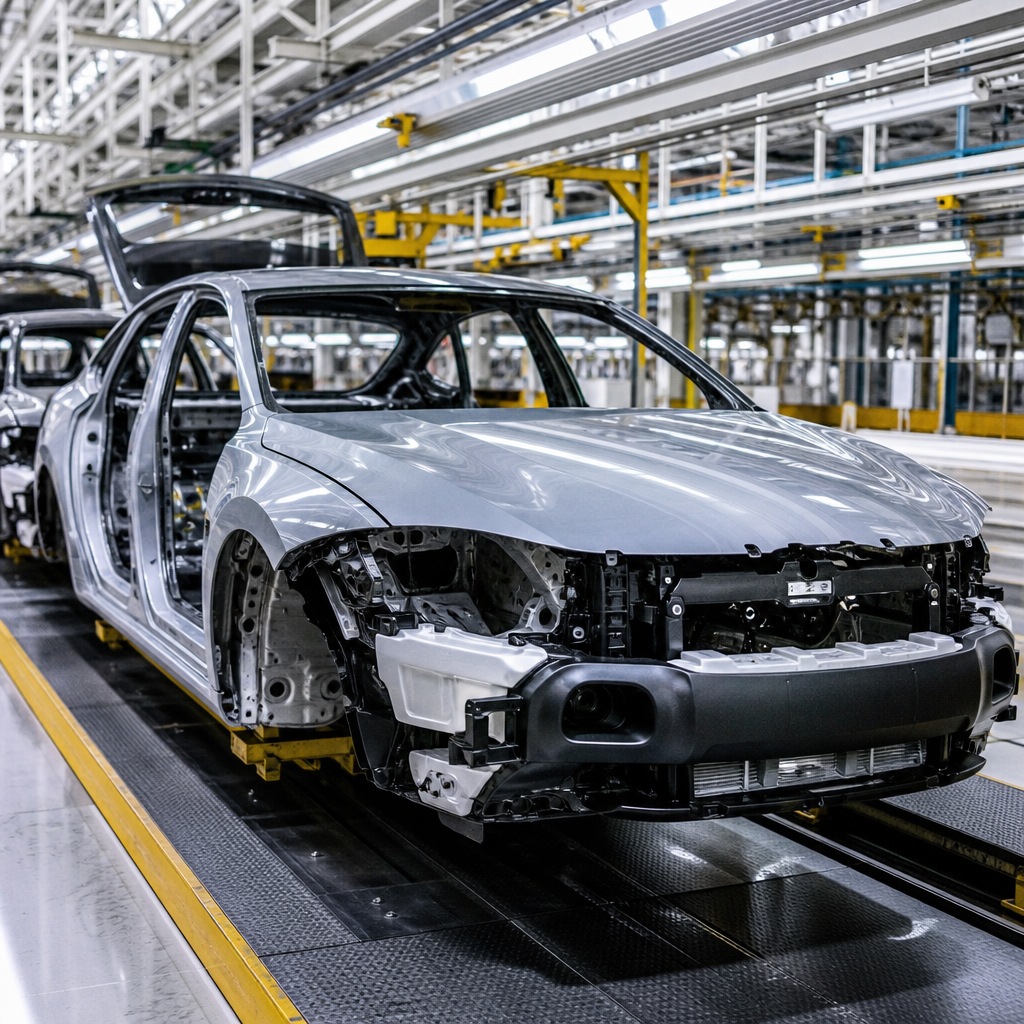
Front-end modules are a classic case. Instead of attaching separate metal brackets, ducts, reservoirs, and support pieces individually, manufacturers can mold an integrated carrier that holds headlights, cooling components, and latches in one coordinated structure. Interior door panels and instrument panels follow the same logic. By using polymer skins, foams, carriers, and decorative films, OEMs create assemblies that are lighter, quieter, and easier to package around electronics and HVAC systems. Surface quality also improves because polymers can be textured, painted, in-mold decorated, laser etched, or soft-touch coated without secondary machining.
| Manufacturing challenge | Polymer solution | Typical material | Result in production |
|---|---|---|---|
| Too many stamped and welded parts | Integrated molded module | Glass-filled polypropylene or polyamide | Lower part count and faster assembly |
| Metal corrosion in wet zones | Noncorroding liners and tanks | HDPE or polypropylene | Longer service life and fewer warranty claims |
| Heavy underhood components | Metal-to-plastic conversion | Glass-filled nylon | Reduced mass with chemical resistance |
| Noise and vibration transmission | Foams, isolators, and soft interfaces | Polyurethane and TPE | Quieter cabin and improved refinement |
| Complex EV cable routing | Molded channels and insulated connectors | PBT, PA, silicone | Safer packaging and easier installation |
Efficiency gains are strongest when design, tooling, and quality teams collaborate early. Polymers can shorten assembly, but they can also introduce sink marks, warpage, knit lines, or tolerance stack issues if the part is not designed for manufacturability. That is why mold-flow analysis, gate optimization, and dimensional validation are standard practice. Done well, polymer integration turns manufacturing complexity into a controllable molding process rather than a labor-heavy assembly chain.
Electrification, electronics, and new mobility demands
The shift toward electrified and software-defined vehicles created fresh challenges that polymers were uniquely positioned to address. Modern cars contain dense networks of connectors, sensors, radar housings, camera mounts, charging components, and battery protection features. These systems require electrical insulation, electromagnetic compatibility considerations, dimensional precision, and resistance to heat and fluids. PBT, PA66, LCP, PPS, and silicone materials are widely used in connectors, busbar supports, wire coatings, and sensor packages because they maintain properties under thermal cycling and offer strong dielectric performance.
Electric vehicles also rely on polymers for aerodynamic efficiency and battery shielding. Underbody panels, active grille shutters, wheel air curtains, and battery pack shields are often polymer-based because they combine low mass with shape freedom. Adhesives and sealants now do more structural work as well, bonding mixed materials and sealing battery enclosures against water and dust to IP-rated levels. These applications show a broader truth: polymers helped automotive manufacturing adapt to new architectures faster than traditional materials alone could support.
At the same time, sustainability expectations changed material strategy. Recycled polypropylene, bio-based polyamides, thermoplastic olefin skins, and design-for-disassembly practices are increasingly important, especially under European end-of-life vehicle and carbon accounting pressures. Recyclability remains uneven across polymer families, and fiber-reinforced composites are still harder to recover than simple thermoplastics. Yet the industry trend is clear. Future problem-solving with polymers will focus not only on performance and cost, but also on circularity, lower embodied carbon, and easier material identification across the supply chain.
Polymers addressed challenges in automotive manufacturing because they solved several problems at once: reducing mass, resisting corrosion, improving energy absorption, integrating complex functions, and speeding high-volume production. Their value is clearest when engineers design specifically for polymer behavior, validate against real service conditions, and accept tradeoffs around heat limits, creep, recycling, or surface control. As vehicles become more electrified, connected, and efficiency driven, polymer applications will expand further into thermal management, electrical protection, structural composites, and sustainable interiors.
For manufacturers, suppliers, and engineers, the main benefit of understanding problem-solving with polymers is better decision-making. The right resin, reinforcement, additive package, and process can eliminate recurring failures or unnecessary mass that conventional materials leave unresolved. The wrong choice can create dimensional drift, brittleness, or end-of-life complications. That is why this topic deserves hub-level attention: it connects materials science directly to plant efficiency, product quality, compliance, and customer experience.
If you are building out a materials strategy or researching case studies and applications, use this page as the starting point for evaluating where polymers create the highest return: underhood systems, EV battery protection, lightweight modules, corrosion-prone zones, and integrated interior assemblies. Map the problem first, then match the polymer family to the load, temperature, chemical exposure, regulatory requirement, and manufacturing method. That approach consistently delivers better automotive outcomes.
Frequently Asked Questions
How did polymers help solve weight and fuel-efficiency challenges in automotive manufacturing?
One of the biggest ways polymers changed automotive manufacturing was by making it possible to remove significant vehicle mass without sacrificing functionality. Traditional materials such as steel and glass are strong, but they are also relatively heavy. Polymers gave manufacturers lighter alternatives for interior panels, bumpers, fuel-system components, under-hood housings, electrical connectors, seating foams, instrument panels, and many exterior trim parts. Because polymers can be molded into complex shapes with thin walls, ribs, and integrated fastening features, engineers often replace multi-part metal assemblies with a single molded component that weighs less and is easier to install.
That reduction in weight matters throughout the life of a vehicle. A lighter car generally requires less energy to accelerate, which improves fuel economy in internal combustion vehicles and extends range in electric vehicles. Lower mass can also help improve handling, braking response, and overall system efficiency because related components such as suspension, brakes, and powertrain parts may also be optimized. In manufacturing terms, polymers contributed not just by being lighter than metals, but by enabling a more efficient design philosophy in which parts could be consolidated, reshaped, and engineered for performance rather than simply copied from older metal-based designs.
Importantly, this was not limited to simple decorative trim. Engineering polymers such as polyamide and reinforced thermoplastics moved into demanding applications where heat resistance, dimensional stability, and chemical resistance were essential. That broadened the role of polymers from cosmetic materials to serious structural and semi-structural solutions. In short, polymers helped automakers address the weight challenge by delivering a practical combination of lower mass, design flexibility, and manufacturability at scale.
Why are polymers considered important for durability and corrosion resistance in vehicles?
Polymers became essential in automotive manufacturing because they helped solve a problem metals have always faced: corrosion. Steel can rust, aluminum can oxidize, and many traditional materials degrade when exposed to road salt, water, oils, fuels, and harsh weather. Many polymers, by contrast, are naturally resistant to moisture and a wide range of chemicals, which makes them especially useful in parts exposed to aggressive service environments. Wheel-arch liners, bumper fascias, fluid reservoirs, fuel lines, protective coatings, seals, and underbody components all benefit from the ability of polymers to resist corrosion-related damage.
Durability goes beyond rust prevention. Automotive polymers can also be formulated to resist ultraviolet radiation, thermal cycling, impact, abrasion, and fatigue. For example, elastomers maintain flexibility in seals and gaskets despite vibration and changing temperatures, while engineering plastics can retain their shape and performance in under-hood conditions where heat and chemical exposure are common. Reinforced polymers can also withstand repeated mechanical loads while avoiding some of the denting, chipping, or galvanic issues associated with metals.
From a manufacturing perspective, this durability reduces warranty claims, extends service life, and improves the long-term appearance and performance of vehicles. It also allows automakers to design parts for environments that would otherwise require complex metal treatments, coatings, or additional corrosion protection systems. So when manufacturers adopted polymers more broadly, they were not simply looking for a low-cost substitute. They were choosing materials that could improve reliability, reduce maintenance concerns, and better withstand the real-world conditions vehicles face every day.
How do polymers improve vehicle safety if many people assume metal is always stronger?
The idea that metal is automatically safer is too simplistic. Vehicle safety depends on how materials behave in specific applications, not just on whether they are metallic or nonmetallic. Polymers improved automotive safety by giving engineers more control over energy absorption, deformation, insulation, and occupant protection. In bumper systems, interior panels, dashboards, seat structures, headrests, and airbag housings, polymers can be engineered to flex, cushion, absorb impact, or maintain structural integrity in ways that support crash performance and passenger safety.
Foamed polymers, for example, play a major role in managing impact energy in seating, headliners, door panels, and knee-bolster areas. Elastomers contribute to sealing, vibration damping, and component resilience, which can reduce wear and improve system reliability. Engineering plastics are also widely used in electrical and electronic systems because they provide excellent insulation, helping support the growing number of sensors, connectors, control modules, and high-voltage components found in modern vehicles. In electric vehicles especially, the insulating and flame-managed properties of certain polymers are critical to battery enclosures, cable systems, and electronic packaging.
Another important point is that polymers allow precise shaping and integration of safety-related features during molding. Mounting points, ducts, clips, reinforcements, and crush-management geometries can be built directly into a part, reducing assembly complexity and improving consistency. In many cases, polymers are used alongside metals rather than instead of them, creating hybrid systems that combine stiffness, energy management, and lightweighting. That is why polymers are now considered a central part of automotive safety engineering: they help optimize how a vehicle protects occupants, electronics, and critical systems under both normal use and crash conditions.
What manufacturing advantages did polymers bring compared with traditional automotive materials?
Polymers transformed automotive manufacturing not only because of their end-use performance, but because they fit modern production methods extremely well. Processes such as injection molding, blow molding, thermoforming, foaming, extrusion, and overmolding allow complex parts to be produced with repeatability, speed, and high dimensional consistency. Unlike many metal components that require multiple forming, machining, fastening, and finishing steps, polymer parts can often be created in near-final shape in a single operation. That reduces tooling complexity for assemblies, lowers labor requirements, and supports high-volume vehicle production.
A major advantage is part integration. With polymers, manufacturers can combine brackets, clips, channels, ribs, hinges, and aesthetic surfaces into one component instead of producing many separate pieces and joining them later. That simplifies supply chains, shortens assembly times, and reduces the number of potential failure points. Polymers also make it easier to tailor properties to a specific job. Fillers, reinforcements, impact modifiers, flame retardants, colorants, and foaming agents can all be used to fine-tune strength, stiffness, appearance, thermal behavior, and chemical resistance.
Design freedom is another major benefit. Automotive stylists and engineers gained the ability to create more aerodynamic shapes, smoother surfaces, integrated lighting features, and more sophisticated cabin designs because polymers can be molded into contours that would be difficult or expensive to achieve in metal or glass. In practical terms, this meant faster development cycles, more innovative vehicle designs, and better alignment between engineering requirements and brand styling. As a result, polymers helped automotive manufacturing become more flexible, more efficient, and more capable of delivering advanced vehicles at scale.
Which types of polymers are commonly used in automotive manufacturing, and why are different categories needed?
Automotive manufacturing uses a broad family of polymer materials because no single polymer can meet every requirement across the vehicle. Commodity plastics such as polypropylene are widely used because they offer a strong balance of low cost, low density, chemical resistance, and processability. That makes them ideal for many interior trims, battery covers, bumper components, and molded housings. Engineering plastics such as polyamide, polycarbonate, ABS, and PBT are chosen when higher heat resistance, mechanical strength, dimensional stability, or electrical performance is needed, especially in under-hood applications and electronic systems.
Elastomers are another essential category. These polymer materials provide flexibility, sealing performance, vibration damping, and resilience, which is why they are used in weather seals, hoses, gaskets, bushings, and numerous comfort and durability applications. Foamed polymers are important for seating, insulation, noise reduction, and impact management. Reinforced polymers, often containing glass fibers or mineral fillers, help bridge the gap between lightweight design and mechanical performance by increasing stiffness and strength for more demanding parts. Adhesives, coatings, and sealants based on polymer chemistry also play a major role by joining dissimilar materials, protecting surfaces, and improving corrosion resistance.
Different categories are needed because vehicles operate in many environments at once. A dashboard panel needs appearance and impact behavior, an intake component needs heat and chemical resistance, a door seal needs flexibility in cold and hot weather, and an electrical connector needs insulation and dimensional precision. Polymers give engineers a toolkit rather than a single answer. That versatility is exactly why they addressed so many challenges in automotive manufacturing: they could be selected, modified, reinforced, bonded, foamed, or coated to match the specific mechanical, thermal, chemical, and aesthetic demands of each automotive application.