Polymers are essential to modern audio equipment because they solve multiple engineering problems at once: they reduce weight, control vibration, insulate delicate circuits, seal against moisture, and enable precise manufacturing at scale. In speakers, headphones, microphones, amplifiers, and connectors, polymer materials are not just cheap substitutes for metal or paper. They are tuned components with specific mechanical, thermal, and electrical properties. I have seen product teams change a diaphragm film, cable jacket, or adhesive system and unlock measurable gains in frequency response, durability, and manufacturing consistency. Understanding how polymers enhance the performance of audio equipment helps designers make better material choices and helps buyers see why material selection matters in real listening conditions.
In this context, polymers include commodity plastics such as ABS and PVC, engineering plastics such as polycarbonate and PBT, elastomers such as silicone and thermoplastic polyurethane, fluoropolymers such as PTFE, and high-performance films including PET, PEN, and polyimide. Their value comes from controllable properties: modulus, damping factor, dielectric strength, glass transition temperature, chemical resistance, moisture uptake, and processability through injection molding, extrusion, thermoforming, and additive manufacturing. Audio equipment depends on all of those traits. A headphone earcup must be rigid yet not ring excessively. A speaker surround must flex millions of times without cracking. A cable insulator must maintain low capacitance and survive bending, sweat, oils, and abrasion. A microphone housing may need electromagnetic shielding through conductive polymer coatings while also isolating handling noise.
This article serves as a hub for polymers in high-tech and electronics by looking across the full audio signal chain, from transducers and enclosures to cabling, adhesives, and manufacturing methods. It explains where polymers are used, why engineers choose one family over another, what tradeoffs exist, and how real products benefit. The topic matters because audio performance is never only about drivers and electronics. Material science shapes resonance, reliability, safety compliance, ingress protection, and long-term consistency. If you want to understand why one product sounds cleaner, lasts longer, weighs less, or costs more to build, polymer selection is often part of the answer.
Why polymers matter in audio engineering
Audio equipment converts electrical energy into mechanical motion and back again, so every material in the system influences acoustics. Polymers matter because they can be formulated to balance rigidity, damping, mass, and environmental resistance in ways metals, ceramics, and untreated natural fibers cannot always match. A rigid material raises breakup frequency in a diaphragm, but too little damping can create sharp resonances. A softer material damps resonance, but excessive compliance can blur transient response. Polymers let engineers target the middle ground by selecting molecular structure, fillers, reinforcements, and geometry together.
They also support manufacturing precision. Injection-molded baffles, waveguides, and connector bodies can hold tight tolerances across high production volumes. In my experience reviewing audio assemblies, this consistency matters as much as the headline material choice. Two products may both use polycarbonate, yet the one with better mold design, shrink compensation, and post-process control will produce more repeatable acoustic results. Polymers additionally simplify integration. A single molded part can combine clips, seals, damping ribs, and mounting points, reducing part count and improving assembly speed without sacrificing performance.
Polymers in speaker diaphragms, surrounds, and suspensions
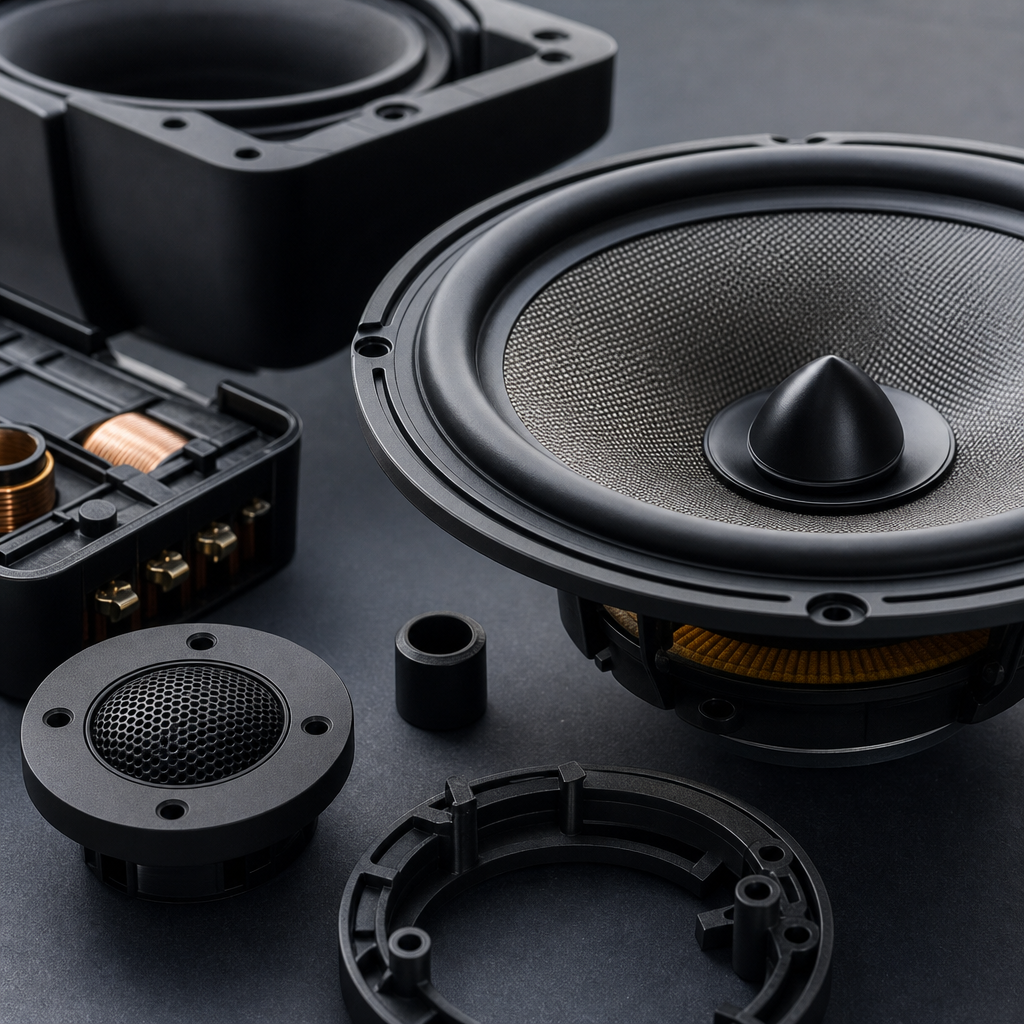
Loudspeakers are one of the clearest examples of polymer performance. Diaphragm films and cones are commonly made from polypropylene, PET, PEN, aramid-reinforced composites, or polymer-coated paper. Polypropylene became widely used because it offers good internal damping, low mass, moisture resistance, and stable large-scale processing. Compared with untreated paper, it is less sensitive to humidity and can deliver smoother response with fewer severe breakup peaks. That is why many woofers and midrange drivers in consumer speakers and automotive audio systems rely on polypropylene cones.
For tweeters and high-frequency diaphragms, PET and PEN films are popular because they can be made very thin, uniform, and strong. PEN generally offers higher stiffness and better thermal stability than PET, making it useful where higher output and improved dimensional stability are needed. Some premium drivers use polyimide films in voice coil formers because polyimide keeps strength at elevated temperatures and resists deformation during sustained power handling. Surrounds and spiders also depend heavily on polymers. Butyl rubber surrounds are valued for flexibility, air sealing, and long fatigue life, while treated cloth and thermoplastic elastomers appear where a different compliance profile is desired.
The practical result is audible and measurable. A well-chosen polymer cone can extend smooth bandwidth, reduce sensitivity to climate, and maintain performance over years of use. In portable Bluetooth speakers, polymer diaphragms and passive radiator surrounds help survive repeated thermal cycling, UV exposure, and accidental drops. In studio monitors, consistency from driver to driver is critical; polymer processing helps manufacturers maintain tighter tolerances in resonance frequency and moving mass, which improves stereo matching.
How polymers improve headphones and microphones
Headphones use polymers in nearly every subsystem. Driver diaphragms often rely on PET, PEN, or other engineered films for a strong stiffness-to-weight ratio. The film thickness may be measured in microns, and small changes affect resonance, sensitivity, and treble extension. Flexible suspensions, acoustic meshes, foam interfaces, ear cushions, and housings are also polymer-based. ABS and polycarbonate blends are common in headbands and earcups because they mold accurately and withstand impact. Thermoplastic polyurethane is widely used in cable jackets and flexible strain reliefs because it resists abrasion and repeated bending better than many commodity plastics.
Comfort is another performance dimension. Memory foam ear pads, silicone tips for in-ear monitors, and soft-touch elastomer overmolds influence sealing and therefore bass response and isolation. A poor seal can remove low-frequency output by several decibels. That means the polymer in a cushion is not a cosmetic detail; it is part of the acoustic system. In microphones, polymers appear in diaphragms, internal shock mounts, insulation films, cable jackets, and windscreens. Electret condenser microphones rely on permanently charged polymer films or fluoropolymer-based materials to maintain a quasi-permanent electric field. Those materials made compact, low-cost microphones feasible in smartphones, laptops, lavaliers, and measurement devices.
Enclosures, damping, and vibration control
Enclosure design is where polymers often deliver hidden value. Speaker cabinets, headphone shells, turntable parts, and amplifier feet all require vibration management. Purely rigid structures are not always best, because reflected energy and panel resonance can color sound. Engineers frequently use glass-filled nylon, ABS, polycarbonate blends, constrained-layer polymer sheets, polyurethane foams, silicone gaskets, and viscoelastic adhesives to control unwanted motion. A polymer part can be ribbed internally to push resonances out of a critical band, while a damping layer converts vibration energy into low-level heat.
In soundbars and compact speakers, polymers enable complex internal geometries that would be expensive in wood or metal. Integrated waveguides, port structures, cable channels, and snap features can all be molded into one assembly. In turntables, elastomer feet and motor isolation mounts help reduce structure-borne vibration reaching the stylus. In microphones, internal elastomer suspensions lower handling noise by decoupling the capsule from the housing. These solutions matter because audio is sensitive to mechanical noise. When engineers speak about lowering coloration, improving isolation, or reducing cabinet talk, polymer damping systems are often central to the fix.
| Audio component | Common polymers | Primary performance benefit | Typical tradeoff |
|---|---|---|---|
| Speaker cone or diaphragm | Polypropylene, PET, PEN, polyimide composites | Controlled stiffness, damping, low mass, moisture resistance | May need reinforcement for maximum rigidity |
| Surrounds and suspensions | Butyl rubber, TPE, silicone | Flexibility, sealing, fatigue resistance | Compliance changes can alter voicing |
| Headphone housings | ABS, polycarbonate, nylon blends | Impact strength, precise molding, low weight | Can resonate if geometry and damping are poor |
| Cable insulation | PVC, PE, PTFE, TPU | Dielectric control, flexibility, chemical resistance | Higher-grade materials increase cost |
| Adhesives and damping layers | Acrylics, epoxies, silicones, urethanes | Bonding, sealing, vibration reduction | Long-term aging must be validated |
Cables, connectors, and electrical insulation
Audio discussions about cables often become exaggerated, but the role of polymers in cable performance is straightforward and important. Insulation and jacketing materials affect capacitance, dielectric loss, flexibility, safety, and service life. PVC remains common because it is inexpensive and easy to process, but polyethylene and foamed PE can offer lower dielectric constant, which helps reduce capacitance in signal cables. PTFE is valued in demanding applications for excellent dielectric properties, thermal resistance, and chemical stability. In broadcast, stage, and studio environments, TPU jackets are often preferred for toughness, flexibility, and abrasion resistance.
Connectors also depend on polymers for insulating inserts, strain reliefs, and overmolds. Materials such as PBT and liquid crystal polymer can maintain dimensional stability and heat resistance during soldering or repeated plugging cycles. For balanced audio, digital interfaces, and RF-adjacent systems such as wireless microphone front ends, stable dielectric behavior helps preserve signal integrity. The advantage is usually not mystical sonic improvement; it is predictable electrical behavior, reduced failure risk, and better durability under handling, coiling, and environmental exposure. That is the correct engineering frame.
Thermal management, flame resistance, and reliability
Audio electronics must survive heat from amplifiers, charging circuits, DSP boards, and power supplies. Polymers support reliability here through insulation systems, fan components, potting compounds, and flame-retardant housings. Polyamide, PBT, PPS, silicone, and epoxy systems are widely used in connectors, bobbins, encapsulation, and board-level protection. Safety standards often drive these choices. Materials may need recognized flammability ratings under UL 94, stable comparative tracking index performance, and compatibility with RoHS and REACH requirements. In portable products, battery proximity makes thermal and flame behavior even more important.
Long-term reliability depends on more than initial specifications. Engineers evaluate creep, hydrolysis resistance, outgassing, UV stability, and resistance to skin oils or cleaning chemicals. I have seen attractive materials fail qualification because they embrittled after sweat exposure or softened near amplifier hotspots. That is why accelerated aging, thermal cycling, salt fog, and flex testing are part of serious audio product development. A polymer that performs well acoustically but degrades after eighteen months is not a successful choice. The best materials deliver stable acoustics and mechanical integrity across years of real use.
Manufacturing, sustainability, and future material trends
Polymers enhance audio equipment not only through performance in use but also through efficient production. Injection molding supports high-volume repeatability for housings and acoustic parts. Extrusion creates cable jackets and profiles with consistent dimensions. Film processing enables ultrathin diaphragms. Overmolding integrates seals and grip features in fewer steps. Additive manufacturing is increasingly used for prototypes, custom ear tips, acoustic waveguides, and short-run parts, especially with photopolymers and nylon powders. Faster iteration means engineers can test acoustic geometries and damping concepts more quickly before committing to hard tooling.
Sustainability is now part of material strategy. Recycled ABS, bio-based polyamides, halogen-free flame-retardant systems, and lower-VOC adhesives are gaining traction, though each option must be validated for acoustic and mechanical consistency. Future trends include nanocomposite diaphragms, conductive polymers for lighter shielding solutions, advanced thermoplastic elastomers for better comfort and durability, and materials tuned for automated assembly. The direction is clear: as audio products become smaller, smarter, more wireless, and more personalized, polymer selection becomes more strategic, not less. Teams that treat polymers as functional engineering materials rather than commodity plastics build products that sound better, last longer, and manufacture more reliably.
Polymers enhance the performance of audio equipment by shaping acoustics, durability, comfort, safety, and production quality across the entire product. They make speaker cones stable, headphone seals effective, microphone systems quieter, cables tougher, and enclosures better controlled. The key lesson is that no single polymer is best for every use. Material choice must match the job through stiffness, damping, dielectric behavior, thermal resistance, fatigue life, and manufacturability. When those factors are balanced correctly, polymers become one of the most powerful tools available to audio engineers.
As a hub for case studies and applications in high-tech electronics, this overview shows why polymers deserve attention in every serious audio discussion. They are not secondary materials added after the circuit and driver are finished. They are part of the signal path, the acoustic path, and the reliability equation. If you are evaluating audio designs, sourcing components, or planning content for deeper subtopic pages, start by mapping where each polymer sits in the system and what problem it solves. That approach leads to better products and better decisions.
Frequently Asked Questions
1. Why are polymers so important in modern audio equipment?
Polymers matter in audio equipment because they solve several design challenges at the same time, often better than traditional materials can on their own. In a single component, a polymer can reduce overall weight, damp unwanted vibration, provide electrical insulation, resist humidity, and still be manufactured with extremely tight tolerances. That combination is especially valuable in products like speakers, headphones, microphones, amplifiers, and signal connectors, where performance depends on the interaction of mechanical, electrical, and environmental factors.
In practical terms, polymers are not simply low-cost replacements for metal, wood, or paper. They are engineered materials with tunable properties. Designers can select a polymer for stiffness, flexibility, dielectric behavior, thermal stability, chemical resistance, or internal damping depending on the exact role of the part. For example, one polymer may be chosen for a speaker surround because it flexes predictably over time, while another may be selected for an amplifier housing or connector insert because it insulates circuits and resists heat. That level of control allows engineers to fine-tune sound quality, product durability, and manufacturing repeatability all at once.
This is one reason audio product teams often revisit material selection during development. Even a small change in diaphragm film, enclosure damping layer, cable jacket, or adhesive can alter resonance behavior, reliability, moisture resistance, or assembly consistency. In modern audio design, polymers are often performance-defining materials, not background materials.
2. How do polymers improve sound quality in speakers and headphones?
Polymers improve sound quality by helping engineers control motion and vibration more precisely. In any transducer, whether it is a loudspeaker driver or a headphone element, the goal is to move air accurately according to the electrical signal. Unwanted resonances, excess mass, inconsistent flexing, or poor damping can all add distortion and coloration. Carefully selected polymers help manage these issues because their stiffness, elasticity, and internal damping can be matched to the function of each part.
In speaker cones and headphone diaphragms, polymer films and composites are often used because they can be made very light while still maintaining enough rigidity to resist breakup over the intended frequency range. A lighter moving assembly generally responds faster and can preserve more detail, especially in transient-rich material like percussion or plucked strings. At the same time, many polymers offer better internal damping than metals, which means they can reduce harsh resonant peaks that would otherwise color the sound.
Surrounds, suspensions, and damping layers are also critical. A polymer surround in a speaker, for example, must allow controlled excursion without introducing excessive mechanical noise or drift in compliance over time. In headphones, polymer-based structures can reduce enclosure resonance, improve seal consistency around the ear, and limit vibration transfer into the housing. Even seemingly secondary parts such as gaskets, internal mounts, and acoustic meshes can influence bass extension, channel matching, and perceived clarity. The result is that polymers often shape not just the durability of an audio product, but its tonal balance, distortion profile, and overall listening character.
3. Are polymers mainly used because they are cheaper than metal or other traditional materials?
No. Cost can be a factor, but in high-performing audio equipment the main reason polymers are used is because they often deliver a better combination of properties for the application. A metal part may be strong and precise, but it can also be heavier, more resonant, electrically conductive, harder to mold into complex features, or less suitable for moisture sealing. Paper may sound good in some cone applications, but it can be more sensitive to humidity and batch variation. Polymers give engineers a much wider material design space.
That design flexibility matters greatly in audio. A polymer can be compounded with fillers, fibers, plasticizers, flame retardants, or reinforcing additives to hit a narrow target for stiffness, damping, heat resistance, or dimensional stability. This means a housing can be molded to include mechanical features, clips, sealing interfaces, and cable channels in one part while still meeting acoustic and safety requirements. Connectors can use engineering polymers that maintain insulation properties and shape accuracy under repeated insertion cycles. Microphone parts can be made with materials that combine low mass, stable geometry, and environmental resistance.
It is also important to remember that cheaper materials are not automatically easier to use successfully. If a polymer grade is poorly selected, it can introduce creep, resonance, warping, or long-term degradation. That is why serious audio manufacturers invest heavily in material validation, environmental testing, and acoustic measurement. The best polymer choices are usually the result of balancing performance, reliability, manufacturability, and cost, not chasing low price alone.
4. What roles do polymers play in protecting audio electronics and improving reliability?
Polymers play a major role in protecting sensitive audio electronics because they are excellent insulating, sealing, and encapsulating materials. Inside amplifiers, powered speakers, wireless earbuds, microphones, and digital audio devices, delicate circuits must be shielded from short circuits, contamination, moisture, dust, and mechanical shock. Engineering polymers are widely used for cable insulation, PCB spacers, connector bodies, potting compounds, conformal coatings, gaskets, and housings because they can prevent electrical failures while also standing up to vibration and environmental stress.
Moisture resistance is especially important in portable and professional audio gear. Condensation, sweat, humidity, and outdoor exposure can all affect performance or cause corrosion over time. Polymer seals and coatings help keep moisture away from vulnerable contacts and components. In headphones and earbuds, this can directly affect product lifespan. In microphones and amplifiers, it helps preserve stable operation in changing environments. Many polymers also resist oils, cleaning chemicals, and UV exposure, which adds another layer of durability for products used on stage, in studios, or in mobile applications.
Thermal management is another area where polymers contribute, even though they are not always thought of as heat-related materials. Some polymers are chosen specifically because they remain dimensionally stable near warm components, while others are formulated to dissipate or tolerate heat in controlled ways. Adhesives and encapsulants can also reduce vibration-induced fatigue on solder joints and components. Taken together, these benefits make polymers central to long-term reliability. They do not just surround the electronics; they actively help the electronics survive real-world use.
5. How do polymers help manufacturers build high-performance audio equipment consistently at scale?
One of the biggest advantages of polymers is that they support precise, repeatable manufacturing. Audio performance depends on consistency. If diaphragm thickness varies, if connector geometry shifts, or if enclosure parts do not fit tightly from one unit to the next, the sound and reliability can change. Polymers can be injection molded, extruded, laminated, coated, or cast into highly controlled forms, which helps manufacturers reproduce critical dimensions and mechanical behavior across large production volumes.
This is especially important in products where tiny differences matter. In headphones, small variations in chamber shape, seal geometry, and diaphragm behavior can alter frequency response and channel matching. In speakers, consistency in surrounds, gaskets, and basket-mounted isolators affects resonance and excursion control. In connectors and cable assemblies, precision polymer components help maintain fit, insulation spacing, and strain relief. For microphones, polymer films and structural parts can be produced with the uniformity needed for predictable sensitivity and acoustic response.
Polymers also simplify part integration. A single molded piece can combine structural support, vibration control features, snap fits, routing channels, and sealing surfaces that would otherwise require multiple parts and more assembly steps. Fewer parts can mean fewer tolerance stack-ups and fewer opportunities for error. That does not guarantee good sound by itself, but it gives engineers a more stable platform for achieving it. In other words, polymers help audio companies deliver products that are not only innovative on the test bench, but repeatable and dependable in the hands of real users.