Polymers have become essential to modern aerospace engineering because they solve a problem every aircraft and spacecraft designer faces: how to reduce mass without sacrificing strength, durability, safety, or manufacturing efficiency. In aerospace, the term polymer refers to a material made of long molecular chains, either used alone as a plastic or elastomer, or combined with reinforcing fibers to create advanced composites. When engineers discuss successful polymer applications, they usually mean more than cabin plastics. They mean carbon fiber reinforced polymers in fuselage sections, high performance thermoplastics in brackets and clips, silicone and fluoropolymer seals in fuel systems, polyimide films in spacecraft insulation, and polymer matrix composites in engines, radomes, and control surfaces.
This matters because every kilogram removed from an airframe reduces fuel burn, extends range, increases payload, or creates margin for additional systems. In orbit, mass savings directly influence launch cost and mission architecture. I have worked on component selection reviews where changing a metal assembly to a polymer based composite did not just save weight; it also reduced part count, simplified corrosion control, and shortened installation time. Those are the kinds of real operational gains that explain why polymers now sit at the center of aerospace design strategy rather than at the periphery.
Successful polymer applications also reflect a broader engineering shift. Aerospace programs no longer evaluate materials only by tensile strength or maximum service temperature. They assess specific strength, fatigue performance, resistance to aviation fluids, smoke and toxicity behavior, electromagnetic transparency, outgassing, manufacturability, inspectability, repairability, and total lifecycle cost. A polymer that performs brilliantly in a laboratory coupon test can still fail as an aerospace choice if it absorbs moisture, creeps under load, degrades under ultraviolet exposure, or becomes impossible to certify at scale. The role of polymers is therefore best understood as a balance of chemistry, structural design, and qualification discipline.
As a hub article on successful polymer applications, this page explains where polymers deliver the most value, how different polymer families are used across aircraft and spacecraft, what tradeoffs engineers manage, and why these materials continue to expand into primary structures, propulsion-adjacent systems, interiors, electronics, and mission critical components. If you want the short answer, it is this: polymers enable lighter, more integrated, more corrosion resistant aerospace systems, but only when matched carefully to load case, environment, and certification requirements.
Why polymers became indispensable in aerospace
The rise of polymers in aerospace engineering started with a simple performance equation: lower structural weight produces system level benefits that metals alone cannot always achieve economically. Aluminum transformed aviation in the twentieth century because it offered a strong weight advantage over steel. Polymer based materials, especially fiber reinforced composites, created the next step change by improving specific stiffness and corrosion resistance while enabling more tailored structural behavior. In practical terms, engineers can orient fibers in a composite laminate so that stiffness is placed exactly where the load path demands it, unlike isotropic metals that behave similarly in all directions.
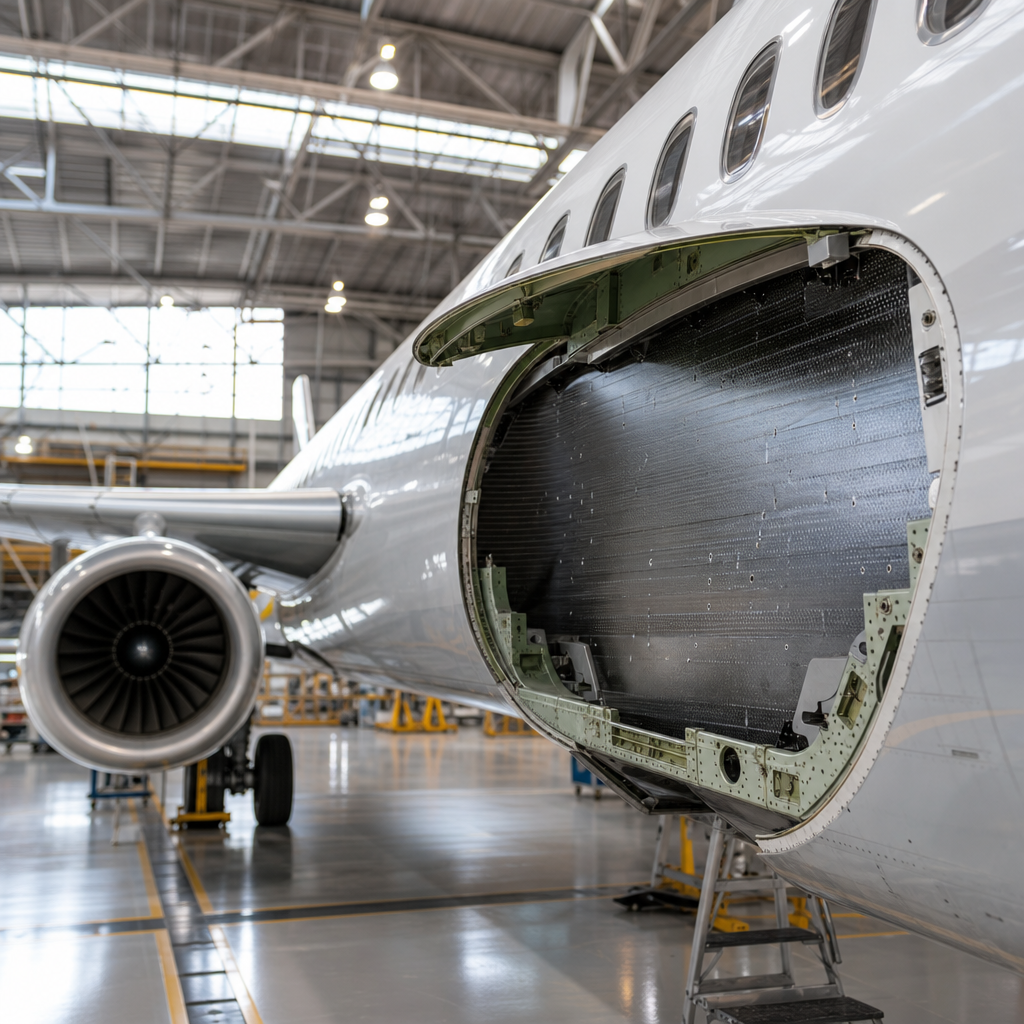
That design freedom has reshaped aircraft architecture. The Boeing 787 and Airbus A350 both use large amounts of carbon fiber reinforced polymer in fuselage barrels, wings, and empennage structures. Those choices were not cosmetic. They were made because composites support high fatigue resistance, reduced corrosion maintenance, and significant weight savings over comparable metallic designs. Airlines benefit through fuel efficiency and potentially lower maintenance burden, while manufacturers benefit from integrated structures with fewer fasteners and joints. In rotorcraft and military platforms, polymer composites have also enabled blades, fairings, and access panels that withstand demanding load spectra while controlling radar signature or vibration behavior.
Polymers are indispensable for another reason: they fill performance gaps that metals cannot address efficiently. Radomes must be structurally sound while remaining transparent to radar frequencies, making reinforced polymer systems ideal. Wire insulation must tolerate heat, flexing, and chemical exposure without adding unnecessary weight, which is why fluoropolymers and polyimides are so common. Adhesives and sealants based on epoxy, polysulfide, and silicone chemistries allow engineers to join dissimilar materials, seal pressurized cabins, and protect fuel tanks in ways that mechanical fastening alone cannot match.
Even where metals remain dominant, polymers often improve the surrounding system. A titanium fitting may still carry a critical load, but polymer bushings reduce wear, elastomeric seals preserve pressure integrity, and thermoplastic covers protect against impact or contamination. Aerospace engineering is therefore not moving toward an all polymer future. It is moving toward optimized hybrid systems in which polymers contribute structural efficiency, insulation, sealing, and integration advantages where they deliver the best total result.
Successful polymer applications in aircraft structures and interiors
The most visible successful polymer applications are found in airframes, cabins, and secondary structures. Carbon fiber reinforced epoxy laminates are now standard in wing boxes, tail sections, floor beams, nacelle components, and control surfaces. Glass fiber reinforced polymers are widely used in fairings, interior panels, and radomes because they combine lower cost with good impact resistance and electromagnetic transparency. Aramid fiber composites, known through materials such as Kevlar, appear in ballistic protection, honeycomb reinforcements, and areas needing toughness rather than maximum compressive stiffness.
In structural work, polymer matrix composites excel when the load case is well defined and anisotropy can be exploited. For example, wing skins see directional stresses that can be matched with tailored fiber orientation, reducing unnecessary mass. Sandwich panels using polymer composite skins over honeycomb cores provide high bending stiffness at very low weight, making them common in floor panels, control surfaces, and interior monuments. These are not niche parts. They are production proven systems that have accumulated millions of flight hours.
Cabin interiors are another major success story. Polyetheretherketone, polyphenylene sulfide, polyetherimide, and flame retardant phenolic systems are used in seat components, cable supports, ducting, sidewall panels, and brackets because they can meet strict flame, smoke, and toxicity standards while trimming mass. In commercial cabins, every saved kilogram matters because it multiplies across fleets and service years. Airlines may not advertise polymer clips or thermoplastic latches, but these parts contribute to lower operating cost and easier maintenance.
Additive manufacturing has strengthened this trend. Aerospace suppliers now print qualifying interior ducts, clips, covers, and tooling from high performance thermoplastics such as ULTEM 9085, a polyetherimide blend valued for its regulatory acceptance in cabin applications. I have seen programs replace multi-piece machined assemblies with a single printed polymer part, cutting lead time dramatically while removing fasteners and reducing inventory complexity. The success is not just material substitution; it is design simplification enabled by polymer processing.
| Application area | Common polymer system | Main benefit | Typical example |
|---|---|---|---|
| Primary structure | Carbon fiber reinforced epoxy | High specific stiffness and fatigue resistance | Wing skins and fuselage sections |
| Radomes and fairings | Glass fiber reinforced polymer | Radar transparency and corrosion resistance | Nose radomes |
| Cabin interiors | PEEK, PEI, PPS, phenolics | Low weight with flame and smoke compliance | Panels, brackets, ducting |
| Seals and fuel systems | Silicone, fluoropolymers, polysulfides | Chemical resistance and leak prevention | Tank sealants and gaskets |
| Spacecraft insulation | Polyimide films | Thermal stability and low mass | Multilayer insulation blankets |
Polymers in propulsion, space systems, and harsh environments
Aerospace polymers are not limited to benign temperature zones. They also operate near engines, in cryogenic systems, and in space environments where radiation, vacuum, thermal cycling, and atomic oxygen create severe degradation risks. Success in these applications depends on careful chemistry selection and aggressive test validation. High temperature thermosets, polyimides, fluoropolymers, and specialized thermoplastics are used because standard engineering plastics would fail quickly under these conditions.
In propulsion-adjacent systems, polymers appear in nacelle acoustic liners, insulation, wire jacketing, seals, composite fan structures, and nonmetallic ducts. Modern turbofan engines use polymer composite nacelle components to reduce weight while preserving aerodynamic shape and acoustic performance. Carbon fiber epoxy fan cases have been deployed in some engine architectures because they can contain blade-out events with lower mass than metallic alternatives when properly engineered. These are highly regulated applications requiring exceptional impact and damage tolerance performance, but they demonstrate how far polymer technology has advanced.
Space systems provide some of the clearest examples of successful polymer applications. Polyimide films such as Kapton have long been used in flexible circuits and thermal blankets because they retain properties over wide temperature ranges and exhibit acceptable vacuum performance. Fluoropolymers and silicones are used in harnessing, seals, and protective layers. Epoxy matrix carbon composites support satellite structures where dimensional stability and weight reduction are mission critical. On spacecraft, outgassing is a decisive issue because volatile compounds can condense on optics or sensors. NASA and ESA materials databases therefore screen polymers by total mass loss and collected volatile condensable material before approval.
Harsh environments reveal the limitations as well as the strengths of polymers. Many resins absorb moisture, some degrade under ultraviolet radiation, and others become brittle at low temperatures or soften under sustained load. In low Earth orbit, atomic oxygen can erode exposed polymer surfaces unless protected. Near propulsion systems, elevated temperatures may push polymer matrices toward thermal aging or char formation. Engineers address these risks through coatings, hybrid laminates, conservative design allowables, and extensive environmental conditioning. The lesson from successful programs is not that polymers are universally superior. It is that they can be highly reliable when the service environment is characterized honestly and qualification testing mirrors reality.
Material selection, certification, and the next wave of applications
Choosing the right polymer for aerospace use is a structured engineering process, not a materials catalog exercise. The first question is always functional: what loads, temperatures, fluids, electrical demands, and certification rules will this part face? From there, engineers compare candidate materials using datasheets, coupon testing, process capability, and program constraints. Standards and methods from ASTM, SAE, ISO, FAA guidance, and company specifications shape this work. For structural composites, design allowables are built from statistically significant test programs, not from best case manufacturer values. For interiors, flammability and smoke compliance can decide the material before strength is even considered.
Certification is one reason successful polymer applications often expand gradually. A polymer may look ideal on paper, but introducing it into a flight critical part requires evidence on damage tolerance, repair methods, aging, manufacturing consistency, and inspection reliability. Non destructive inspection for composites, including ultrasonic testing, thermography, and shearography, is now mature, but each method has limits depending on geometry and defect type. Repair is another practical concern. Bonded composite repairs can be highly effective, yet field execution requires trained technicians, environmental control, and approved procedures.
The next wave of applications is being driven by thermoplastic composites, automation, and digital manufacturing. Thermoplastic composite systems based on PEEK and PEKK offer toughness, weldability, and shorter processing cycles compared with many thermosets. Automated fiber placement and tape laying are improving repeatability in large structures. Recyclability, once a weak point for aerospace composites, is also receiving more attention as regulators and manufacturers examine lifecycle impacts. Short fiber and continuous fiber reinforced printed polymers are moving beyond prototyping into tooling, ducting, and selected end-use parts, especially where customization and low production volume matter.
For engineers and procurement teams evaluating successful polymer applications, the practical takeaway is straightforward. Start with the operating environment, not the marketing claim. Match polymer chemistry and reinforcement to real service conditions. Verify manufacturability at production scale. Build qualification around worst case exposure, including fluids, humidity, heat, impact, and long term aging. When this discipline is followed, polymers deliver exceptional value across modern aerospace engineering. They lower mass, reduce corrosion, enable complex geometry, support electrical and thermal functions, and open design spaces that metals alone cannot reach. To build a stronger materials strategy, map your current components by load, environment, and certification burden, then identify where polymer upgrades can create measurable performance gains today.
Frequently Asked Questions
Why are polymers so important in modern aerospace engineering?
Polymers are important in aerospace because they help engineers reduce weight while still meeting demanding performance, safety, and durability requirements. In aircraft and spacecraft design, every kilogram matters. Lower structural mass can improve fuel efficiency, increase payload capacity, extend range, and reduce operating costs. Traditional metals such as aluminum, titanium, and steel still play critical roles, but polymers give designers access to a broader set of material solutions, especially when lightweight construction is a priority.
In aerospace, polymers are used in several forms. Some are employed as plastics for interior panels, housings, insulation, seals, and cable protection. Others are used as elastomers in vibration damping systems, gaskets, O-rings, and flexible connections. Perhaps most importantly, polymers act as the matrix in fiber-reinforced composites, where they bind high-strength fibers such as carbon or glass into a structural material with an exceptional strength-to-weight ratio. This allows engineers to create parts that are both lighter and highly capable under complex loading conditions.
Beyond weight reduction, polymers also support corrosion resistance, fatigue performance, design flexibility, and manufacturing efficiency. They can be molded into complex shapes, integrated into multifunctional components, and tailored for specific thermal, chemical, and mechanical environments. That combination of low density, adaptability, and performance is why polymers have become foundational to modern aerospace engineering rather than just a secondary material option.
How are polymers different from metals when used in aerospace applications?
The biggest difference is that polymers and metals behave very differently at the molecular and structural level, which leads to different engineering advantages and limitations. Metals are generally isotropic, meaning they tend to perform similarly in multiple directions, and they are known for high stiffness, conductivity, and predictable behavior under a wide range of temperatures. Polymers, by contrast, are made of long molecular chains and often have lower density, greater chemical versatility, and more tunable properties. This makes them especially valuable when weight savings, corrosion resistance, or shape complexity are important.
When polymers are used on their own, they typically do not match metals in raw stiffness or high-temperature strength. However, they often outperform metals in areas such as resistance to corrosion, electrical insulation, vibration damping, and ease of manufacturing for complex geometries. In aerospace cabins, electronic systems, and secondary structures, these advantages are extremely useful. Polymers can also reduce part count by allowing multiple functions to be integrated into a single molded or bonded component.
The comparison becomes even more interesting with polymer composites. A carbon-fiber-reinforced polymer can offer excellent specific strength and specific stiffness, meaning high performance relative to its low weight. That is why composite polymers are used in fuselage sections, wing structures, radomes, fairings, and satellite components. Even so, engineers must account for tradeoffs such as impact sensitivity, temperature limits, moisture effects, and different inspection and repair methods compared with metal structures. In practice, aerospace engineers rarely see polymers and metals as direct replacements in every situation; instead, they select each material where its performance profile makes the most sense.
What types of polymer materials are commonly used in aircraft and spacecraft?
Aerospace uses a wide range of polymer materials, each selected for a specific role. Thermoplastics are one major category. These materials soften when heated and can often be reshaped or welded, which can be useful for manufacturing and repair. High-performance thermoplastics such as PEEK, PEI, PPS, and PTFE are often chosen for parts that need chemical resistance, dimensional stability, electrical insulation, or good behavior at elevated temperatures. They can be found in brackets, clips, ducting, cable insulation, bearings, and interior components.
Thermosetting polymers are another essential category. Unlike thermoplastics, thermosets cure into a permanent network structure and do not remelt once set. Epoxy, phenolic, bismaleimide, and polyimide resins are especially important in aerospace because they are widely used as the matrix materials in structural composites. These resins hold reinforcing fibers in place, transfer loads, and help determine thermal and environmental resistance. Epoxy-based carbon-fiber composites, for example, are now standard in many high-performance aircraft and space systems.
Elastomers also play a major role. Silicone, fluorocarbon, nitrile, and other specialized elastomers are used in seals, gaskets, hoses, vibration isolation systems, and components that must remain flexible under changing temperatures and pressures. Adhesives, coatings, foams, and insulating materials add another layer of polymer use throughout aerospace platforms. In spacecraft, polymers may also appear in thermal blankets, wire insulation, optical assemblies, and deployable structures. The material selection process is highly application-specific, and engineers evaluate each polymer based on weight, strength, outgassing behavior, flame resistance, radiation tolerance, thermal stability, manufacturability, and long-term reliability.
What are the main benefits of polymer composites in aerospace structures?
Polymer composites offer one of the most significant material advances in modern aerospace because they combine low weight with high structural performance. A typical aerospace composite consists of strong reinforcing fibers, such as carbon fiber, embedded in a polymer matrix, usually a thermoset or high-performance thermoplastic. The fibers provide most of the load-carrying capability, while the polymer matrix binds the fibers together, distributes loads, protects them from environmental damage, and helps preserve the shape of the part. This combination allows engineers to build structures that are much lighter than comparable metal parts.
The primary advantage is a superior strength-to-weight and stiffness-to-weight ratio. Reducing structural mass can improve fuel economy in commercial aviation, enhance maneuverability in military aircraft, and increase payload efficiency in spacecraft. Composites also allow engineers to tailor material properties by orienting fibers in specific directions, which is a major advantage over conventional metals. Instead of relying on a one-size-fits-all material response, designers can place strength and stiffness exactly where they are needed. That design freedom supports more efficient structures and can reduce unnecessary mass.
Additional benefits include corrosion resistance, good fatigue behavior, and the ability to manufacture aerodynamically smooth, integrated shapes. Composite parts can often consolidate multiple metal components into a single structure, reducing fasteners, joints, and assembly complexity. This can improve reliability and simplify maintenance in some cases. However, the benefits come with engineering challenges. Composite design requires careful control of layup, curing, bonding, inspection, and damage tolerance. Engineers must also consider impact damage, repair procedures, and how the material performs over time in temperature extremes, moisture, and other harsh service environments. Even with those challenges, polymer composites have become indispensable because their performance advantages are so substantial.
What challenges do engineers face when using polymers in aerospace environments?
Although polymers offer major advantages, aerospace environments are unforgiving, and that means material selection must be extremely rigorous. One of the biggest challenges is temperature. Many polymers perform well within a defined range but may soften, degrade, or lose stiffness when exposed to excessive heat. Aircraft engines, high-speed flight surfaces, and spacecraft exposed to direct solar radiation can create thermal conditions that eliminate many standard polymer options. Engineers therefore rely on specialized high-temperature resins, protective system design, and detailed thermal analysis before approving a polymer for use.
Environmental exposure is another major concern. Moisture absorption can affect dimensional stability and mechanical properties in some polymers and composites. UV radiation, aviation fluids, hydraulic chemicals, de-icing agents, and atomic oxygen in low Earth orbit can also degrade certain materials over time. In spacecraft, outgassing is a critical issue because volatile compounds released from polymers can contaminate sensitive instruments, optics, and sensors. For cabin applications, flame, smoke, and toxicity requirements are especially strict, so aerospace polymers must meet demanding certification standards before they can be used in occupied environments.
Inspection, damage detection, and repair can also be more complex than with metals. A metal dent or crack may be relatively visible, but composite and polymer-based structures can experience internal delamination, matrix cracking, or impact damage that is not obvious on the surface. This requires specialized non-destructive inspection methods such as ultrasonic testing, thermography, or other advanced techniques. Manufacturing consistency is equally important. Cure cycles, fiber alignment, void content, bonding quality, and processing conditions all affect final performance. In short, polymers are powerful materials in aerospace, but they require careful engineering, tight quality control, and a deep understanding of how they behave under real operating conditions.