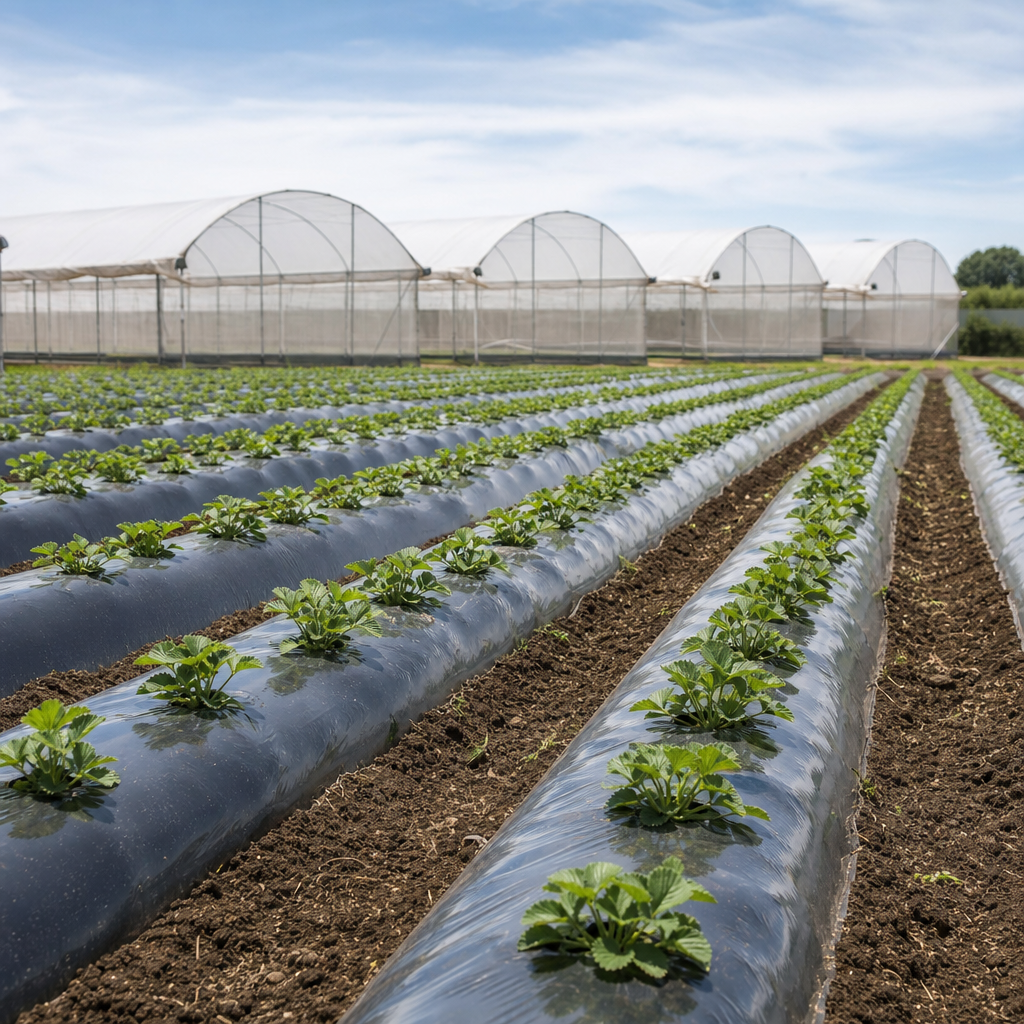
Polymers are embedded in modern agriculture, from the films that protect seedlings to the superabsorbent materials that hold water in dry soils. In practical terms, a polymer is a large molecule made of repeating units, engineered to deliver specific properties such as flexibility, strength, permeability, biodegradability, or chemical resistance. When farmers, agronomists, and input manufacturers talk about agricultural innovations, they increasingly mean polymer-enabled systems that improve yield, resource efficiency, crop protection, and post-harvest performance.
This matters because farming now operates under tighter margins and greater environmental pressure than at any point in recent decades. Water scarcity is intensifying in many growing regions. Labor shortages are pushing growers toward automation and easier-to-handle materials. Regulators and buyers are demanding lower pesticide drift, lower plastic waste, and more traceable inputs. At the same time, climate variability is making uniform crop establishment harder. In that environment, polymers are not a niche material category. They are a functional platform used in mulch films, greenhouse coverings, controlled-release fertilizers, seed coatings, silage wraps, irrigation components, nets, twines, and packaging systems that reduce loss across the value chain.
Successful polymer applications share one trait: they solve a specific agronomic problem better than the conventional alternative. A mulch film works because it modifies soil temperature, suppresses weeds, and conserves moisture. A controlled-release fertilizer coating works because it meters nutrient release to plant demand. A biodegradable transplant clip succeeds only if it performs through the crop cycle and then breaks down under realistic field or composting conditions. Having worked with growers and suppliers evaluating these materials, I have seen that performance in agriculture is never about chemistry alone. It depends on installation method, climate, soil biology, machine compatibility, recovery logistics, and total cost per hectare.
For a hub article on successful polymer applications, the useful approach is to organize the subject by function. Where do polymers create measurable value in the field, under cover, in irrigation, in crop nutrition, in animal feed preservation, and after harvest? What tradeoffs should buyers understand before adoption? Which standards and tools help compare options? The sections below answer those questions directly, using real agricultural use cases and the terminology professionals rely on when making material decisions.
Mulch Films, Covers, and Protected Cultivation Systems
One of the most established polymer uses in agriculture is plasticulture: the use of polymer films and coverings to shape the crop environment. Polyethylene mulch films are widely used in vegetables such as tomato, pepper, melon, strawberry, and cucumber. Black mulch blocks light and suppresses weed emergence. Clear mulch warms soil more aggressively but may require herbicide or fumigation support because light transmission can stimulate weeds. Reflective silver films can deter certain insect pests, including aphid vectors, by altering light signals. The core agronomic benefit is consistency. By reducing evaporation and stabilizing the root zone, mulch often improves early vigor and marketable yield.
Greenhouse and tunnel covers are another major application. Low-density polyethylene and ethylene-vinyl acetate films are chosen for light transmission, diffusion, anti-drip behavior, and thermal retention. In commercial protected cultivation, additives are tuned to local conditions. Diffuse light films are valuable in high-radiation regions because they spread incoming light deeper into the canopy, reducing scorch and improving photosynthetic uniformity. Anti-condensation treatments matter because dripping water can spread disease and create leaf wetness. UV stabilization matters because unprotected films degrade quickly under solar exposure. These are not minor features. Cover selection can change disease pressure, labor requirements, and harvest timing over an entire season.
Nonwoven polymer row covers and insect nets extend the same logic. Polypropylene spunbond covers protect against frost, wind, and some pests while still allowing air and water movement. Insect exclusion nets made from polyethylene or similar polymers are now common in high-value horticulture where virus pressure is severe. A simple example is brassica production under netting to reduce flea beetle damage without repeated foliar sprays. The success of these systems depends on mesh size, durability, and management discipline. A torn net or poorly sealed edge can undermine the whole investment.
Water Management: Drip Irrigation, Pipes, and Superabsorbent Polymers
Water management is where polymer applications often deliver their clearest return. Drip irrigation systems rely on polyethylene laterals, emitters, filters, valves, and connectors that can withstand pressure, sunlight, fertilizers, and field handling. Compared with flood or overhead irrigation, drip allows targeted delivery to the root zone, reducing evaporation and often improving water-use efficiency substantially. In orchards, vineyards, and vegetable systems, the polymer components themselves are not the whole innovation; the innovation is the precision they enable. Pressure-compensating emitters maintain more uniform flow across varying topography, which directly affects plant uniformity and fertigation accuracy.
Superabsorbent polymers are another important category, especially in nurseries, landscaping, and some field establishment scenarios. These materials can absorb many times their own weight in water and then release it gradually as the surrounding medium dries. In container production, they may reduce irrigation frequency and buffer against short-term water stress. In tree planting or transplant establishment, they are sometimes blended into the root zone to improve moisture retention. The critical point is that performance depends on water quality, salt concentration, and soil texture. In saline conditions, absorption capacity drops. In poorly drained soils, they may add little value. They are most effective when matched to a clear irrigation management objective rather than used as a generic drought cure.
Reservoir linings also deserve attention. Geomembranes made from high-density polyethylene and related polymers are used in irrigation ponds and effluent containment because they reduce seepage and resist chemical exposure. In regions where every cubic meter of stored water matters, a sound liner can protect the economics of the whole farm. Installation quality is decisive here. Even premium material fails if the subgrade is poorly prepared or seams are not welded and tested correctly.
Controlled-Release Fertilizers, Seed Coatings, and Crop Protection Delivery
Polymers have transformed how nutrients and crop protection products are delivered. Controlled-release fertilizers use polymer coatings around nutrient granules to regulate release based on moisture and temperature. Rather than dumping nitrogen or other nutrients into the soil solution at once, the coating slows diffusion so plants receive a more sustained supply. In turf, ornamentals, and specialty crops, this can reduce leaching losses and cut the number of applications. In row crops, adoption depends on economics and local nutrient loss risk, but the agronomic rationale is strong where rainfall patterns or sandy soils increase losses.
Seed treatment is another area where polymers are indispensable. Film coatings help bind active ingredients, colorants, micronutrients, and biologicals uniformly onto the seed surface. Good polymer binders reduce dust-off, which improves operator safety and preserves dose accuracy. This matters with high-value seeds such as maize, canola, cotton, vegetables, and cereals treated with fungicides, insecticides, inoculants, or combinations of these. Pelleting goes a step further, using polymers and fillers to create more uniform seed shape for precision planting. In crops like lettuce or onion, that uniformity improves singulation and stand establishment.
Encapsulation technologies also improve pesticide handling and field performance. Microencapsulated formulations can reduce volatility, improve shelf stability, and moderate release. That is particularly relevant for actives that are sensitive to light or prone to rapid loss. However, formulation technology must be judged against efficacy, residue limits, and environmental persistence. The best systems improve deposition and crop safety without creating disposal or runoff problems. Experienced buyers look beyond the label claim and ask how the polymer matrix behaves in actual field conditions, including heat, UV exposure, and tank-mix compatibility.
Biodegradable Agricultural Polymers and End-of-Life Management
Conventional agricultural plastics deliver strong performance, but disposal remains one of the sector’s most persistent operational problems. Soil-contaminated mulch film is expensive to recover and recycle. Greenhouse coverings have finite service lives. Twines, clips, and wraps accumulate quickly across intensive production systems. That is why biodegradable agricultural polymers have become one of the most watched innovation areas. Materials based on polymers such as polylactic acid, polybutylene adipate terephthalate blends, and starch-based compounds are being developed for mulch films, clips, pots, and other short-life items.
The promise is straightforward: maintain field performance during use, then break down in soil or industrial composting without leaving problematic residues. The reality is more nuanced. Biodegradation depends on temperature, moisture, microbial activity, thickness, and formulation. A film certified under a recognized standard may still degrade differently in a cool, dry field than in a warm, biologically active one. Standards such as EN 17033 for biodegradable mulch films provide a useful benchmark, but growers should still ask for local trial data. I have seen products perform well agronomically yet disappoint on retrieval assumptions because users expected rapid disappearance under conditions that did not support it.
| Application | Common Polymer Type | Main Benefit | Key Limitation |
|---|---|---|---|
| Mulch film | Polyethylene or biodegradable blends | Weed suppression and moisture conservation | Recovery or degradation conditions |
| Greenhouse cover | LDPE, EVA | Light management and season extension | UV aging and replacement cost |
| Drip irrigation line | Polyethylene | Precise water delivery | Clogging, disposal of seasonal tape |
| Controlled-release fertilizer | Polymer-coated granules | Improved nutrient timing | Higher upfront input cost |
| Seed coating | Polymer binder films | Uniform treatment retention | Must preserve germination and flowability |
End-of-life planning should be part of procurement, not an afterthought. For conventional plastics, ask about collection programs, recyclability, contamination tolerance, and minimum lot requirements. For biodegradable products, ask whether degradation is intended for soil, home compost, or industrial composting, and request the exact certification. Matching the material to the waste pathway is as important as matching it to the crop.
Silage Wrap, Twine, Nets, and Post-Harvest Protection
Successful polymer applications extend beyond crop production into livestock feed preservation and post-harvest handling. Silage films, bale wraps, net wraps, and twines are critical in forage systems because oxygen exclusion determines feed quality. Stretch films made primarily from polyethylene create a tight seal around baled forage, supporting anaerobic fermentation and reducing dry matter losses. In practical farm terms, better film puncture resistance and cling translate into fewer spoiled bales and more consistent feed value. That affects milk production and ration economics, not just storage neatness.
Grain storage and produce packaging also rely heavily on polymers. Hermetic storage liners and bags help suppress insect activity by limiting oxygen exchange, an important tool where chemical fumigation is constrained or costly. Fresh produce packaging uses perforated polymer films to balance moisture retention and gas exchange, extending shelf life for items such as cucumbers, leafy greens, berries, and herbs. Modified atmosphere packaging is a highly technical area, but the principle is simple: the film’s permeability can slow respiration and water loss enough to preserve quality during transport and retail display.
In post-harvest chains, the most successful polymer systems reduce loss without creating hidden handling burdens. For example, a berry punnet film that extends shelf life by two days may create real value if it aligns with packhouse machinery, condensation control, and retailer specifications. If it fogs badly or seals inconsistently, the theoretical benefit disappears. Material choice therefore has to be tested across the actual chain from field heat removal to distribution, not judged in isolation.
How to Evaluate Successful Polymer Applications on Farm
Choosing the right polymer application starts with a narrow agronomic question. Are you trying to save water, suppress weeds, reduce nutrient loss, protect from insects, improve transplant survival, or cut post-harvest waste? Once the problem is defined, compare options using measurable criteria: service life, tensile strength, puncture resistance, UV stability, light transmission, permeability, compatibility with machinery, labor demand, disposal pathway, and cost per hectare or per ton of output. Reputable suppliers should provide technical data sheets, certification details, and trial evidence relevant to your crop and climate.
Field validation is essential. Run side-by-side trials with clear success metrics such as emergence rate, irrigation frequency, marketable yield, fruit size distribution, nitrate leaching reduction, bale spoilage, or shelf-life extension. Include operational metrics too. A mulch film that boosts yield but tears during laying may not survive scale-up. A drip tape that performs hydraulically but clogs under your fertigation program is not a successful application. The best farm teams track both biological and operational outcomes because profitability depends on both.
The larger lesson from successful polymer applications is that agriculture benefits most when materials are treated as part of a system, not as stand-alone products. A greenhouse film changes irrigation demand. A seed coating may affect planter calibration. A controlled-release fertilizer alters nutrient scheduling. A biodegradable mulch changes end-of-season labor. When growers evaluate these interactions upfront, polymers become practical tools for resilience, efficiency, and quality improvement. Review your biggest production bottleneck, identify where a polymer-based system can solve it, and test the option with disciplined on-farm data.
Frequently Asked Questions
1. What are polymers, and why are they so important in modern agriculture?
Polymers are large molecules made from repeating structural units, and they can be engineered to perform very specific functions. In agriculture, that matters because farming environments are demanding: materials must withstand sunlight, moisture, chemicals, temperature swings, and physical wear while still delivering reliable performance. Polymers can be designed for flexibility, toughness, water retention, gas permeability, UV resistance, biodegradability, or controlled chemical release, which makes them extremely useful across a wide range of agricultural applications.
They are important because they help solve practical on-farm problems. For example, polymer films can protect young plants, reduce evaporation, and suppress weeds. Polymer tubing and components improve irrigation efficiency. Superabsorbent polymers can hold and slowly release water in dry soils. Coatings made from specialized polymers can control how seeds, fertilizers, or crop protection products interact with the environment. In each case, the polymer is not just a material choice; it is a functional technology that can improve crop establishment, reduce resource waste, and support more predictable yields.
Another reason polymers matter is that they allow agriculture to become more precise. Instead of applying water, nutrients, or protection products broadly and hoping for the best, polymer-enabled systems can help deliver inputs more effectively and at the right rate. That translates into better efficiency, lower losses, and often a reduced environmental footprint. As farming continues to adapt to climate variability, labor pressures, and sustainability goals, polymers are becoming a foundational part of agricultural innovation.
2. How are polymers used in agricultural films, mulches, and greenhouse coverings?
Agricultural films are one of the most visible and widely adopted uses of polymers in farming. These films are used as mulches on soil surfaces, as covers for tunnels and greenhouses, and as wrapping materials for silage and hay. The reason polymers work so well in these applications is that their properties can be tuned very carefully. A mulch film, for instance, may be designed to block light and suppress weeds, conserve soil moisture, warm the soil, and protect fruit from direct soil contact. Greenhouse films may be engineered to transmit selected wavelengths of light, reduce heat loss at night, resist tearing, and tolerate prolonged UV exposure.
In practical terms, polymer mulch films help farmers create a more favorable microclimate around the crop. Soil temperature becomes more stable, moisture evaporates more slowly, and weed pressure can drop significantly. That often leads to earlier planting windows, faster crop development, cleaner produce, and less reliance on mechanical or chemical weed control. In greenhouse and tunnel production, polymer coverings help extend growing seasons and shield crops from wind, rain, frost, and some pest pressures, which is especially valuable for high-value fruits, vegetables, flowers, and nursery crops.
Modern innovation in this area also includes biodegradable and soil-degradable film technologies, although performance depends on climate, soil conditions, crop cycle length, and product formulation. The industry is working to balance durability in use with easier end-of-life management. Overall, polymer films and coverings have become essential tools for protected cultivation, water conservation, and yield enhancement because they allow growers to actively shape crop conditions rather than simply react to them.
3. What role do polymers play in irrigation and water management?
Polymers play a major role in making agricultural water use more efficient, which is increasingly important in regions facing drought, groundwater stress, or rising irrigation costs. In irrigation systems, polymers are used in pipes, drip lines, emitters, connectors, liners, valves, and filtration components because they offer durability, corrosion resistance, flexibility, and long service life. These materials help deliver water more precisely to the root zone, reducing losses from evaporation, runoff, and overapplication.
One of the most important innovations tied to polymers is drip irrigation. Polymer-based tubing and emitters allow water to be distributed gradually and consistently, which supports better plant health and can significantly improve water-use efficiency compared with less targeted methods. In addition, polymer linings in ponds, canals, and reservoirs help reduce seepage losses, preserving valuable stored water for later use. This is especially important in arid and semi-arid farming systems where every unit of water counts.
Superabsorbent polymers are another key example. These materials can absorb and retain large amounts of water and then release it gradually over time, helping buffer crops against short dry periods. When used appropriately in soils or growing media, they can improve moisture availability near plant roots and may also reduce irrigation frequency in some applications. Their effectiveness depends on soil type, crop, salinity, and application method, so they are not a universal solution, but they are a meaningful tool in water management strategies. Taken together, polymer-based irrigation infrastructure and water-retentive materials help farmers move toward more resilient, efficient, and controlled water use.
4. How are polymers used in fertilizers, seed coatings, and crop protection products?
Polymers are widely used to improve how agricultural inputs are delivered and how long they remain effective. In fertilizers, polymer coatings can create controlled-release products that release nutrients more gradually instead of all at once. This helps better match nutrient availability with crop demand, which can improve uptake efficiency and reduce nutrient losses through leaching, runoff, or volatilization. For growers, that can mean more consistent plant performance, fewer application passes in some cases, and improved nutrient management under variable field conditions.
In seed technology, polymers are often used as binders, films, or protective coatings applied around the seed surface. These coatings can help improve seed flowability during planting, reduce dust-off, protect active ingredients, and carry additives such as micronutrients, biologicals, colorants, or crop protection agents. A well-formulated polymer seed coating can support more uniform planting and better early-stage crop establishment. Some coatings are also designed to manage water interaction around the seed, which can be important during germination and emergence.
Polymers also support crop protection by acting as encapsulation materials, adjuvants, carriers, or controlled-delivery systems for herbicides, fungicides, and insecticides. Their role is to help active ingredients stay stable, spread properly, adhere to plant surfaces, or release over time in a more controlled manner. This can increase the effectiveness of the product while potentially reducing off-target movement or unnecessary reapplication. In short, polymers do not just package agricultural inputs; they improve the precision, efficiency, and field performance of those inputs in ways that are central to modern agronomy.
5. Are agricultural polymers sustainable, and what challenges do they present?
Agricultural polymers can support sustainability, but their overall impact depends on the material type, how it is used, and how it is managed at the end of its life. On the positive side, polymer-enabled technologies often help conserve water, reduce input waste, improve storage and handling, extend infrastructure life, and boost productivity on existing farmland. For example, mulch films can reduce herbicide demand and evaporation, drip systems can cut water losses, and controlled-release fertilizers can lower nutrient inefficiency. In that sense, polymers can contribute meaningfully to more resource-efficient agriculture.
However, there are also legitimate challenges. Conventional polymer products may create disposal issues if they are contaminated with soil, plant residue, or chemicals, making collection and recycling more difficult. Some agricultural plastics degrade physically over time and can become harder to recover if not managed properly. Cost is another consideration, especially for smaller producers or in regions with limited waste-handling infrastructure. Performance trade-offs can also arise with biodegradable alternatives, since materials must balance strength and durability during use with reliable breakdown afterward.
This is why the future of sustainable agricultural polymers is centered on smarter design and better systems, not simply more material use. Manufacturers are developing biodegradable polymers, recyclable film structures, longer-lasting components, and formulations tailored to lower environmental impact. At the same time, growers and supply-chain partners are paying more attention to recovery programs, product stewardship, and life-cycle thinking. The most sustainable approach is one that evaluates the full picture: agronomic benefit, durability, resource savings, end-of-life management, and local farming conditions. When chosen and handled well, polymers can be part of a more sustainable agricultural model, but responsible use and disposal remain essential.