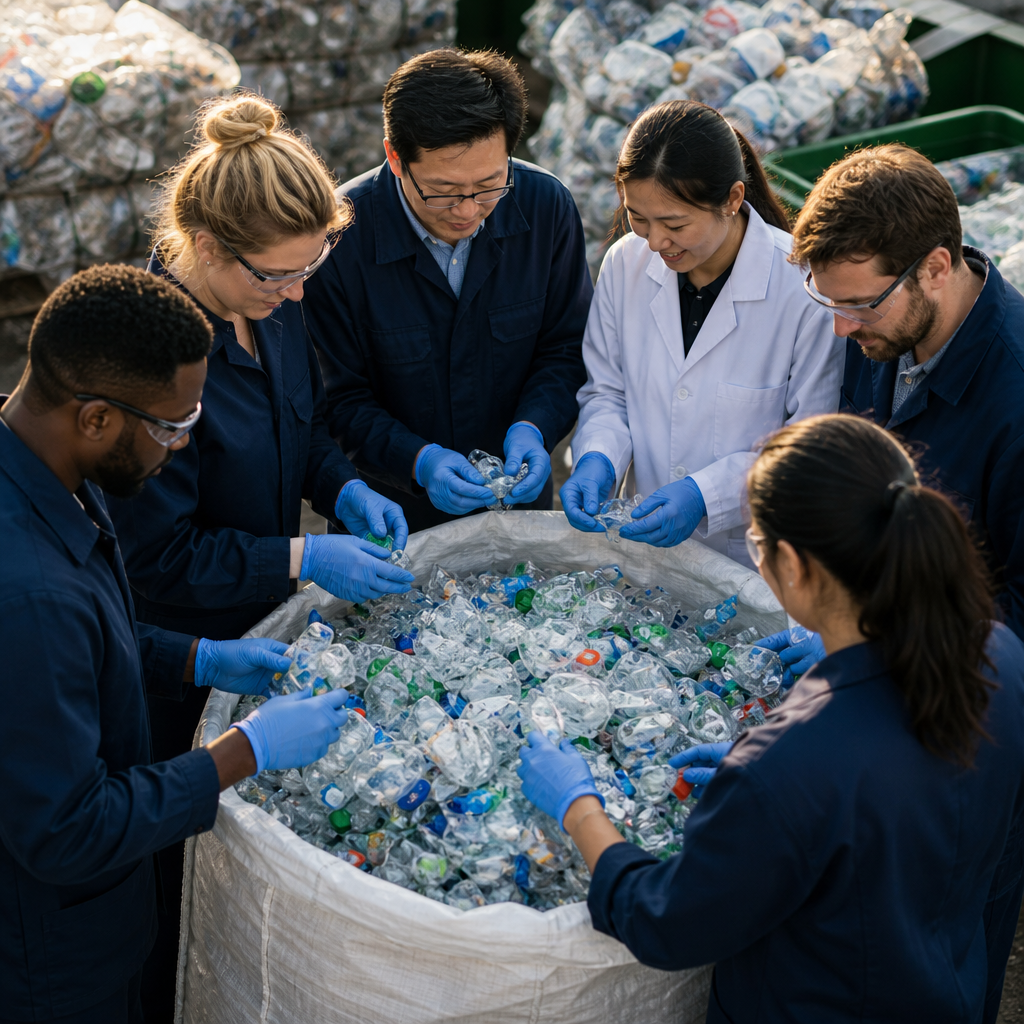
Global collaboration has become one of the defining forces shaping modern polymer recycling efforts, turning a fragmented waste challenge into a shared industrial, environmental, and policy agenda. In this context, polymer recycling refers to the collection, sorting, reprocessing, and reintegration of plastic-based materials into new products through mechanical, chemical, or solvent-based methods. Global collaboration means cross-border cooperation among governments, manufacturers, waste managers, research institutions, standards bodies, and investors. I have worked on recycling content strategy and technical briefings for manufacturers and circular economy programs, and one lesson stands out: polymer recycling scales fastest when countries, companies, and institutions stop treating waste as a local problem and start building interoperable systems. That matters because plastics move through international supply chains long before they become waste. Packaging resin may be produced in the Gulf, converted in Southeast Asia, filled in Europe, consumed in Africa, and discussed by regulators at the United Nations. Any serious recycling solution must therefore connect design standards, collection systems, certification rules, and end-market demand across borders.
This hub page on case studies in polymer recycling examines how global collaboration changes real outcomes, not just intentions. It looks at why harmonized design-for-recycling guidelines improve material recovery, how shared investment lowers risk for advanced recycling infrastructure, and why international standards for traceability and recycled content matter for buyers. It also covers the practical limitations: contamination, uneven collection systems, economics tied to virgin resin prices, and the persistent gap between pilot projects and full-scale deployment. Readers searching for case studies in polymer recycling usually want direct answers to a few questions. What does effective collaboration actually look like? Which industries are making measurable progress? Where do projects fail, and why? This article addresses those questions while serving as a central resource for the broader subtopic. The core takeaway is simple: global collaboration does not replace local execution, but it makes local execution more consistent, bankable, and technically credible.
Why Global Collaboration Matters in Polymer Recycling
Polymer recycling succeeds when multiple parts of the value chain align, and that alignment rarely happens inside one company or one country alone. A packaging producer can redesign a bottle for recyclability, but if municipal sorting facilities cannot identify the resin, the improvement is lost. A recycler can install a wash line for polyethylene film, but if brand owners do not commit to buying recycled pellet, the economics collapse. Cross-border cooperation matters because polymer markets are global, equipment vendors sell internationally, and consumer brands set packaging requirements across regions. In practice, I have seen stronger outcomes when collaboration includes three elements at once: common technical definitions, long-term procurement signals, and transparent data sharing. Without those, projects remain isolated case studies rather than repeatable models.
International collaboration also reduces duplication. Organizations such as the Ellen MacArthur Foundation, the Alliance to End Plastic Waste, Plastics Recyclers Europe, APR, and ISO working groups have helped create shared language around recyclability, recycled content, and material quality. That shared language is not academic. It directly influences bale specifications, labeling rules, audit requirements, and capital allocation. For example, if a consumer goods company sets a global target for post-consumer recycled content in polypropylene packaging, it needs consistent testing methods and supplier documentation across continents. Collaboration turns recycling from a patchwork of local experiments into a network of interoperable systems. That is the difference between isolated recovery and a functioning circular materials market.
Case Studies in Polymer Recycling: What the Best Examples Have in Common
The strongest case studies in polymer recycling typically combine policy support, design changes, technology deployment, and market demand. Germany’s packaging recovery system illustrates this well. Its relatively mature collection and sorting infrastructure, combined with extended producer responsibility and clear labeling expectations, created stable feedstock streams for mechanical recycling. The lesson is not that every country should copy Germany line for line. The lesson is that predictable rules and consistent material flows make investment possible. Similar patterns appear in the Netherlands, where advanced sorting capacity and collaboration between municipalities and private operators have improved recovery for rigid plastics.
Another important example comes from food and beverage packaging. When multinational brands standardized clear PET bottle formats, reduced problematic additives, and supported bottle-to-bottle recycling systems, recyclers gained access to cleaner input streams. PET recycling has advanced partly because companies across regions converged around designs that sorting systems could recognize and end markets could trust. By contrast, multi-material flexible packaging has lagged because collaboration on collection, sorting, and end-use standards has been weaker. Good case studies are therefore not just stories about technology. They show coordinated decisions made upstream, midstream, and downstream.
| Case study area | Collaboration mechanism | Result | Main lesson |
|---|---|---|---|
| PET beverage bottles | Brand alignment on design, deposit systems, recycler contracts | Higher collection rates and bottle-grade recycled PET output | Standardized formats improve quality and economics |
| HDPE household packaging | Shared sorting specifications and post-consumer resin testing | More stable supply for non-food and some food-contact uses | Quality assurance builds buyer confidence |
| Agricultural film programs | Cooperation among farmers, distributors, and local consolidators | Better recovery of dirty, dispersed polyethylene film | Logistics partnerships matter as much as processing technology |
| Mixed flexible packaging pilots | Joint investment in advanced sorting and chemical recycling trials | Technical progress but uneven commercial scale | Innovation needs long-term feedstock and offtake commitments |
How Standards, Data, and Design Rules Improve Outcomes
Standards are one of the least visible but most powerful forms of collaboration in polymer recycling. Recyclers need repeatable inputs, converters need reliable recycled resin, and brand owners need defensible claims. That requires specification discipline. Design guidance from APR and RecyClass, for example, helps packaging teams avoid features that disrupt recycling, such as carbon black pigments in certain streams, incompatible labels, full-body shrink sleeves, or adhesive systems that contaminate wash water. When global brands use common design rules across markets, they simplify sorting and improve yield. I have seen packaging teams treat these guides as optional until they compare line losses, discoloration, and customer complaints linked to poor feedstock quality. After that, design-for-recycling stops being a sustainability slogan and becomes an operational requirement.
Data transparency matters just as much. Mass balance accounting, chain-of-custody certification, and recycled content verification are increasingly central where chemical recycling or complex multi-site supply chains are involved. ISCC PLUS is often used to document attributed recycled content in certified supply systems. ASTM methods and ISO standards support testing for properties such as melt flow, contamination, density, and mechanical performance. Buyers need this because polymer recycling is ultimately judged by whether the output works in demanding applications. If a recycled polypropylene grade cannot meet impact resistance targets for caps and closures, no amount of messaging will create a market. Collaboration around data standards gives converters confidence to qualify recycled content without increasing product risk.
Technology Transfer and Shared Investment Across Borders
Global collaboration accelerates technology transfer by spreading proven methods faster than any one market could on its own. Optical sorting, near-infrared detection, digital watermarking trials, hot-wash systems, deodorization units, and depolymerization technologies have all advanced through international partnerships among equipment makers, resin producers, universities, and public agencies. In several projects I reviewed, facilities avoided expensive trial-and-error because they adapted process settings and contamination controls already validated in other countries. This is especially important for emerging markets, where capital budgets are tight and feedstock quality can be highly variable. Access to tested equipment configurations and operating knowledge reduces commissioning risk.
Shared investment is equally important. Building polymer recycling infrastructure is capital intensive, particularly for advanced recycling plants, solvent purification systems, or integrated sorting and washing hubs. International development banks, corporate venture funds, and strategic joint ventures can help close financing gaps. For instance, collaborations involving petrochemical producers and waste management firms have supported pyrolysis oil supply chains for mixed polyolefin waste, although commercial performance remains uneven and depends heavily on feedstock control. The practical lesson is clear: collaboration does not guarantee success, but it improves the odds by distributing risk, improving technical oversight, and creating offtake pathways before assets come online.
Regional Examples That Show the Power and Limits of Collaboration
Europe offers some of the clearest examples of coordinated polymer recycling, largely because regulation, producer responsibility, and consumer brand pressure have moved in the same direction. Countries with deposit return systems often achieve much higher beverage container collection rates than those without them, creating cleaner PET streams for bottle-to-bottle applications. The European Union’s recycled content mandates and packaging policy discussions have also pushed companies to qualify more recycled resin in mainstream products. Still, even in Europe, flexible packaging and food-contact polyolefins remain difficult, proving that strong policy cannot fully compensate for technical complexity.
In Asia, collaboration often takes a different form. Manufacturing scale, export-oriented supply chains, and rapid packaging growth make the region central to polymer recycling economics. Japan has long emphasized disciplined waste separation and industrial coordination. South Korea has combined policy direction with advanced processing capability. In Southeast Asia, progress is more uneven, but partnerships among global consumer brands, local recyclers, and nongovernmental organizations have improved collection in urban areas, especially for PET and HDPE. In North America, the picture is mixed but important. The United States has strong innovation capacity, major resin producers, and sophisticated reclaimers, yet collection systems vary by municipality. Cross-company initiatives such as The Recycling Partnership and the Closed Loop Partners network show how collaboration can fill infrastructure and education gaps where policy is inconsistent.
The Hard Problems Collaboration Still Has to Solve
Despite real progress, polymer recycling still faces barriers that collaboration alone cannot erase. Contamination remains a basic and expensive problem. Food residue, incompatible polymers, labels, inks, fillers, and multilayer structures all reduce yield and increase processing cost. Mechanical recycling also degrades polymer properties over time, which means not every product can become the same product again without additives, blending, or downcycling into lower-spec applications. Chemical recycling can handle some streams that mechanical methods struggle with, but energy use, capital cost, and mass balance accounting continue to attract scrutiny. A credible strategy requires matching each waste stream to the right process, not assuming one technology will solve everything.
Economics are another constraint. When virgin resin prices fall, recycled polymers can become less competitive unless regulation, procurement commitments, or brand requirements support demand. Collection costs are especially challenging in regions with dispersed populations or informal waste systems. Collaboration helps by improving logistics, standardizing packaging design, and aggregating demand, but those gains do not remove market volatility. That is why the most resilient case studies combine commercial realism with policy support. They recognize that polymer recycling is both an engineering problem and a market design problem.
How This Hub Supports Deeper Case Study Research
As a hub for case studies in polymer recycling, this page is designed to frame the main patterns readers should look for when evaluating any project or regional example. The best case studies answer five questions directly. What polymer stream is being targeted: PET, HDPE, PP, LDPE film, polystyrene, nylon, or mixed waste? What collection and sorting system supplies the feedstock? What processing route is used: mechanical regranulation, dissolution, depolymerization, pyrolysis, or hybrid upgrading? Who buys the output, under what quality specifications, and at what volume? Finally, which collaboration model underpins the project: policy coordination, brand consortium, technology partnership, municipal-private contract, or vertically integrated investment? If a case study cannot answer those questions, it is usually more marketing than evidence.
The broader benefit of global collaboration is not abstract goodwill. It is faster learning, lower technical risk, better material quality, and stronger end-market confidence. Polymer recycling improves when designers use shared guidelines, governments create predictable frameworks, recyclers publish quality data, and buyers commit to qualified recycled content. The strongest case studies prove that no single actor can build circularity alone. Use this hub as your starting point for deeper analysis of specific polymers, regions, technologies, and commercial models, and evaluate every example through the same practical lens: feedstock, process, standards, economics, and proof of demand. That is how collaboration turns ambition into measurable recycling performance.
Frequently Asked Questions
1. Why is global collaboration so important for improving polymer recycling efforts?
Global collaboration is essential because polymer waste does not follow national borders, while supply chains for plastics, packaging, manufacturing, and consumer goods are already deeply international. A product may be designed in one country, produced in another, consumed in a third, and discarded somewhere else entirely. Without cross-border cooperation, recycling systems remain fragmented, standards vary widely, and valuable materials are often lost because collection, sorting, labeling, and processing practices are not aligned. Collaboration helps connect these disconnected parts of the value chain into a more functional system.
In practical terms, international cooperation allows governments, manufacturers, recyclers, waste managers, research institutions, and brand owners to work toward shared definitions, technical standards, and policy frameworks. That means clearer material identification, more recyclable product design, better infrastructure planning, and improved market confidence in recycled polymers. It also helps reduce duplication of effort. Instead of each region independently trying to solve the same technical and regulatory problems, stakeholders can share data, pilot results, and best practices.
Global collaboration also matters because polymer recycling includes multiple pathways, including mechanical recycling, chemical recycling, and solvent-based recovery, each with different technical and economic requirements. Some countries have advanced sorting systems but limited end-market demand, while others have strong manufacturing capacity but weaker waste collection systems. By cooperating, countries and industries can build complementary strengths rather than operating in isolation. The result is a more resilient recycling ecosystem that can process more material, improve quality, and support circular economy goals on a much larger scale.
2. How does international cooperation improve the technology and efficiency of polymer recycling?
International cooperation accelerates technological progress by making innovation more transferable and scalable. Polymer recycling is a technically complex field that depends on accurate sorting, contamination control, polymer-specific processing, and stable output quality. Different countries and companies often develop valuable solutions in isolation, such as advanced optical sorting, AI-driven waste characterization, improved depolymerization systems, or solvent purification techniques. When these innovations are shared through research partnerships, industry consortia, standards bodies, and public-private initiatives, they can be tested and adopted much faster across markets.
Efficiency improves when collaboration creates more consistency in what enters the recycling stream. For example, if packaging formats, labeling systems, additives, and material combinations become more standardized internationally, recyclers can operate with less uncertainty and lower processing costs. A recycling facility performs better when incoming waste is more predictable. Cross-border cooperation on design-for-recycling principles can therefore improve everything from bale quality and sorting yield to reprocessing performance and the final value of recycled resin.
Another major benefit is shared investment in infrastructure and knowledge. Some technologies, especially in chemical recycling and advanced purification, require significant capital, long development timelines, and regulatory confidence. Global collaboration helps distribute those risks. Joint ventures, multinational funding programs, and shared pilot projects allow stakeholders to test technologies under different waste conditions and regulatory environments. This creates stronger evidence on what works, where it works, and how it can be commercially scaled. Over time, that kind of coordinated learning improves both the technical performance and economic viability of polymer recycling systems worldwide.
3. What role do governments and international policy frameworks play in global polymer recycling collaboration?
Governments play a foundational role because they shape the regulatory conditions under which polymer recycling either grows or struggles. Collection systems, extended producer responsibility programs, recycled content mandates, landfill restrictions, import and export rules, product labeling requirements, and environmental permitting all influence whether recycling becomes a preferred pathway for plastic waste. When countries collaborate on policy, they reduce regulatory mismatch and create a more stable environment for investment, trade, and innovation in recycled polymers.
International policy frameworks are especially important in areas where inconsistent rules can disrupt material flows or discourage infrastructure development. For instance, if one country classifies certain polymer waste as a valuable secondary raw material while another treats it as a problematic waste stream, recyclers and manufacturers face uncertainty. Harmonized frameworks can clarify how materials are tracked, traded, processed, and certified. This is particularly relevant for ensuring that exported plastic waste is handled responsibly and that recycled polymers meet quality and safety expectations across markets.
Governments also support collaboration by funding research, setting procurement targets, promoting common standards, and participating in multinational environmental agreements. Their involvement helps align environmental goals with industrial strategy. Importantly, policy can encourage not just more recycling, but better recycling by rewarding circular product design, improving traceability, and supporting domestic and international demand for recycled content. In that sense, government action is not separate from global collaboration; it is one of the main mechanisms through which collaboration becomes operational, measurable, and durable over time.
4. What are the biggest challenges that global partnerships face in polymer recycling?
One of the biggest challenges is inconsistency. Countries differ widely in waste collection coverage, recycling infrastructure, technical capabilities, labor costs, environmental enforcement, and consumer behavior. Even when stakeholders agree on broad goals, translating those goals into compatible systems is difficult. A packaging format considered recyclable in one market may be non-recyclable in another because the local sorting equipment, reprocessing capacity, or end-use market is different. These uneven starting points can slow collaboration and make global standards harder to implement.
Another challenge is economic alignment. Recycling must compete with virgin polymer production, which can be cheaper, especially when fossil fuel prices are favorable and policy support for recycled content is weak. Global partnerships may agree on sustainability principles, but if financial incentives are not aligned, recycled materials can still struggle in the marketplace. Investments in collection, sorting, and advanced processing require long-term confidence, and that confidence can be undermined by fluctuating regulations, uncertain demand, or limited transparency in supply chains.
Trust and data quality are also major issues. Effective collaboration depends on credible reporting about collection rates, contamination levels, recycling yields, emissions performance, and recycled content claims. If stakeholders use different methodologies or lack transparent verification, it becomes difficult to compare results and make sound decisions. There are also geopolitical and trade-related concerns, including restrictions on waste shipments, concerns about environmental justice, and fears that lower-income regions may become burdened with poorly managed plastic waste. Addressing these challenges requires more than goodwill. It requires enforceable standards, transparent monitoring, fair financing, and a commitment to building systems that are environmentally sound as well as commercially practical.
5. How can global collaboration shape the future of the circular economy for polymers?
Global collaboration can shape the future of the circular economy by moving polymer recycling from a largely reactive waste-management activity to a more integrated material strategy. In a circular model, polymers are not treated as disposable outputs but as resources that retain value through repeated use, recovery, and reintegration into manufacturing. Achieving that vision requires coordinated action across product design, collection logistics, recycling technology, quality assurance, procurement, and end-market development. No single company or country can build that system alone.
Looking ahead, collaboration is likely to drive stronger design-for-circularity principles, more interoperable recycling standards, and better digital traceability tools that follow materials through the supply chain. It can also expand access to recycling infrastructure in regions that are currently underserved, helping to reduce leakage into land and marine environments while increasing the volume of polymers available for recovery. As more nations and industries share technical expertise and investment, the quality and reliability of recycled polymers should improve, making them more competitive in high-value applications.
Perhaps most importantly, global collaboration can redefine success in polymer recycling. The future circular economy will not be measured only by how much plastic is collected, but by how effectively materials are kept at their highest practical value, how safely they are processed, and how well environmental and economic outcomes are balanced. Cross-border partnerships make it possible to scale proven solutions, avoid repeating failures, and create common expectations for accountability. If sustained, this cooperative approach can help transform polymer recycling into a more mature, efficient, and globally connected pillar of circular industry.