Polymers have become essential to improving electronic device performance because they solve practical engineering problems that traditional materials often cannot address at scale. In electronics, a polymer is a large molecule made of repeating units that can be engineered to be insulating, conductive, flexible, transparent, heat resistant, chemically stable, or highly processable. That combination matters because modern devices are no longer judged only by raw computing power. They are evaluated by weight, durability, battery life, manufacturability, thermal stability, signal integrity, and user experience. In every one of those areas, polymers now play a direct role.
In my work reviewing materials choices for consumer electronics, industrial sensors, and compact power systems, the same pattern appears repeatedly: when a device underperforms, the root cause is often not the semiconductor itself but the surrounding materials system. Packaging cracks during thermal cycling. Moisture degrades circuits. Rigid housings limit form factor. Adhesives fail under vibration. Excess heat shortens component life. Signal losses increase at higher frequencies. Engineers increasingly turn to high-performance polymers, conductive polymers, elastomers, epoxies, polyimides, silicones, fluoropolymers, and liquid crystal polymers to address those problems without adding excessive mass or cost.
This hub article explains how polymers improve electronic device performance through problem-solving applications. It defines the major functions polymers serve, shows where they outperform metals, ceramics, or glass, and highlights the tradeoffs engineers must manage. It also acts as a practical map for related case studies under the broader Case Studies and Applications topic. If you want to understand why phones bend less, batteries last longer, wearables flex safely, circuit boards survive heat, and sensors function in harsher environments, the answer usually includes a carefully selected polymer system.
Why Polymers Matter in Electronic Device Design
Polymers matter because they let engineers tune material behavior more precisely than many conventional materials allow. A single device may require electrical insulation, controlled dielectric properties, impact resistance, flame retardancy, optical clarity, and compatibility with automated assembly. Metals excel at conductivity and strength, but they add weight and can create electromagnetic interference issues. Ceramics tolerate heat well, yet they are brittle and harder to process into thin, complex shapes. Polymers fill the gap by offering tailored combinations of mechanical, thermal, and electrical performance.
A common misconception is that polymers are merely cheap plastic enclosures. In advanced electronics, they are structural, functional, and often mission critical. Polyimide films are used in flexible printed circuits because they combine thermal stability with bend resistance. Epoxy molding compounds protect semiconductor packages from moisture and mechanical shock. Silicone gels cushion delicate components and manage stress around wire bonds. Thermoplastic polyurethanes improve wearable comfort while protecting embedded sensors. Liquid crystal polymers are used in high-frequency connectors and antennas because their dielectric properties support signal performance in compact designs.
Performance gains come from matching polymer chemistry to failure mode. If the problem is heat, engineers choose materials with higher glass transition temperatures, thermal conductivity additives, or stable long-term aging behavior. If the problem is miniaturization, they select polymers that mold into thin walls and fine features without warping. If the issue is repeated flexing, they prioritize fatigue resistance and low modulus. This is why polymers have moved from supporting materials to design enablers in smartphones, electric vehicles, medical electronics, industrial automation, aerospace control systems, and next-generation communications hardware.
Solving Thermal Management and Reliability Problems
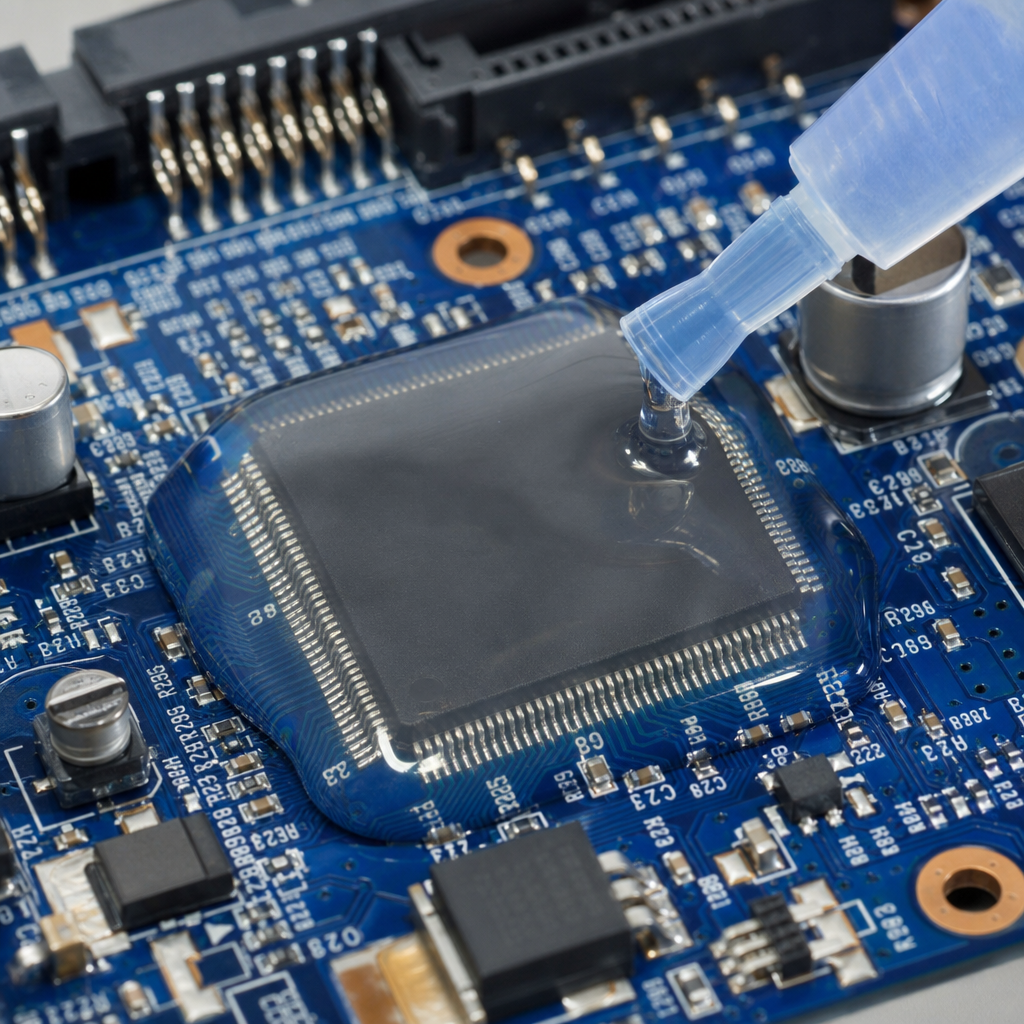
Thermal management is one of the most persistent problems in electronic device performance, and polymers contribute more than many designers initially expect. Pure polymers are usually thermal insulators, but engineered formulations can dissipate heat effectively while preserving electrical insulation. Thermal interface materials, potting compounds, gap fillers, and encapsulants often use silicone or epoxy matrices loaded with alumina, boron nitride, or aluminum nitride. These systems transfer heat away from processors, power modules, LEDs, and battery packs while reducing mechanical stress between dissimilar materials.
In power electronics, reliability often depends on surviving thermal cycling rather than peak temperature alone. Components repeatedly expand and contract during operation. If surrounding materials have poor adhesion or mismatched coefficients of thermal expansion, solder joints crack and packages delaminate. I have seen redesigns succeed simply by replacing a rigid encapsulant with a more compliant polymer formulation that redistributed stress. That change did not alter the chip architecture, yet field failures dropped because the polymer solved the real mechanical-thermal mismatch.
LED lighting offers a clear example. High junction temperatures reduce lumen output and accelerate degradation. Polymers improve LED systems through reflective housings, encapsulants with optical stability, and thermal interface materials that move heat toward sinks. In battery systems, flame-retardant polymers and separator materials are equally critical. Polyethylene and polypropylene separators in lithium-ion cells prevent direct contact between electrodes while allowing ion transport. Advanced coatings improve shutdown behavior and thermal stability, directly affecting safety and cycle life.
Thermal solutions always involve tradeoffs. Adding ceramic filler can improve conductivity but may raise viscosity and complicate dispensing. Softer materials relieve stress but may pump out under pressure. Engineers therefore validate polymer choices with thermal cycling, damp heat exposure, adhesion testing, and accelerated life methods such as JEDEC and IPC-aligned qualification protocols.
Improving Electrical Performance, Signal Integrity, and Miniaturization
As electronics become faster and smaller, polymers increasingly determine whether electrical performance goals are realistic. Dielectric constant, dissipation factor, insulation resistance, comparative tracking index, and dielectric breakdown strength are not abstract lab metrics; they affect signal loss, arcing resistance, power density, and long-term stability. Materials used around high-speed interconnects and antennas must support clean signal transmission. At millimeter-wave frequencies, losses that seem minor at lower frequencies become unacceptable.
Liquid crystal polymer, polytetrafluoroethylene, and certain engineered polyolefins are valuable in high-frequency applications because they exhibit low moisture absorption and stable dielectric behavior. That matters in 5G antennas, radar modules, and compact RF connectors. Moisture uptake changes dielectric properties and can shift signal performance, especially in outdoor or humid conditions. A polymer with low water absorption protects electrical consistency over time.
Miniaturization also depends on polymers because they can be injection molded with extremely fine tolerances and thin walls. Connectors, coil formers, chip carriers, and sensor housings all benefit from dimensional stability and precision processing. In printed circuit assemblies, solder masks, underfills, conformal coatings, and laminate resins all influence reliability. Epoxy-based FR-4 remains standard in many boards, but higher-performance resin systems are used when frequencies rise or operating environments become harsher.
| Electronic problem | Polymer solution | Typical application | Performance benefit |
|---|---|---|---|
| Signal loss at high frequency | Liquid crystal polymer | 5G antennas and connectors | Lower dielectric loss and better dimensional stability |
| Cracking during thermal cycling | Compliant silicone encapsulant | Power modules | Stress reduction and longer service life |
| Moisture-driven corrosion | Acrylic or silicone conformal coating | Industrial control boards | Barrier protection in humid environments |
| Rigid form factor limits | Polyimide flexible substrate | Wearables and foldable devices | Bendability with heat resistance |
| Heavy device construction | Glass-filled engineering thermoplastic | Laptop and sensor housings | Weight reduction with structural strength |
Conductive polymers also deserve attention. Materials such as PEDOT:PSS are used in antistatic coatings, organic electronics, sensors, and transparent conductive applications. They do not replace copper in mainstream power transmission, but they solve niche problems where flexibility, low-temperature processing, or optical transparency matter more than maximum conductivity. That is the broader lesson: polymers often improve electronics not by outperforming metals at their own strengths, but by enabling performance combinations that metals cannot deliver.
Enabling Flexibility, Protection, and Advanced User-Centered Design
Consumer and medical electronics have pushed polymers into the spotlight because users now expect devices to be thinner, lighter, tougher, and more comfortable. These expectations create conflicting design requirements. A wearable sensor must flex with the body but still shield electronics from sweat, impact, and daily abrasion. A foldable display must survive repeated bending while maintaining optical quality and adhesion across multiple layers. A medical patch must be biocompatible, breathable, and electrically dependable. Polymers make these products feasible.
Flexible electronics rely on polymer substrates such as polyimide, polyethylene terephthalate, and thermoplastic polyurethane. Polyimide remains the benchmark for many flexible circuits because it survives soldering temperatures and repeated bending. PET is common where cost and transparency matter, including membrane switches and some display layers. TPU is valued in soft wearables because it combines elasticity with toughness. These materials support sensors, batteries, conductive traces, and protective layers in formats rigid boards cannot match.
Protection is equally important. Conformal coatings based on acrylic, urethane, silicone, parylene, or epoxy protect printed circuit boards against moisture, dust, salt spray, and chemicals. Each chemistry solves a different problem. Acrylics are easy to process and repair. Silicones tolerate wide temperature ranges. Parylene provides a very uniform vapor-deposited barrier for medical and aerospace electronics. Urethanes resist solvents well. Choosing the wrong coating can trap stress, complicate rework, or fail in chemical exposure, so environment-specific selection is essential.
Polymers also improve human factors. Soft-touch overmolding, transparent covers, low-weight housings, and gasket materials shape the way devices feel and survive daily use. In rugged handheld scanners and field instruments, thermoplastic elastomers absorb impact energy better than brittle casing materials. In earbuds and hearing devices, silicone components improve comfort and seal quality. Better usability is not cosmetic. It increases adoption, reduces breakage, and extends real-world service life, which is a measurable performance outcome.
Manufacturing Efficiency, Sustainability Pressures, and Material Selection Strategy
Another reason polymers improve electronic device performance is that they enable scalable manufacturing. Injection molding, film extrusion, lamination, dispensing, transfer molding, and additive deposition all support high-throughput production with tight repeatability. A material that performs well in the lab but cannot be processed consistently at volume is not a true solution. Polymers often win because they integrate performance with manufacturability. For example, a liquid crystal polymer connector housing can maintain precision in thin sections while supporting automated assembly, helping both signal quality and production yield.
Material selection, however, is never one-dimensional. Engineers balance thermal class, dielectric requirements, chemical resistance, UL 94 flammability ratings, outgassing limits, RoHS and REACH compliance, coefficient of thermal expansion, mold shrinkage, and total cost. In automotive electronics, long-term heat aging and vibration resistance are critical. In aerospace, low outgassing and radiation tolerance may dominate. In consumer products, surface finish, drop performance, and cost pressure often lead decisions. The best polymer choice depends on the actual failure risks and business constraints of the device.
Sustainability is now part of that evaluation. Electronics manufacturers face pressure to reduce halogens, improve recyclability, lower embodied carbon, and extend product life. Polymers present both opportunities and challenges here. Lightweight polymer housings can reduce shipping emissions and energy use in portable devices. Durable encapsulants can extend service intervals. Bio-based polymers and recycled-content engineering plastics are growing, but performance validation remains essential because electronics demand consistency across years of use. A greener material that absorbs too much moisture or creeps under load can create more waste through premature failure.
The most effective strategy is disciplined problem-solving with polymers: define the dominant failure mode, map performance requirements, compare candidate chemistries, prototype under realistic loads, and validate with accelerated testing plus field feedback. That approach consistently produces better electronics than selecting materials by habit or brochure claims alone.
Conclusion
The impact of polymers on improving electronic device performance is broad, measurable, and still expanding. Polymers solve heat, moisture, vibration, insulation, signal loss, weight, flexibility, and protection challenges that directly affect whether a device succeeds in the field. They support semiconductor packaging, flexible circuits, conformal coatings, battery safety layers, precision connectors, and ergonomic housings. In many applications, the polymer system around the electronics is what makes advanced functionality reliable enough for everyday use.
The central lesson of problem-solving with polymers is simple: better electronics come from better materials matching, not from chasing a single headline specification. Engineers need to understand the environment, the failure mechanisms, the processing route, and the tradeoffs among thermal, mechanical, and electrical properties. When that work is done well, polymers do more than protect components. They unlock smaller designs, higher reliability, greater comfort, and lower manufacturing risk.
Use this hub as your starting point for deeper case studies on packaging, flexible electronics, thermal materials, coatings, and high-frequency applications. If you are evaluating a new device design or troubleshooting a persistent reliability issue, begin with the materials stack. In modern electronics, polymer selection is often the fastest route to meaningful performance improvement.
Frequently Asked Questions
1. How do polymers improve electronic device performance compared with traditional materials?
Polymers improve electronic device performance by addressing several engineering requirements at the same time, which is something many traditional materials struggle to do efficiently or economically. In electronics, polymers can be designed to act as insulators, semiconductors, conductive layers, flexible substrates, encapsulants, adhesives, and thermal management materials. That versatility allows engineers to tailor a material for a very specific function rather than forcing a rigid metal, ceramic, or glass component to meet demands it was never optimized for. As a result, devices can become lighter, thinner, more durable, and easier to manufacture at scale.
One of the biggest advantages is processability. Many polymers can be deposited as thin films, molded into complex shapes, coated over large areas, or printed using cost-effective manufacturing methods. This helps reduce production complexity while supporting miniaturization and high-volume output. Polymers also contribute to electrical reliability by providing insulation between sensitive components, protecting circuits from contamination, and maintaining stable performance under changing environmental conditions. In advanced electronics, specially engineered polymers can even participate directly in charge transport, signal transmission, or light emission, making them active contributors to performance rather than just passive support materials.
Another important factor is that modern electronic devices are evaluated on more than speed alone. Consumers and manufacturers care about portability, flexibility, power efficiency, durability, thermal stability, and long-term reliability. Polymers support all of those goals. They help devices survive bending, vibration, moisture exposure, and repeated thermal cycling while enabling new product categories such as wearables, foldable displays, flexible sensors, and lightweight portable electronics. In practical terms, polymers improve device performance not just by enhancing electrical behavior, but by making electronics more robust, manufacturable, and better suited to real-world use.
2. What types of polymers are most commonly used in electronics, and what roles do they play?
The electronics industry uses a wide range of polymers because different applications require very different material properties. Insulating polymers are among the most common. These materials are used in wire coatings, printed circuit boards, dielectric layers, and device packaging because they prevent unwanted current flow and protect sensitive electronic structures. Examples include epoxy resins, polyimides, polyethylene, and fluoropolymers. These materials are valued for dielectric strength, chemical resistance, thermal stability, and long service life.
Conductive and semiconductive polymers are also increasingly important, especially in advanced applications. Unlike conventional insulating plastics, these polymers can transport electrical charge when designed with the right molecular structure or when combined with conductive additives. They are used in organic light-emitting diodes, flexible transistors, antistatic coatings, sensors, photovoltaic devices, and electromagnetic shielding systems. Their appeal comes from the ability to combine electrical functionality with flexibility, light weight, and compatibility with low-temperature processing methods.
Structural and protective polymers play another major role. Encapsulation materials protect chips and circuits from moisture, dust, chemicals, and mechanical stress. Adhesive polymers help assemble compact electronic packages while maintaining alignment and performance under thermal expansion. Transparent polymers are used in display technologies, touch interfaces, and optical components where clarity and impact resistance matter. High-performance engineering polymers such as PEEK, liquid crystal polymers, and polyimides are especially valuable in applications that demand dimensional stability, heat resistance, and mechanical strength. Together, these polymer categories support nearly every layer of an electronic device, from internal circuitry to external protection and user-facing surfaces.
3. Why are polymers especially important for flexible, wearable, and next-generation electronic devices?
Polymers are especially important for flexible and wearable electronics because they offer a combination of properties that rigid materials typically cannot provide. Traditional electronic materials such as silicon, glass, and many metals perform well in fixed, rigid systems, but they become challenging when a device must bend, twist, stretch, or conform to the human body. Polymers solve this problem by enabling mechanical flexibility without automatically sacrificing electrical functionality, protection, or manufacturability. This is essential for products such as smart watches, health monitoring patches, bendable displays, soft sensors, electronic textiles, and portable medical devices.
Comfort and durability are also major reasons polymers matter in these applications. Wearable electronics need materials that are lightweight, skin-compatible, and able to withstand repeated movement and environmental exposure. Many polymers can be engineered to resist sweat, moisture, oils, and temperature fluctuations while remaining soft or flexible enough for everyday use. In addition, they can serve as stretchable substrates, encapsulation layers, or conductive components that maintain performance under mechanical strain. That makes them ideal for electronics that must operate reliably outside controlled laboratory conditions.
From a design and manufacturing perspective, polymers also open the door to new device architectures. They can be processed into thin films, fibers, inks, and multilayer structures, which supports printed electronics and roll-to-roll manufacturing. These production methods can lower cost and enable large-area, lightweight devices that would be difficult to build with traditional rigid materials alone. In short, polymers are foundational to next-generation electronics because they align material performance with the evolving expectations of the market: mobility, comfort, resilience, energy efficiency, and new form factors that integrate more naturally into daily life.
4. How do polymers contribute to thermal management, insulation, and long-term reliability in electronics?
Polymers contribute significantly to thermal management, electrical insulation, and long-term reliability by protecting electronic systems from the conditions that typically degrade performance over time. Electrical insulation is one of their most established roles. In dense electronic assemblies, components are packed closely together, and even minor leakage currents or unintended contact can lead to malfunction, signal interference, or catastrophic failure. High-quality polymer dielectrics provide the insulating barriers needed to maintain circuit integrity, reduce short-circuit risk, and preserve stable operation across a wide range of voltages and frequencies.
In thermal management, polymers are often used in more specialized ways. While many polymers are not naturally as thermally conductive as metals, they can be formulated with ceramic or carbon-based fillers to create thermal interface materials, gap fillers, encapsulants, and heat-dissipating components. These materials help move heat away from sensitive components, improve contact between surfaces, and reduce thermal stress within the device. This is increasingly important as electronics become smaller and more powerful, since higher energy density creates more heat in less space. Effective thermal control directly supports performance, safety, and component lifespan.
Reliability is where polymers often deliver their greatest value. Electronic devices face ongoing exposure to humidity, oxidation, dust, chemicals, vibration, mechanical shock, and repeated heating and cooling cycles. Protective polymer coatings, sealants, and encapsulants act as barriers against these threats, helping maintain electrical performance and structural integrity over time. Advanced polymers can also be selected for low outgassing, flame resistance, chemical stability, and resistance to cracking or deformation. By reducing environmental damage and mechanical fatigue, polymers help electronics maintain consistent performance throughout their intended service life, which is critical in consumer devices, automotive systems, aerospace electronics, medical instruments, and industrial controls.
5. What is the future of polymers in electronics, and what innovations are driving their adoption?
The future of polymers in electronics is highly promising because the industry is moving toward devices that are smarter, smaller, lighter, more energy-efficient, and more adaptable to nontraditional environments. As those expectations grow, polymers are becoming more important not only as support materials but also as functional materials that directly influence device behavior. Research is expanding rapidly in conductive polymers, stretchable electronic materials, self-healing polymers, biodegradable electronics, advanced dielectric polymers, and polymer composites with enhanced thermal or electromagnetic properties. These innovations are helping polymers move beyond packaging and insulation into core performance roles.
One major driver of adoption is the rise of printed and organic electronics. Polymer-based materials can often be processed at lower temperatures and deposited over large areas, which supports scalable manufacturing methods for sensors, displays, solar cells, RFID tags, and disposable diagnostic devices. Another important trend is the development of materials for flexible hybrid electronics, where polymers work alongside traditional semiconductors and conductors to combine high performance with mechanical adaptability. This hybrid approach is especially attractive in healthcare, automotive interiors, consumer wearables, and connected industrial systems.
Sustainability is also shaping the future of polymer use in electronics. Manufacturers are under increasing pressure to reduce waste, lower energy consumption, and improve recyclability. That is pushing innovation toward bio-based polymers, recyclable polymer systems, and materials designed for easier disassembly or reduced environmental impact. At the same time, performance demands remain high, so the next generation of electronic polymers must balance sustainability with conductivity, thermal resistance, processability, and long-term reliability. Overall, the future of polymers in electronics is defined by multifunctionality. The most successful materials will be those that combine electrical, mechanical, thermal, and environmental advantages in a single platform, enabling devices that are more capable and more practical for the real world.